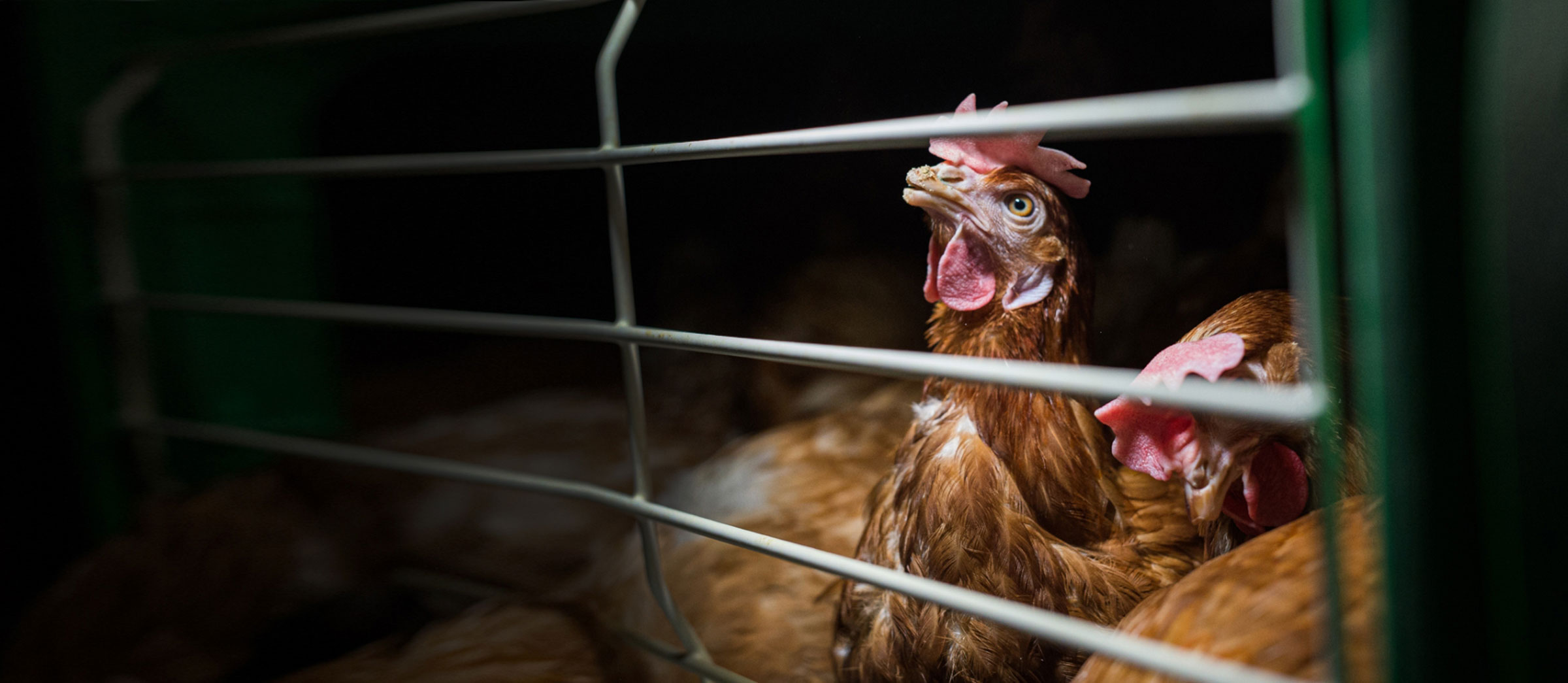
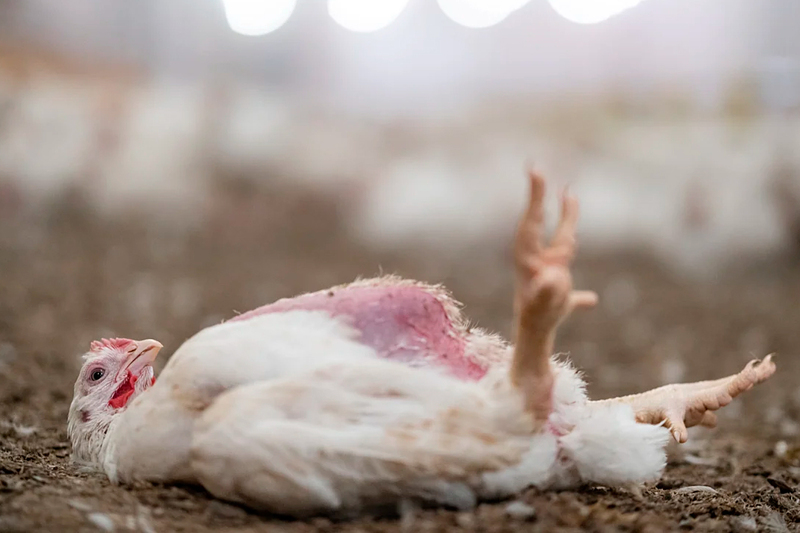
It is six weeks old. Its legs are buckling. The weight of its own body, inflated at a speed nature never designed, crushes it against the damp floor covered in its own excrement. It cannot walk normally. It can barely breathe. In 28 to 42 days, it will go to the slaughterhouse. This will be the only life it will ever know.
This is not an exception. It is the norm. According to data from Eurogroup for Animals, a European coalition of which AnimaNaturalis is a part, 95% of chickens raised for meat in the European Union are fast-growing breeds, animals genetically selected for decades with a single criterion: to gain weight in the shortest possible time. The result is one of the most widespread and silenced animal welfare crises in the world. Up to 58.8% of these individuals suffer from clinical lameness. Up to 58% develop skin lesions from permanent contact with the ground. Their cardiovascular systems, unable to supply an organism that grows too fast, fail even before they are slaughtered. Six billion animals per year in the EU. Each one, an individual capable of feeling pain.
"What happens in industrial poultry farms is not invisible: it has been documented, studied, and denounced for decades. The problem is that industry and governments have taken too long to act," expresses Aïda Gascón, director of AnimaNaturalis in Spain. "Every day that passes without legislation, millions of individuals pay with their well-being the price of our collective inaction."
The Decision No One Had Made Before
In this context of industrialized suffering, Norway has just made history. The country's largest meat producer, Nortura, together with the Norwegian Association of Meat and Poultry Industry (KLF), have announced a commitment to completely eliminate fast-growing chicken breeds by December 31, 2027. It is the first time in history that a country has completed this transition in a binding way for the entire sector.
The measure is not rhetorical. Since Nortura owns the country's last hatchery that still used fast-growing breeds, its commitment guarantees that this practice will disappear entirely from Norwegian territory. Currently, around 60% of Norwegian chickens belong to these breeds, mainly the Ross 308, the same one used by 90% of the UK poultry industry. The transition will affect more than 70 million animals raised each year in the country.
The announcement is accompanied by a second equally significant prohibition: from July 1, 2027, the culling of male chicks in the egg industry will be banned. Each year, more than three million animals in Norway are killed within their first hours of life solely because they cannot lay eggs. To avoid this, the sector will implement in ovo sexing technologies, which make it possible to determine the sex of the embryo inside the egg before hatching, without waiting for birth. Research into these standards will be carried out by the Animalia.no institute, which will develop reference protocols for the entire industry.
The transition was already underway. In the last five years, Norwegian producers had been introducing alternative breeds with higher welfare, such as Rustic Gold and Hubbard JA787. The 2027 commitment turns this gradual process into an irreversible obligation, as reported by New Food Magazine.
A Mature Technology the World Is Beginning to Adopt
In ovo sexing is not a future promise: it is an expanding reality that reached global dimensions in 2025. According to the market penetration report published that same year by Innovate Animal Ag, 28% of the 393 million hens in the EU already came from eggs sexed with this technology by the end of the first quarter of 2025. Since the mass adoption of the system in 2022, about 175 million male embryos had been identified and separated before hatching, avoiding their immediate culling after hatching.
In Norway, Steinsland & Co. itself, the country's largest hatchery plant, achieved 22% penetration in the Norwegian market in just 18 months after implementing the Respeggt system. In the Netherlands, most hatchery plants are already equipped with technologies accepted in the German market. In the United States, Walmart — the world's largest egg retailer, with more than 30 million hens in its supplier network — included in ovo sexing as a requirement for its suppliers in the update of its animal welfare policies in February 2025.
The argument that this transition is unfeasible or premature is untenable in light of this data. The technology exists, it works, and it is being adopted by the largest players in the global market. What has been lacking, until now, is political will.
"Norway demonstrates that these changes are not utopias: they are perfectly executable business and political decisions when real will exists," notes Gascón. "The question we must ask ourselves is why the rest of the countries continue to delay the inevitable."
Europe Moves, But Too Slowly
Norway is not alone in this direction. Several European countries have been advancing for years, with different paces and depths, towards the same goal.
The Netherlands completed its own transformation with the Chicken of Tomorrow initiative, introduced between 2014 and 2015: today 100% of the Dutch fresh chicken market is supplied by higher-welfare breeds, under the Better Life label of the Dutch Society for the Protection of Animals (SPA). In February 2025, the Dutch Ministry of Agriculture also presented a roadmap to eliminate the culling of male chicks by 2026. In the United Kingdom, Waitrose completed the total transition to higher-welfare breeds in all its chicken products, and Marks & Spencer announced the completion of that process for the end of 2025. Denmark and Sweden have promoted parliamentary initiatives to ban fast-growing breeds nationally. Germany has banned the culling of day-old chicks since 2022.
In the corporate sphere, the European Chicken Commitment (ECC), also known as the Better Chicken Commitment, already brings together more than 378 companies in Europe committed to standards that include maximum densities of 30 kg/m², elimination of fast-growing breeds, and access to natural light, perches, and enrichment materials. According to Eurogroup for Animals, these standards are economically viable and are being implemented successfully.
And yet, the European Commission (EC) has not yet followed the recommendations that the European Food Safety Authority (EFSA) itself published in 2023, which include reducing the maximum density to 11 kg/m² and imposing a limit of 50 grams of daily growth. Citizen pressure exists: more than 230,000 official responses were submitted to the public consultation on animal welfare in the EU. The 2023 Eurobarometer reveals that 91% of European citizens consider that the welfare of animals on farms should be better protected, and that 94% believe that all farm animals should have enough space to move freely.
"European citizens have already spoken. Scientists have too. Now it's the European Commission's turn to act," states Gascón. "The Norwegian precedent eliminates the last argument of those who said this was impossible. There are no more excuses."
Join the Change
The case of Norway did not happen by chance. Behind it are five years of sustained campaigning by animal protection organizations, a citizenry that demanded changes, and a sector that finally listened. You can be part of that process here.
- Reduce or eliminate consumption of industrially produced chicken. Every choice in the supermarket is a message to the market. Informing yourself about the origin and rearing conditions of the animals whose products you consume is the first step to stop financing their suffering.
- Share this information. Most people are unaware of what happens on industrial poultry farms. Talking about it, sharing this article, and making the problem visible amplifies the social pressure that precedes legislative changes.
- Demand that your political representatives act. Write to your MEP. Sign ongoing petitions for the revision of European animal welfare legislation. Support campaigns that bring these demands to the institutions where decisions are made.
- Join AnimaNaturalis. We have been working for years to ensure non-human animals are recognized for what they are: sentient beings capable of suffering and entitled to a dignified life. With your support as a member or donor, we continue to investigate, denounce, and pressure so that what happens in Norway today becomes the norm across Europe tomorrow.