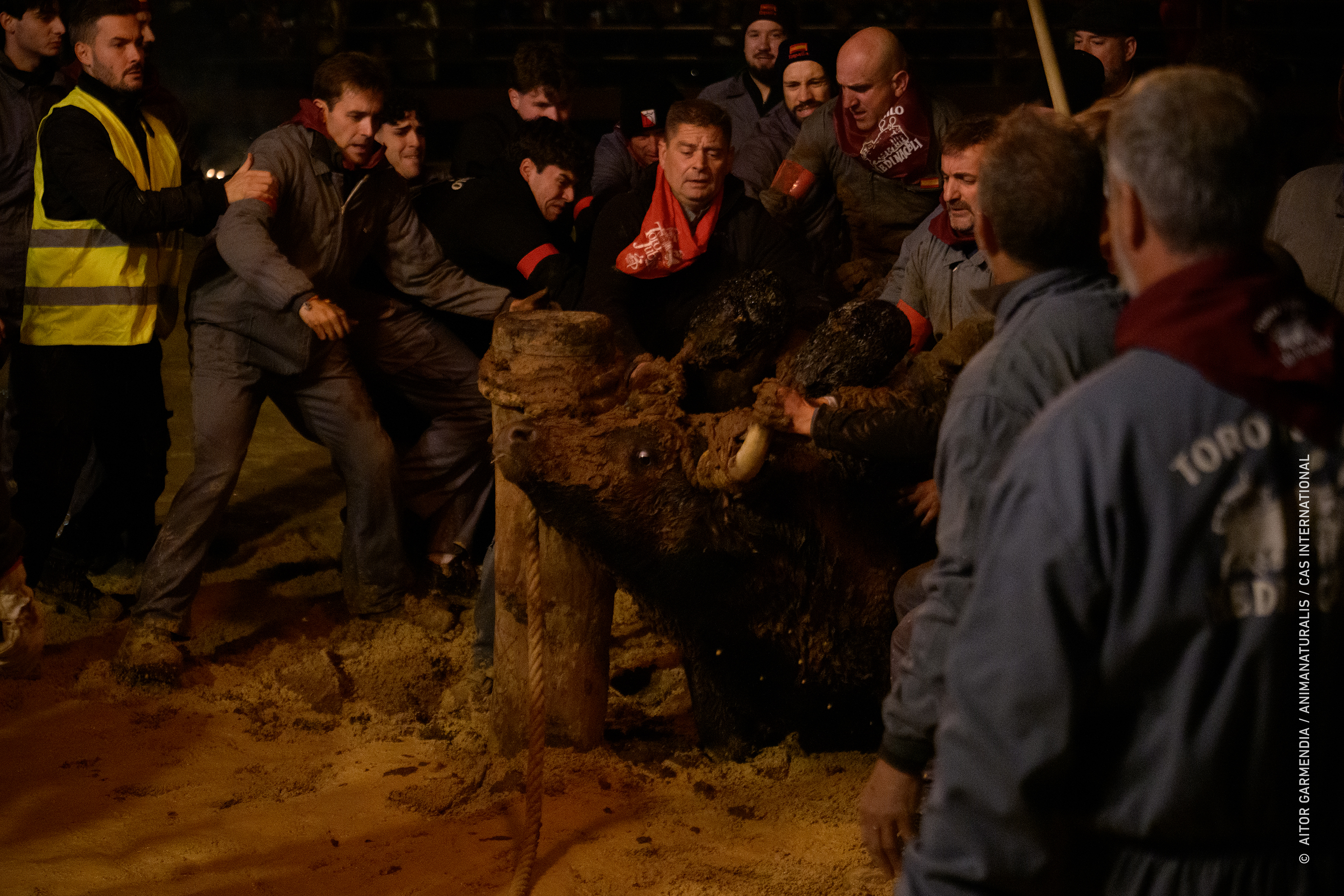
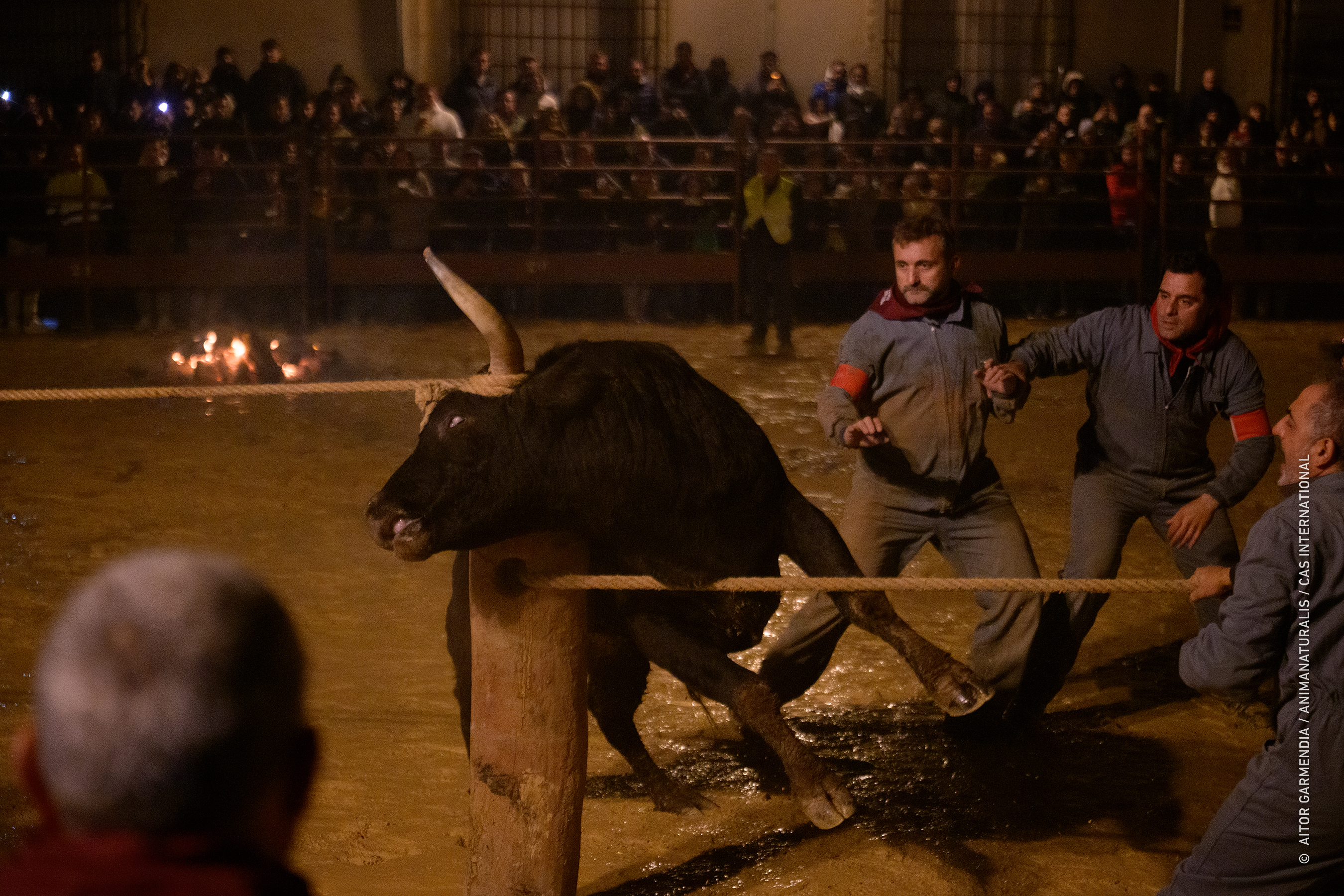
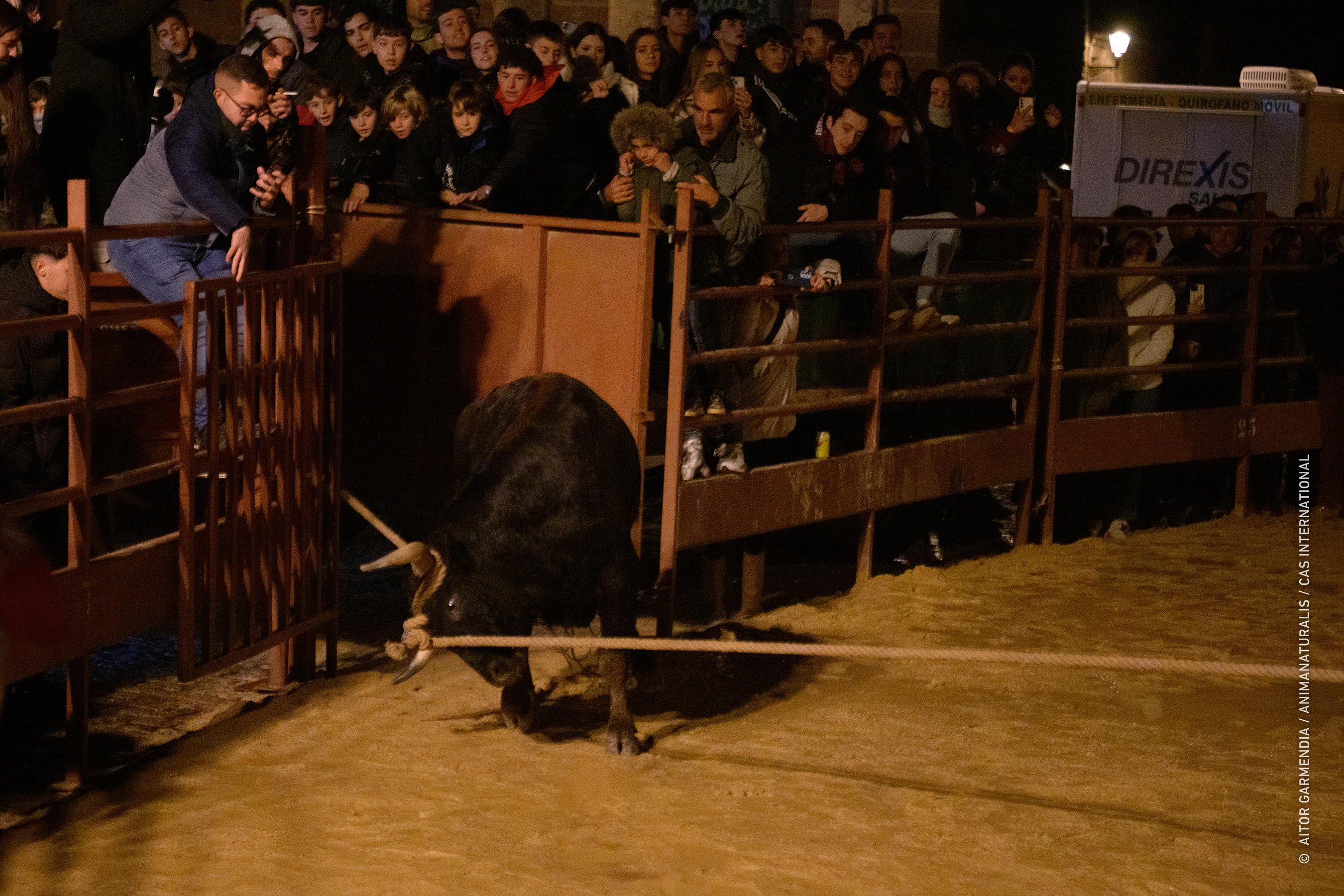
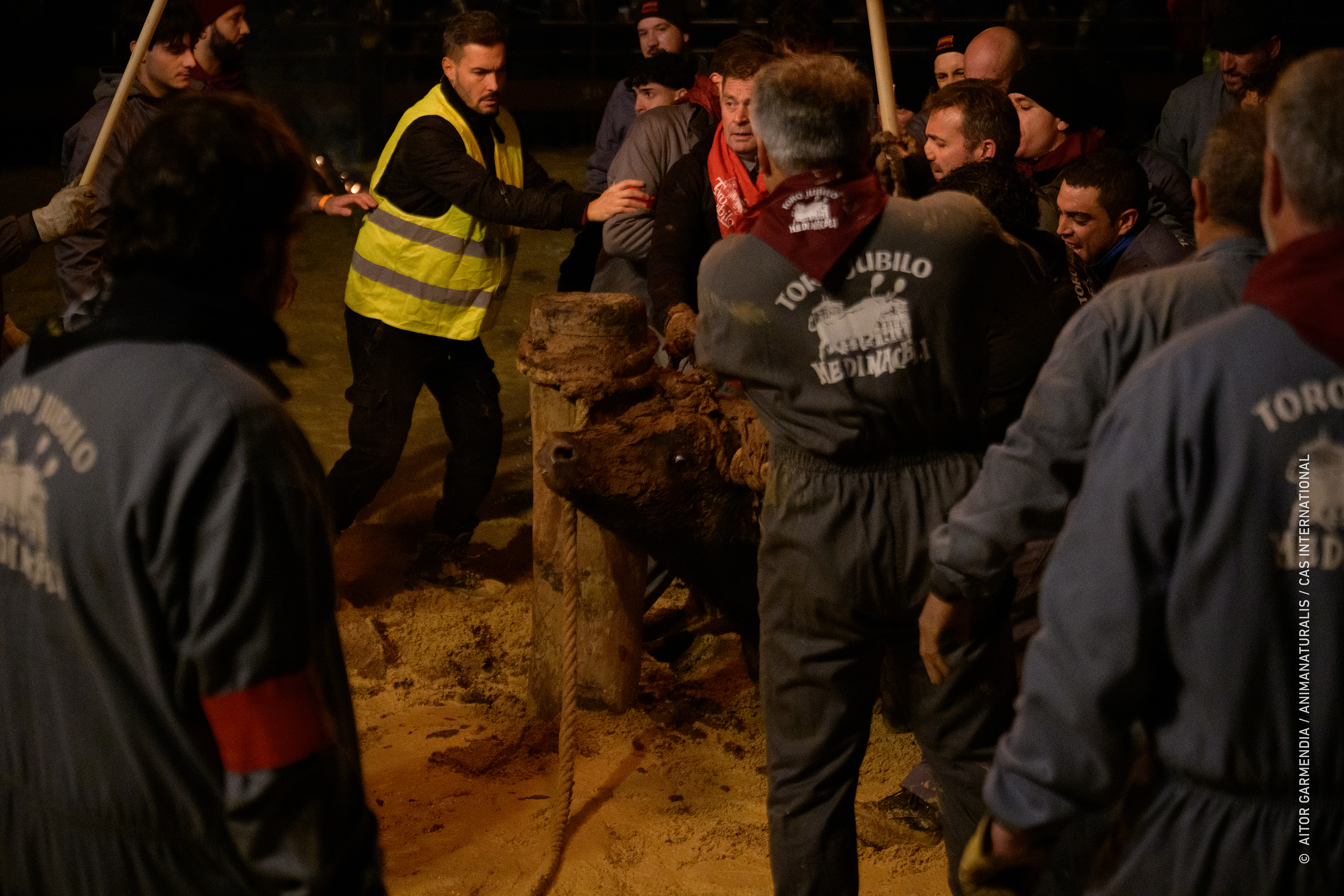
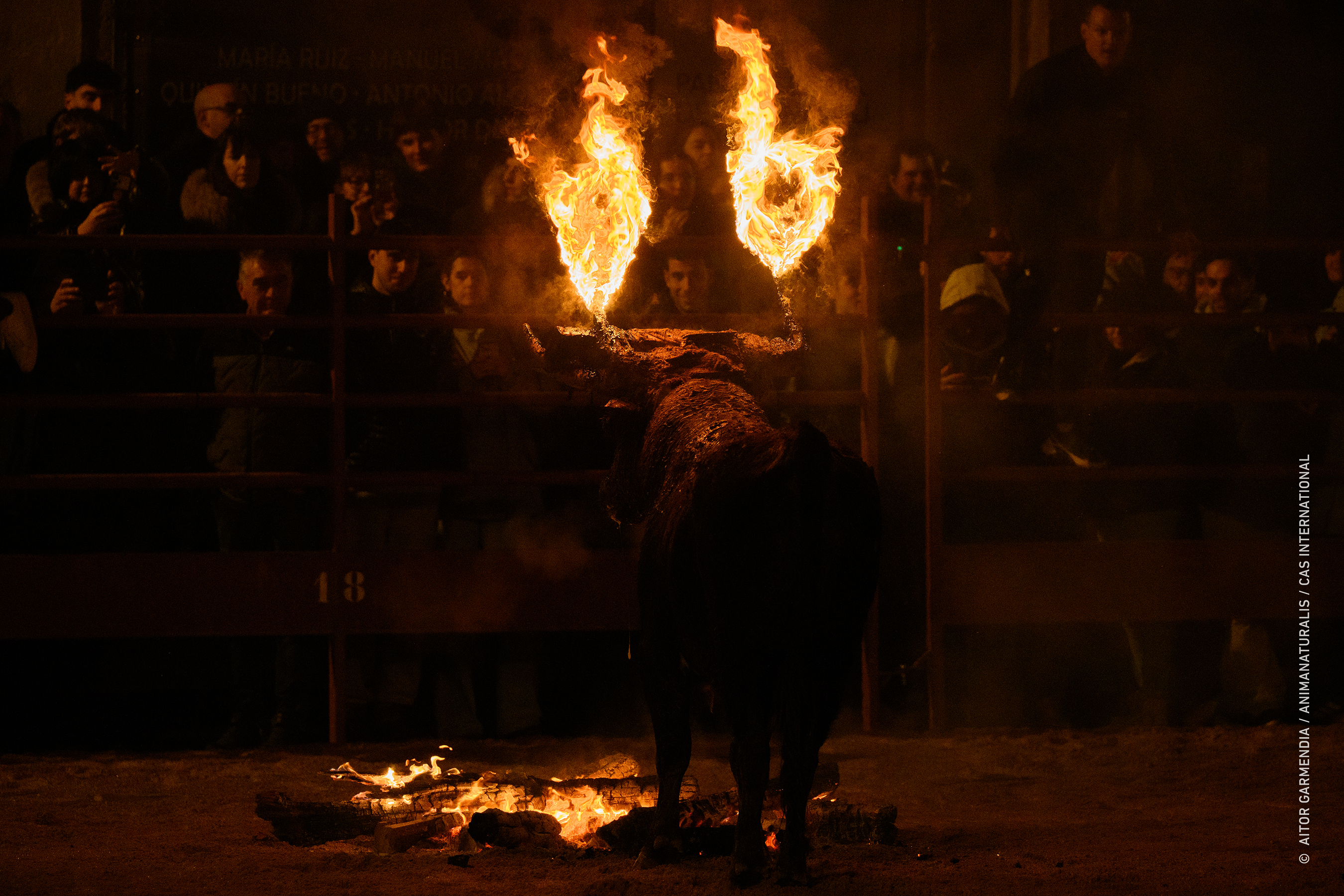
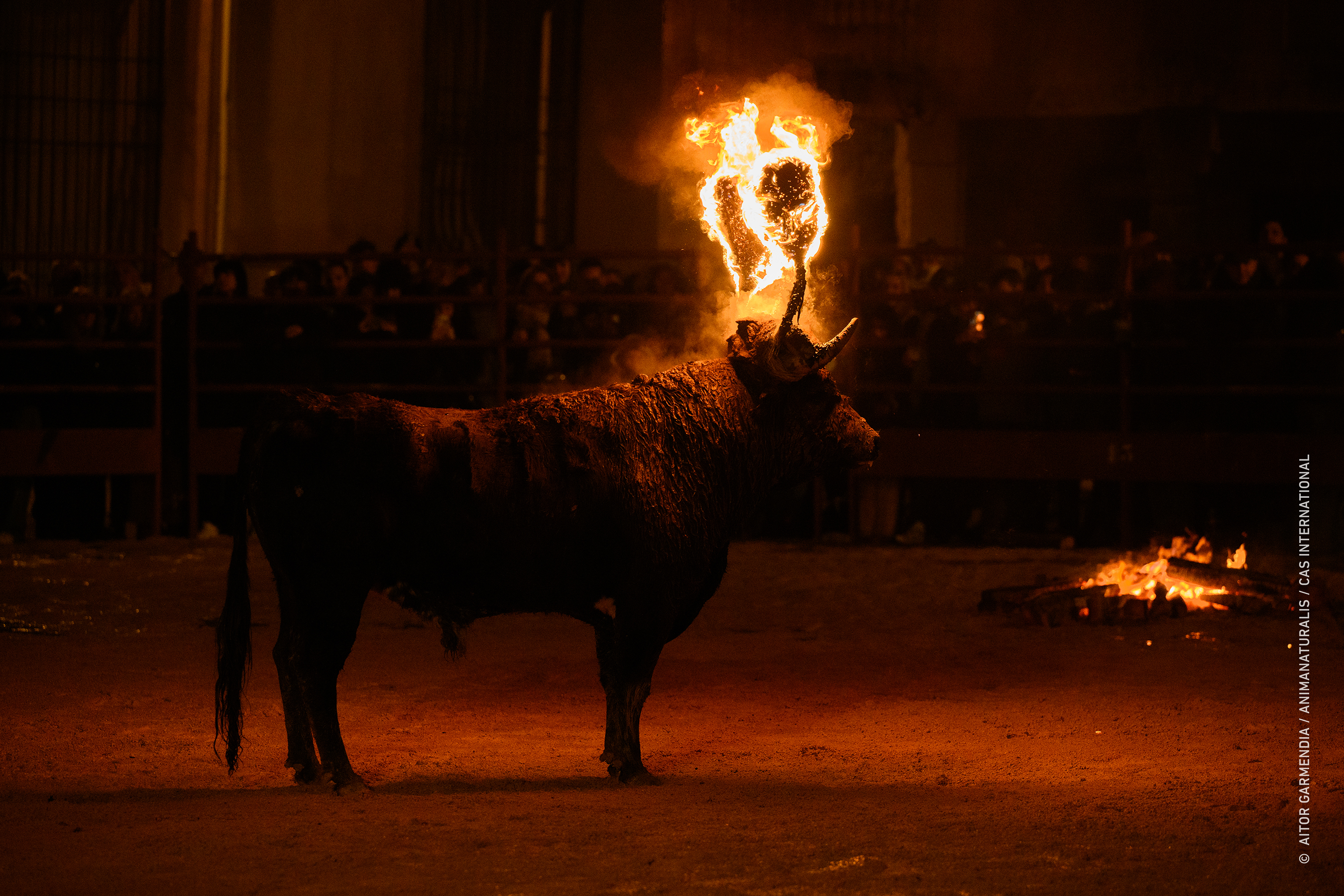
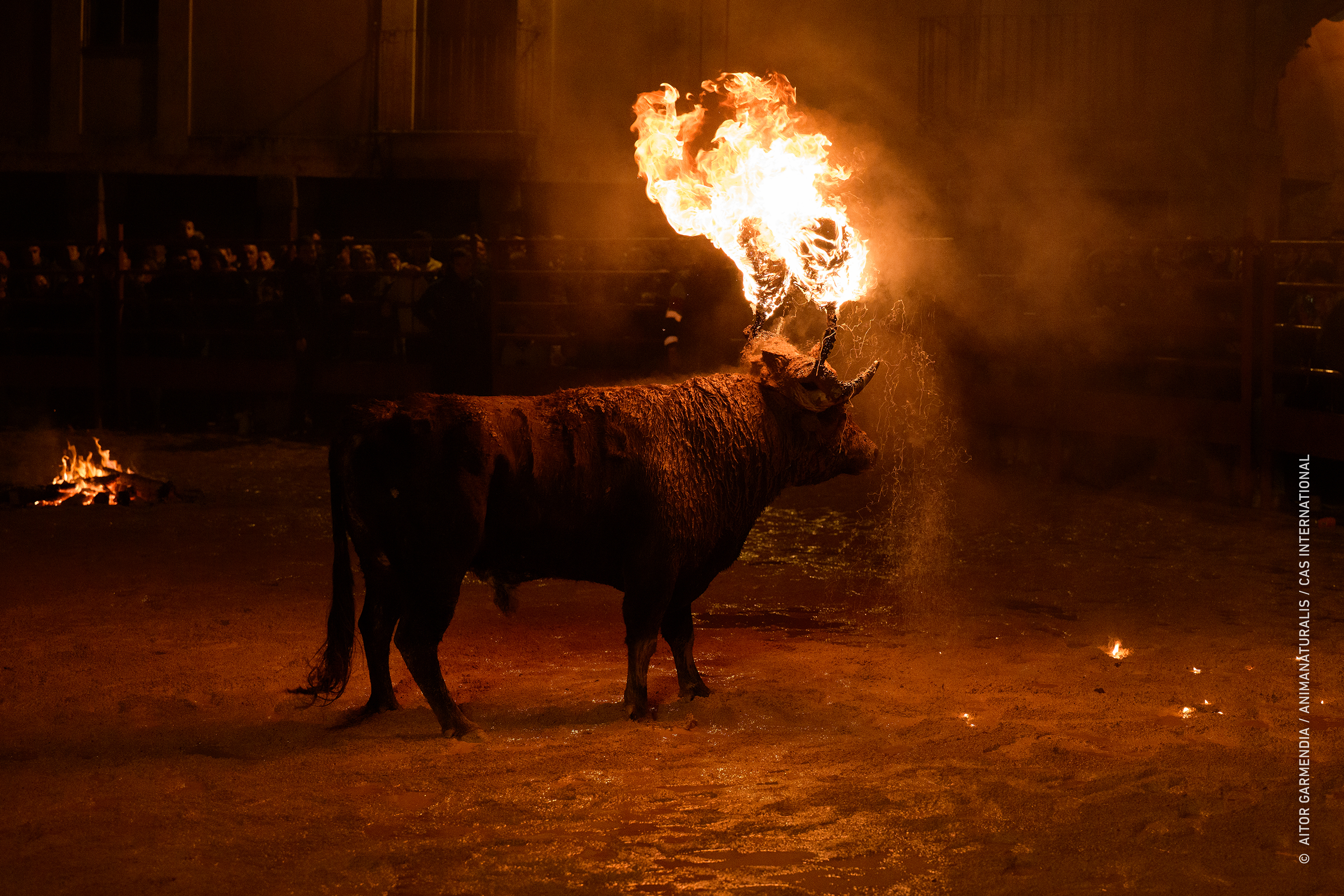
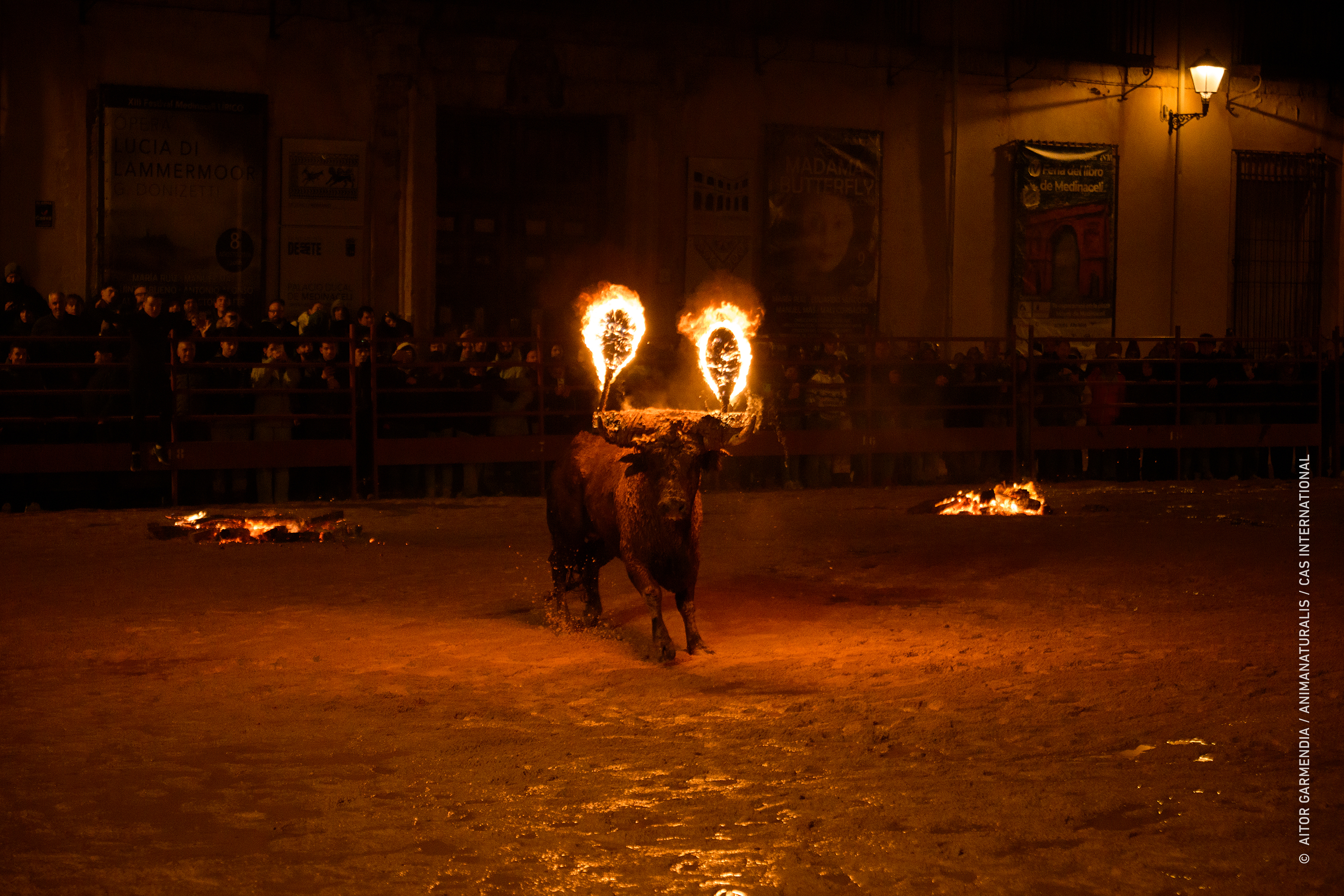
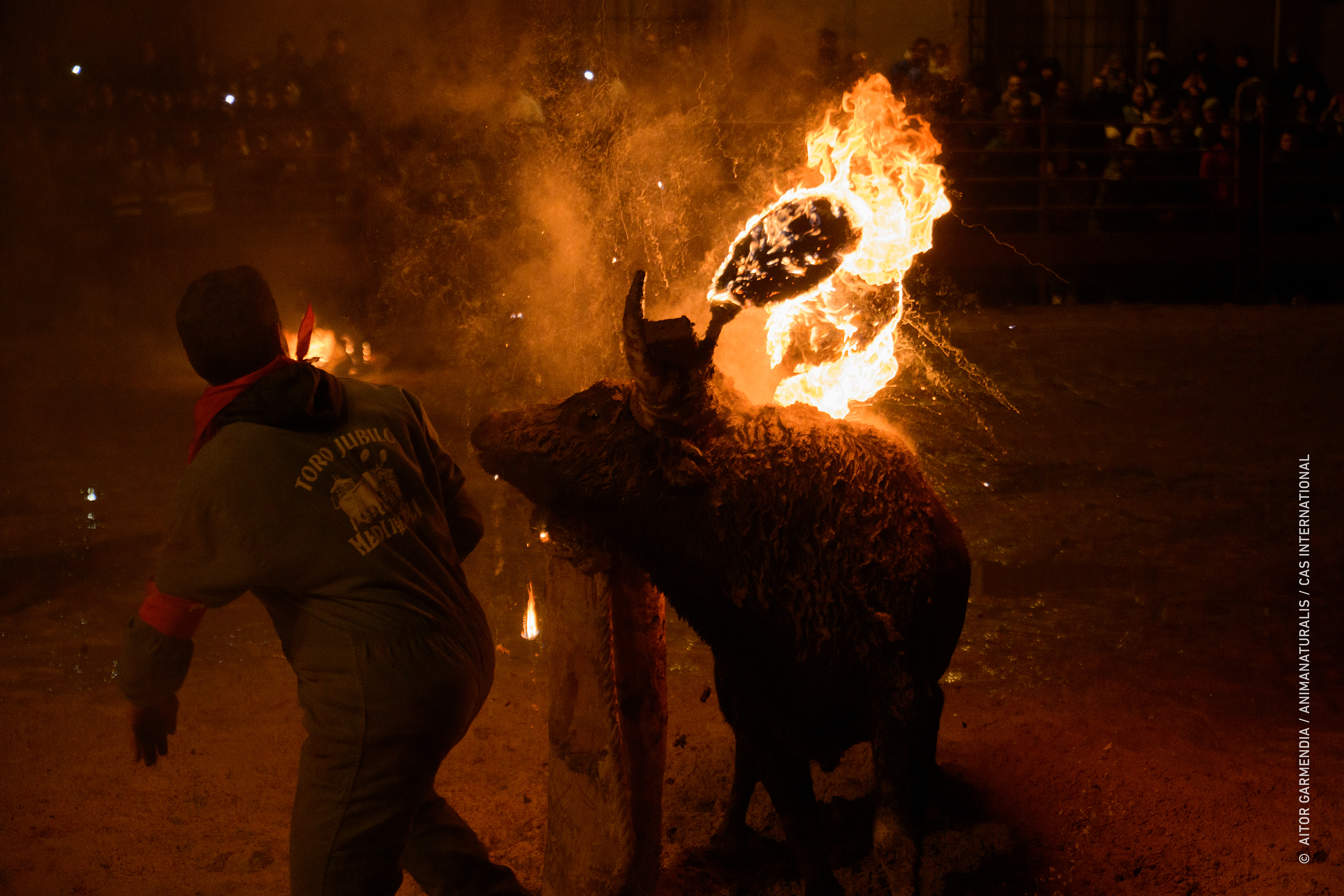
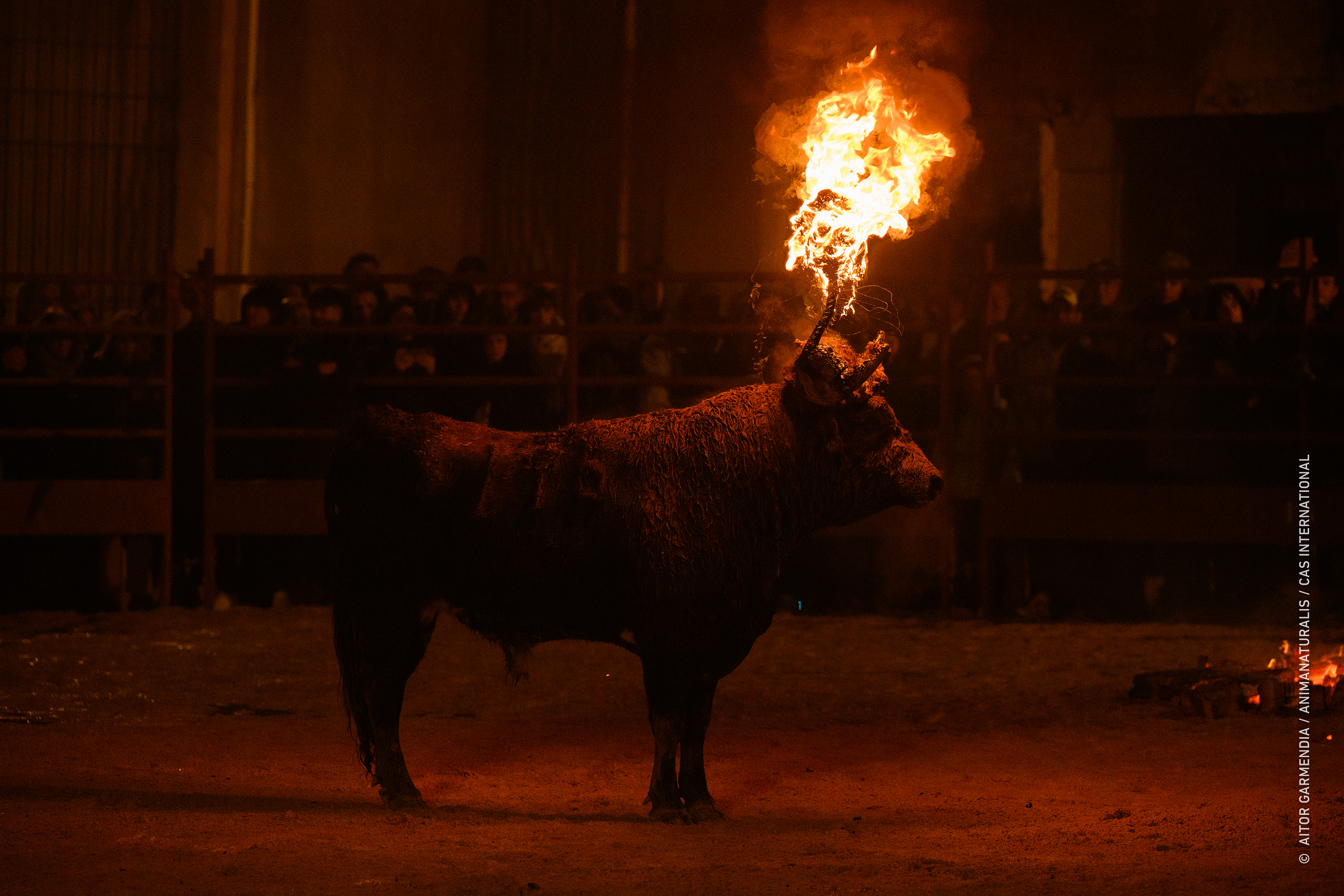
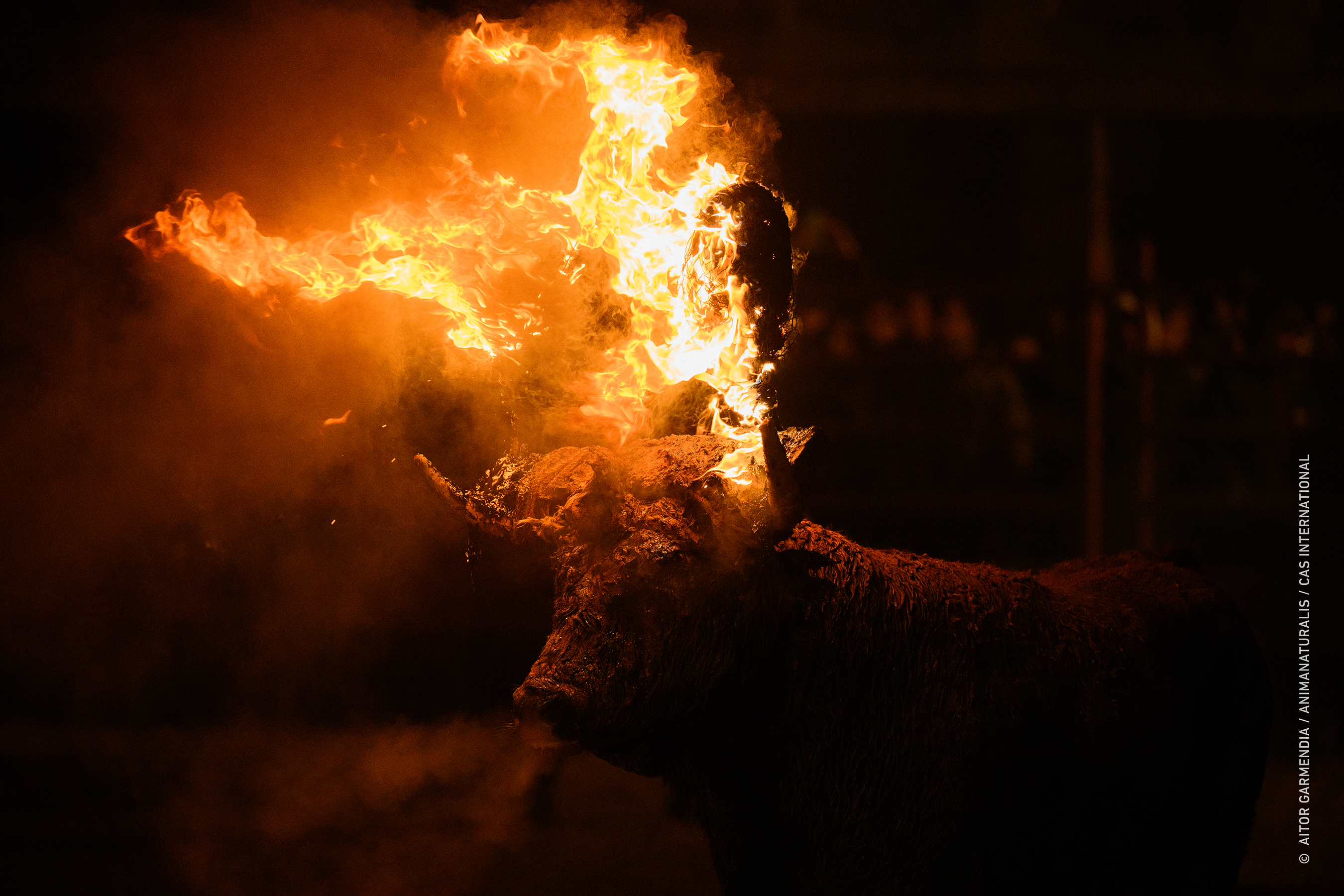
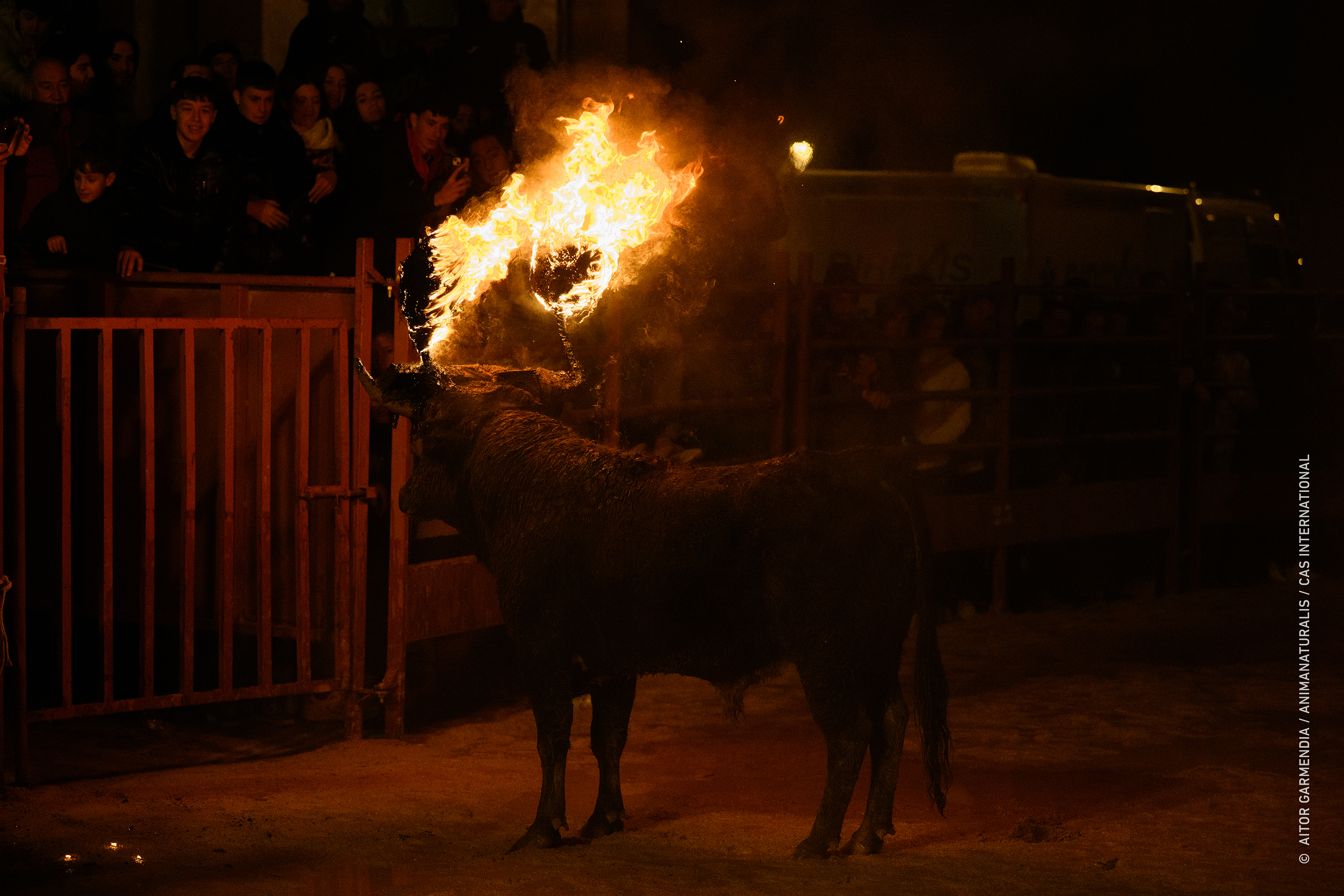
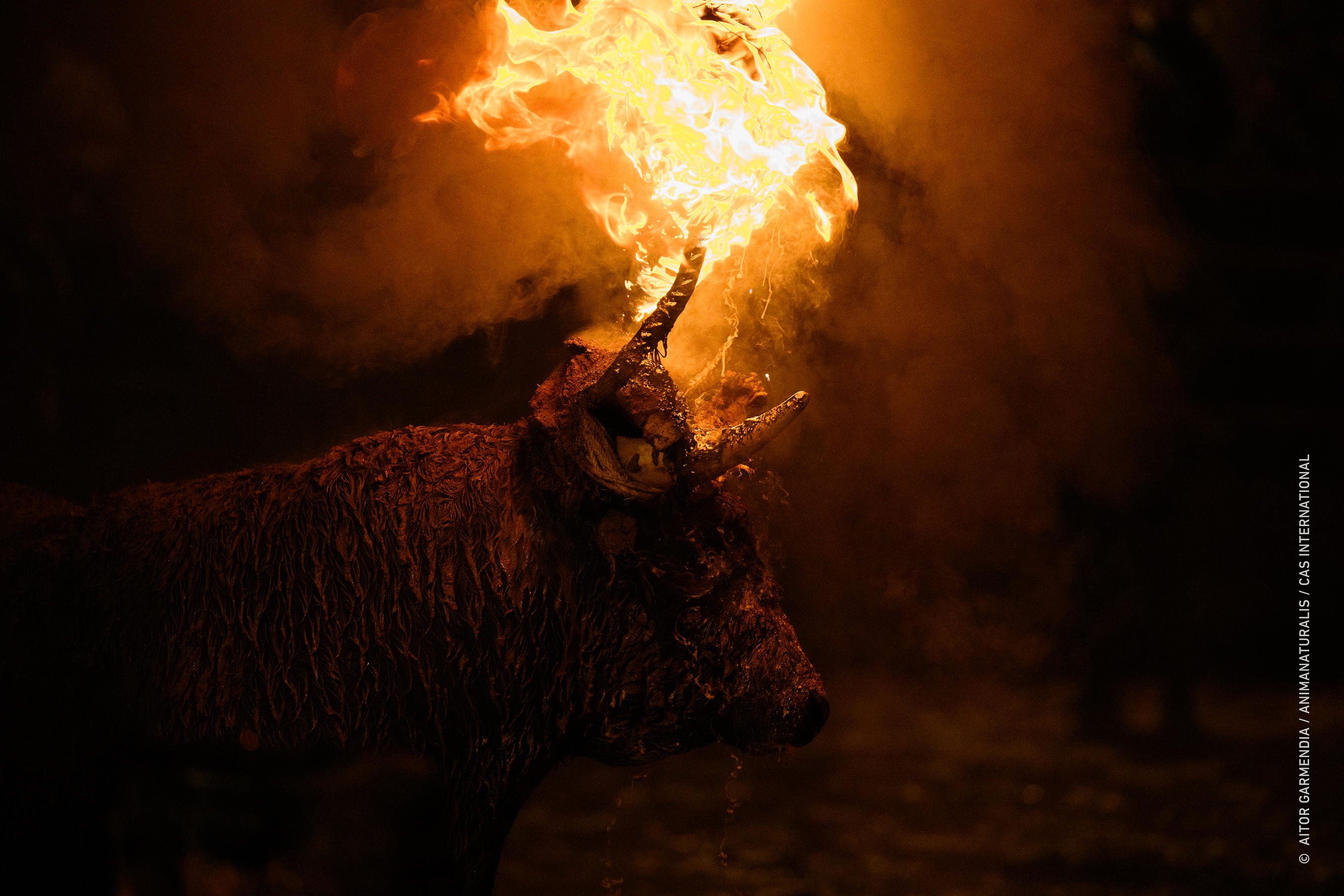
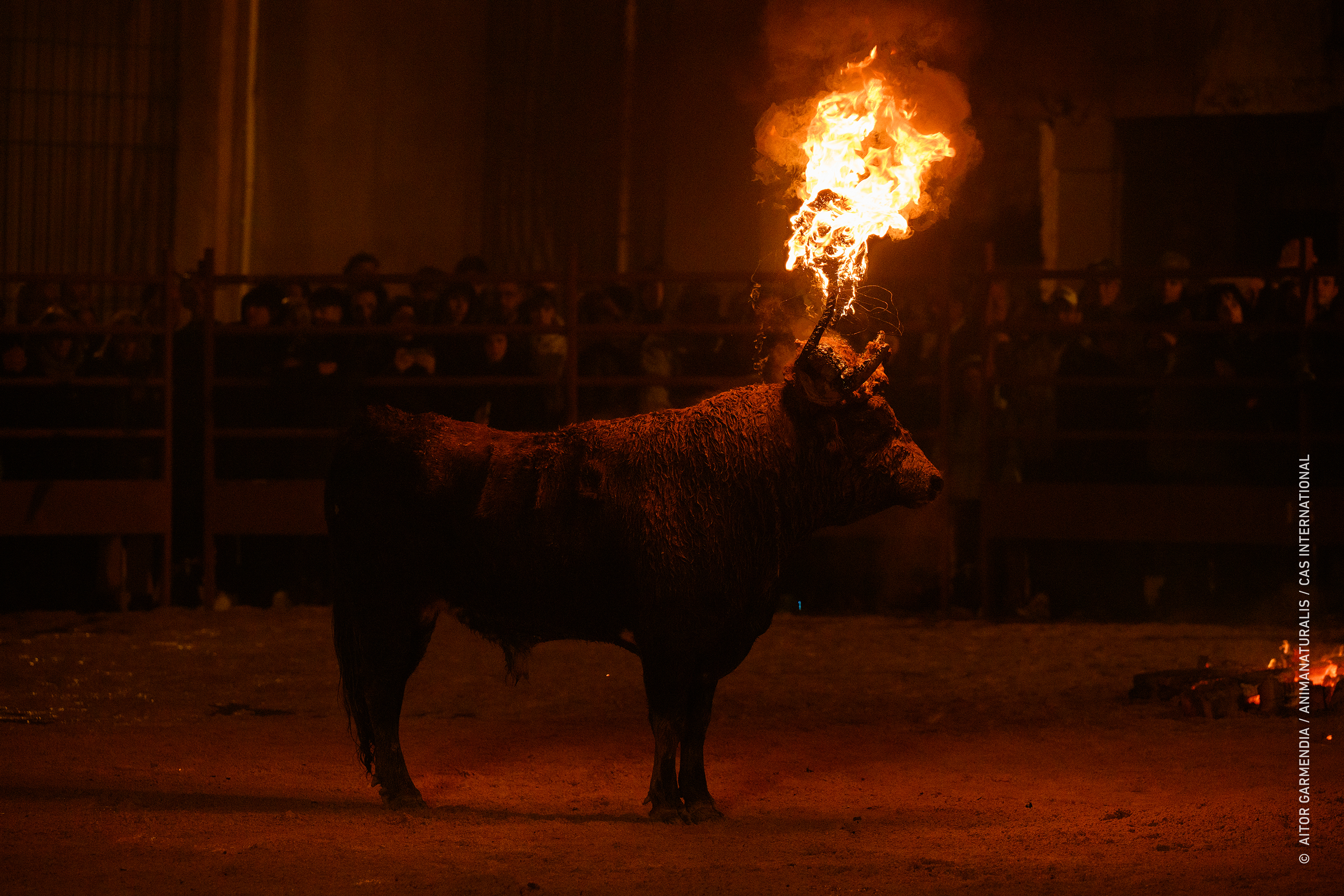
At around 11.30pm, the ritual began: the bull was restrained and a metal frame holding the balls of fire was fixed to its head. When the flames died down, just after midnight, it was returned to the bull pens. It was pardoned, as it is every year.
This year's event followed the script to the letter. The bull did not die, as one did in 2022, when our team documented a bull that came out into the square with a bloodied mouth, panting, collapsed after 48 minutes and ended up dying. In 2026 there were no surprises, and that is precisely what we want to tell you about.
“Here, normal means the bull was tortured exactly as planned. The fact that it didn't die this time doesn't change what it went through. The images show a terrible ordeal that no tradition can justify”, says Aïda Gascón, director of AnimaNaturalis.
We obtained the images and video that accompany this article despite the difficulties faced in Medinaceli by anyone documenting the event. Our team has been there before, in 2022, 2023 and 2025.
What happens in the square when everything goes as planned
Soria Noticias describes the ritual in detail. The bull's body is covered in clay mud and a metal frame with two large balls of pitch, made from tow, turpentine and sulphur, is fixed to its horns. Once they are lit, the bull is released into the square, where it runs across the sand between five bonfires. The local men run in front of it while it burns, and the event ends when the balls have burnt out.
The mayor of Medinaceli, Gregorio de Miguel, defends it as different from other festivals involving bulls with fire on their horns because the animal is pardoned before it enters the square and returns alive to the ranch. “I can't wait for 1am to arrive and for everything to have gone well”, said De Miguel. But the pardon comes at the end, after the bull has already gone through the restraint, the fire and the chase.
This was also the first edition since the Junta de Castilla y León declared it an intangible Asset of Cultural Interest (Bien de Interés Cultural) by Agreement 38/2026 of 10 June, published on 15 June 2026 in the regional official gazette. The agreement describes it as the only fire bull in the region and has been in force since 5 July 2026. Earlier, in 2024, the festival was suspended as a precautionary measure, which the High Court of Justice of Castilla y León later overturned, according to Soria Noticias.
What vets measure in a bull under stress
As far as we have been able to find, nobody has published measurements of stress hormones in bulls with fire on their horns during the festival itself. There are, however, studies on fighting bulls subjected to intense exercise, being chased and handled by people, and they all point in the same direction.
The most recent was published in August 2025 in the journal Animals, by a team from the Catholic University of Valencia and the University of Murcia. It analysed 53 fighting bulls before and after 45 minutes of continuous running, chased by participants in bull-running celebrations (toro de cuerda) in four autonomous communities. Mean cortisol rose from 4.6 to 6.1 µg/dL, when the reference range for cattle used by the authors is 0.5 to 0.76, and ACTH and creatine kinase, a marker of muscle damage, also increased (full study). The authors note that most parameters remained within the usual ranges for the species, and warn that this capacity to adapt should not be read as an absence of welfare problems.
Another study, by Escalera-Valente and colleagues, measured 438 bulls after a bullfight and recorded severe hyperglycaemia, mean cortisol of 117.5 nmol/L and mean creatine kinase of 6,729 IU/L, which they attribute to intense stress and exercise, muscle injury and dehydration (Animals, 2021). And research from the Complutense University of Madrid, by Illera and colleagues, found higher ACTH and cortisol in recortes events, in which bulls are chased by people, than in full bullfights (Revista Complutense de Ciencias Veterinarias, 2007).
On bulls with fire on their horns specifically, the Association of Veterinarians Against Bullfighting and Animal Abuse (AVATMA) published a technical veterinary report in 2016, signed on behalf of its 485 veterinarians. It argues that, even without wounds or bleeding, the festival is not harmless: the bulls live on free-range farms, unused to human handling, and any disruption to their routine causes them stress and fear. It recalls a 1996 trial in the journal Physiology & Behavior in which fighting cows were subjected to controlled handling, such as restraint in chutes, release and transport, which recorded significant increases in cortisol with every one of them.
The report identifies as sources of stress the restraint with ropes to fit the frame, the lack of escape routes in an enclosed space, the people running in front of the animal and the fire, which according to the authors the bull instinctively recognises as a sign of danger. It describes an effort of between 30 and 60 minutes that can cause metabolic acidosis and muscle damage, with elevated enzymes such as creatine kinase, and lists among the visible signs rapid breathing, constant charging and eyes opened wide enough to show the sclera.
A night of fire without a live bull
The alternative exists and is already celebrated in other towns. The fire bull (toro de fuego) is a metal structure in the shape of a bull, fitted with fireworks, which local men carry through the square or the streets. It is celebrated in many places, including Haro (La Rioja) and Barrax (Albacete), and this custom may well have arisen precisely to replace the bull with fire on its horns.
It keeps the night, the fire and the men running, and leaves out the animal. What Medinaceli thinks of that possibility is something only the town can answer, and we have found no data that would allow us to anticipate the response.
“We understand what this festival means to those who take part in it, but science and the images agree that the bull suffers. A tradition can evolve without ceasing to be a festival”, adds Gascón. AnimaNaturalis is calling on the Junta de Castilla y León and Medinaceli Town Council to end the use of a live animal in the Toro Jubilo.
What you can do for the bulls of the festivals
Watch the images and video in this article and share them with anyone who still believes that a festival without a death is a festival without suffering. The conversation about these traditions starts with the people around you, and many have never seen what happens in that square.
Our team returns to these squares whenever it can, with cameras and patience, and it does not do so alone. If you want to be part of this alliance for animals, become a supporter of AnimaNaturalis and stand with us in defending the bulls that cannot tell us what they go through.