
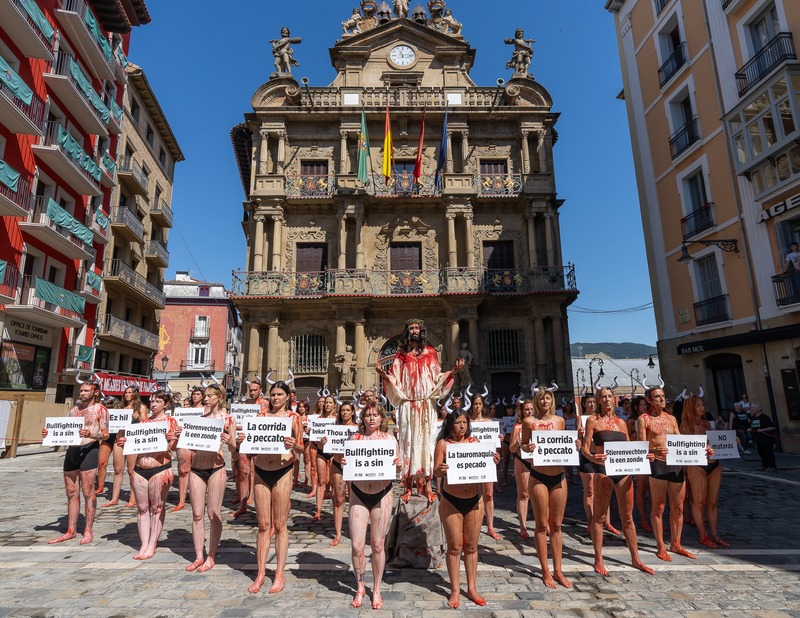
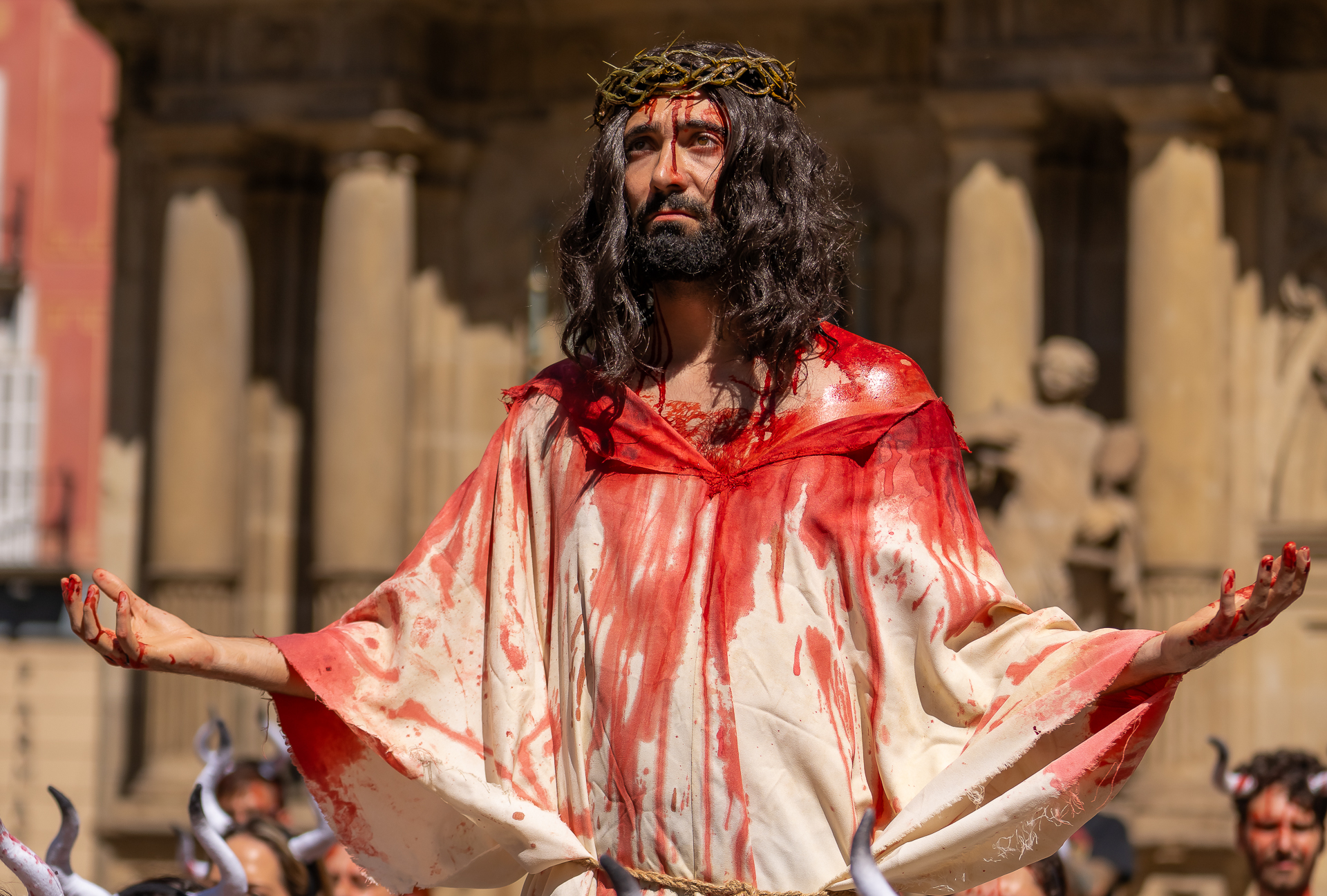
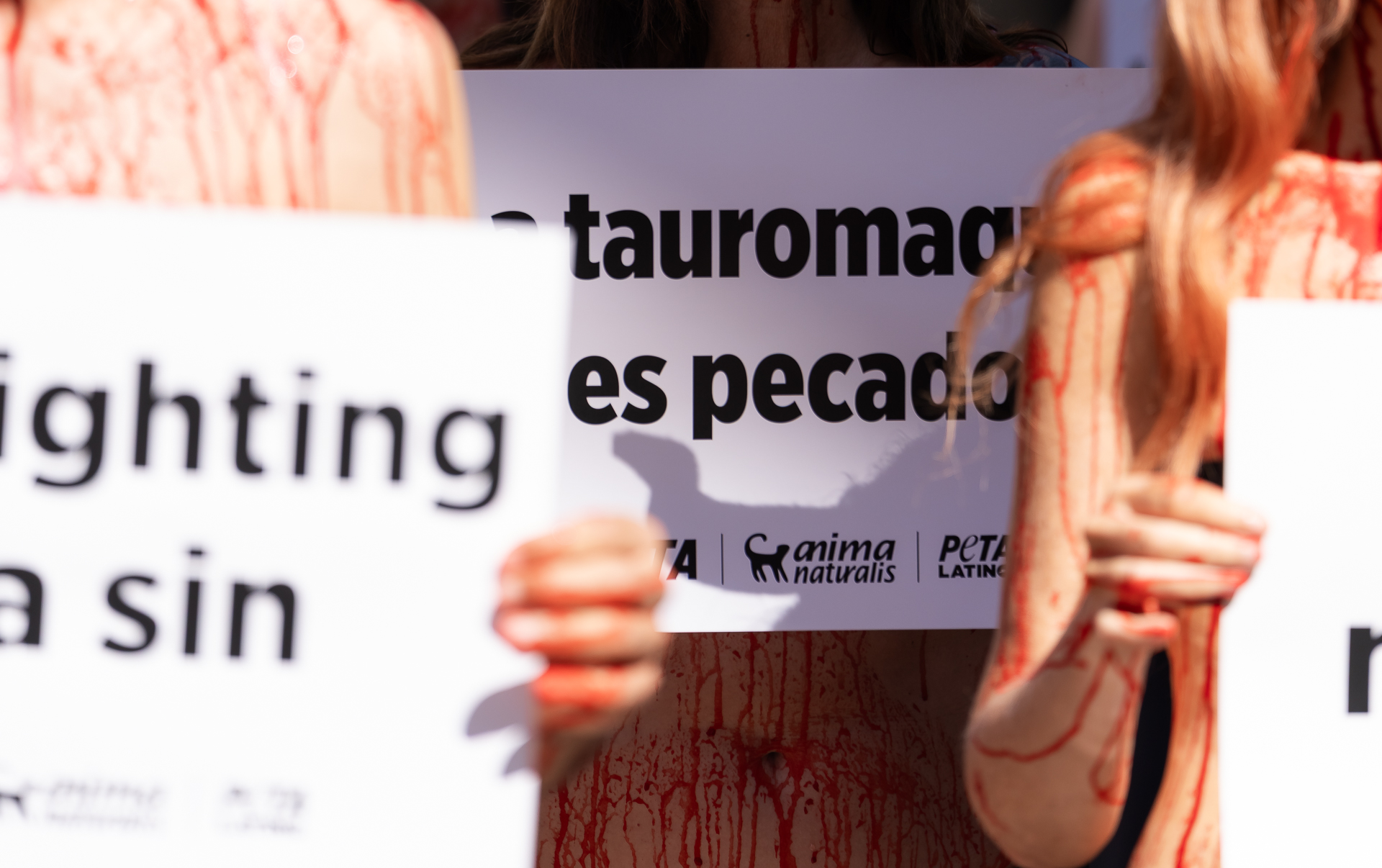
On Sunday 5 July, hours before the first rocket of the chupinazo went off, a hundred activists stood in front of Pamplona City Hall with a message that struck at the very symbolic heart of San Fermín: bullfighting is a sin. The slogan was no accident. Behind Pamplona's Plaza de Toros — the third largest in the world, built in 1922 — there is no private company, but the Casa de Misericordia, a Catholic charitable foundation that runs the bullring and organises the San Fermín bull runs, according to historical records kept by the festival's own organisers.
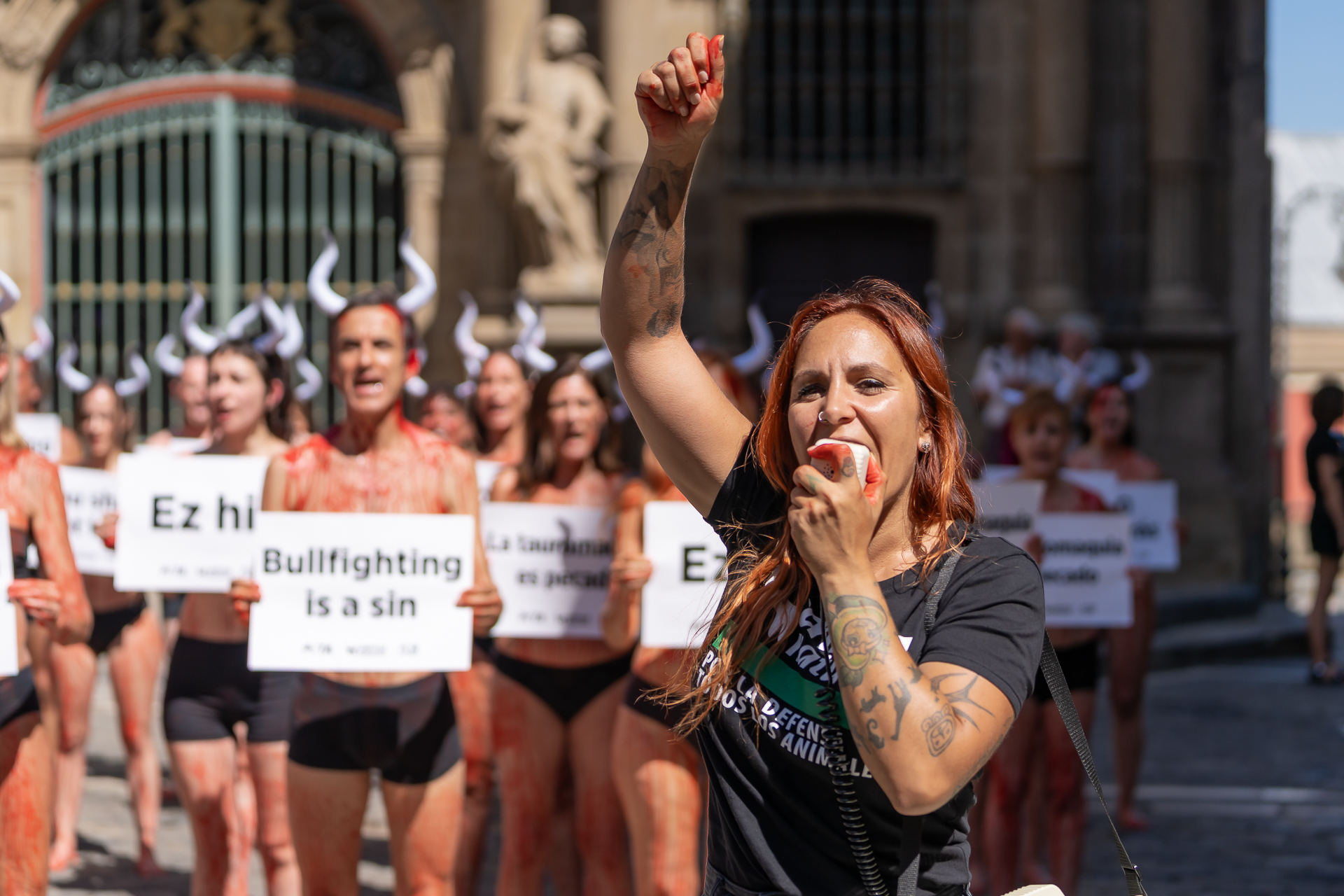
That is the paradox that AnimaNaturalis and PETA came to point out: an institution founded to help the most vulnerable funds its social work with the death of animals in the ring. "It is unacceptable for a religious institution, founded on Christian charity, to profit from the suffering and death of animals. The commandment Thou Shalt Not Kill makes no exception for entertainment", states Aïda Gascón, Director of AnimaNaturalis in Spain.
The complaint also has historical backing within the Church itself. In 1567, Pope Pius V issued the bull De salute gregis Domini, banning bullfighting under pain of excommunication and describing it as a spectacle fit for demons, incompatible with Christian piety. Philip II blocked its enforcement in Spain, and Gregory XIII softened the ban for laypeople in 1585, but the original moral condemnation still stands as a historical argument. "It seems the Christian values they claim to follow can be set aside as long as the profit is high enough", adds Gascón.
Public money keeps flowing
The figures back up the urgency of the demand. Every year, during the San Fermín bullfighting fair, 48 bulls and 6 young bulls die in the afternoon events, according to records from the San Fermín organising committee. Nationally, the Ministry of Culture's Yearbook of Cultural Statistics confirms that bullfighting events fell by 62% between 2009 and 2023, dropping from 2,684 to just 1,021 events a year.
Public support is collapsing at the same pace. A 2025 study by the BBVA Foundation found that 77% of Spaniards want bullfighting to end, and that the average rating given to bullfighting fell from 2.7 out of 10 in 2008 to 1.8 out of 10 in 2025. A Sigma Dos survey for El Mundo shows that 78% of citizens do not consider themselves bullfighting supporters, and 48% back stripping it of its cultural heritage status. Even in Pamplona, according to a municipal survey from June 2025, 71% of residents admit they do not regularly follow the bullfights and 68% do not attend them — a rejection especially marked among women and people aged 15 to 44.
Politics, however, has not kept pace with that social shift. On 7 October 2025, Congress rejected processing the #NoEsMiCultura popular legislative initiative — which had gathered 664,777 signatures validated by the Central Electoral Board, well above the legal threshold of 500,000 — with only 57 MPs in favour, votes against from the PP and Vox, and an abstention from the PSOE. "The fact that Congress rejected the #NoEsMiCultura initiative in October 2025, thanks to the PSOE's abstention and the votes of the PP and Vox, shows that the gap between politics and society has only grown wider", argues Gascón.
Meanwhile, public money keeps propping up the business. In Navarre, the regional government allocated a total of €750,000 in aid to fighting bulls in 2020, and Tafalla Town Council signed a contract worth almost a million euros to organise bullfighting events between 2022 and 2023. In April 2025, Tudela Town Council rejected a motion to end that funding. Pamplona City Council, for its part, sets aside €81,750 for open activities run by the peñas, but explicitly excludes bullfighting season tickets from that funding.
A San Fermín without bloodshed is possible
Pamplona's own municipal data offers a clue as to where change could lead: most residents already experience a festival that does not revolve around the bullring. The peñas, the music, the food and the life on the streets — activities the City Council itself funds separately from the bulls — show that San Fermín can thrive without depending on a spectacle of death.
The Parliament of Asturias has already taken a step in that direction, approving a non-binding motion that declares bullfighting to be animal abuse and calls on the central Government to strip it of its protected cultural heritage status. Catalonia and the Balearic Islands tried before: the Constitutional Court struck down their bans, citing Law 18/2013 — the very law the #NoEsMiCultura initiative sought to repeal. Despite the setback in Congress, the debate remains open.
Redirecting the public money that currently funds bullfighting events — Navarre's €750,000, Tafalla's million-euro contract — towards social programmes, or towards the very charitable work the Casa de Misericordia claims to champion, is not a utopian idea: it is simply consistency. "It is a paradox that millions of euros in public funds continue to be poured into a spectacle that the vast majority of citizens do not want and consider cruel", concludes Gascón.
Demand an end to this contradiction
The gap between what Pamplona celebrates and what Pamplona actually thinks has already been measured: seven out of ten residents do not follow the bullfights. You can help turn that silent majority into public policy. Share this information, join AnimaNaturalis' campaigns, and demand that your council and your representatives stop using everyone's money to fund a spectacle that almost 80% of society rejects.
Outside Pamplona City Hall, on Sunday 5 July, the message was made clear: there is no Christian charity to be found in the blood of the bullring. "It's time to stop wasting everyone's money on a practice in decline and listen to what society is saying", concluded Gascón. Become a member of AnimaNaturalis and help us build the San Fermín that most people already want: one without animal suffering.