
In Spain, there are many traditional variants: encierros with lead bulls, vaquillas in the streets, capeas or bulls on ropes, bous a la mar (bulls into the sea) and the bull embolado itself. According to anthropological research, these taurine rituals have their roots in ancient agrarian ceremonies: the bull with fire recalls prehistoric rites of the sun and fertility, in which bundles of embers were carried to celebrate the harvests. In fact, historians cite accounts such as that of Hannibal, who used bulls with lit torches on their horns at the Battle of Helike (3rd century BC) as a historical antecedent of this Levantine custom.
Today, the bull embolado is practiced mainly in Spain’s Levantine region: almost the entire province of Castellón (Valencia) includes it in its patron saint festivities, as do towns in Alicante and Valencia. It is also typical in Aragón (e.g., Cariñena in Zaragoza) and in the southern part of Catalonia (Tierras del Ebro, Tarragona). Other isolated spots include the Medinaceli area (Soria), where a unique version of the bull embolado is organized every year.
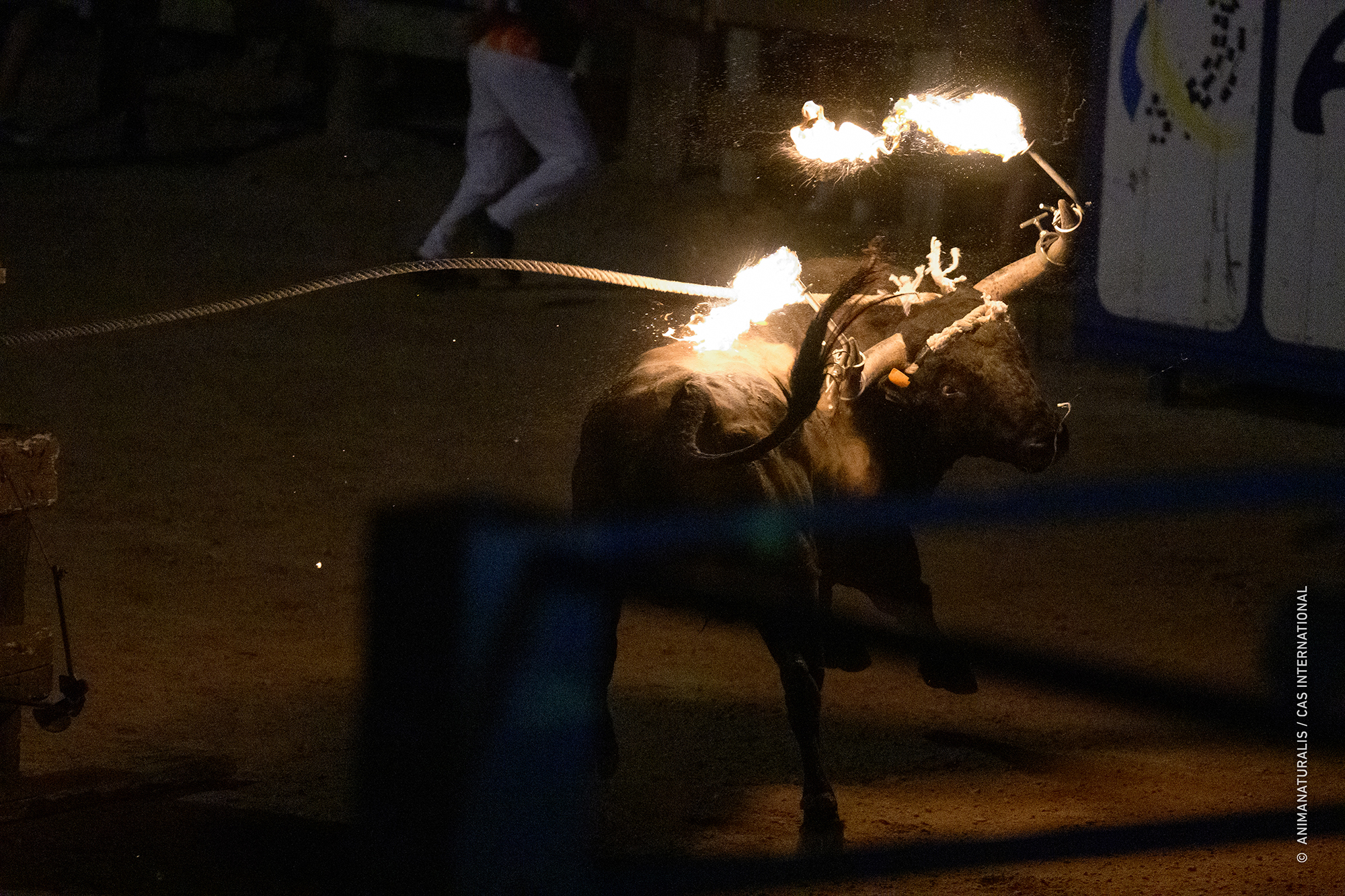
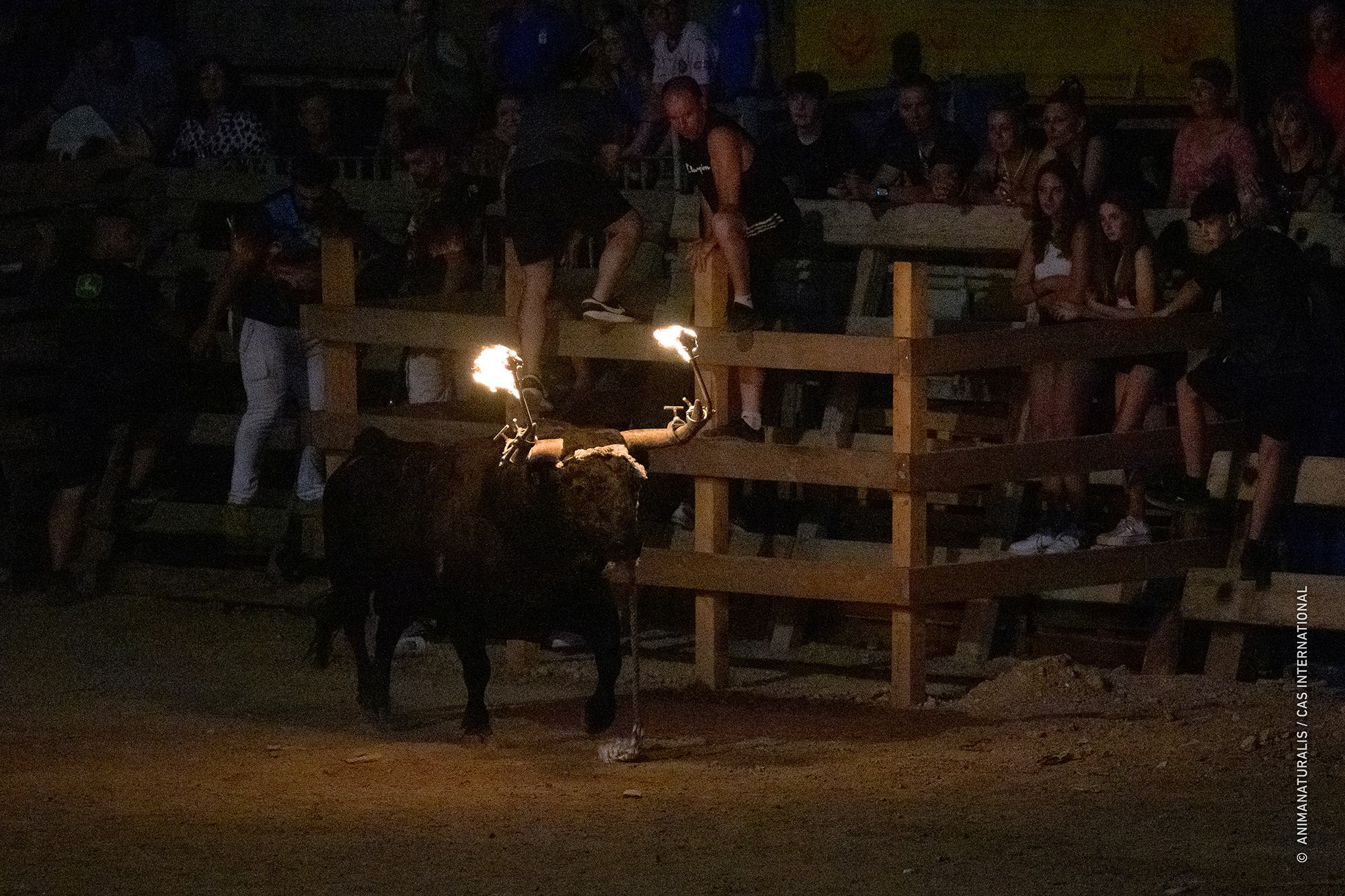
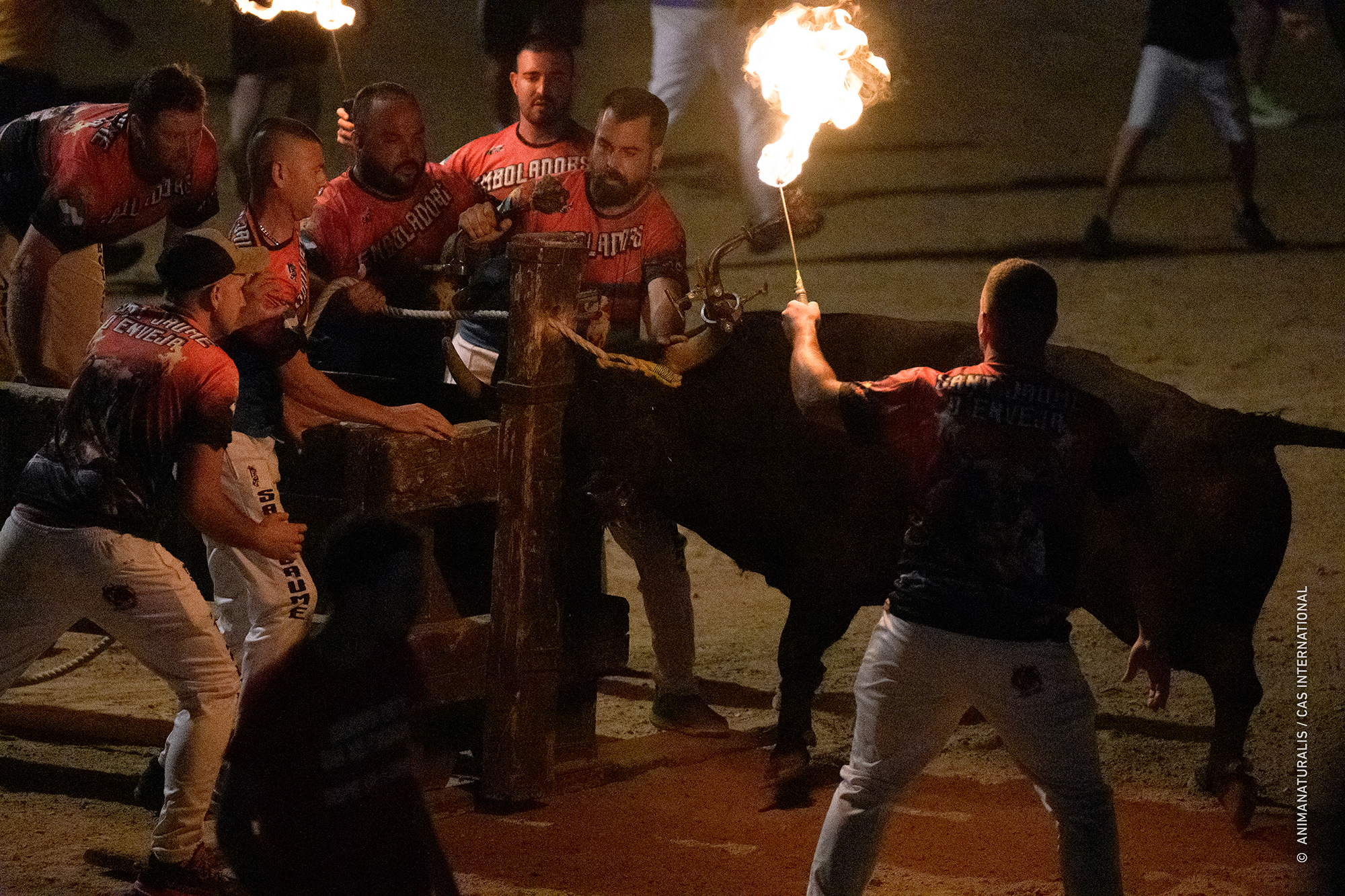
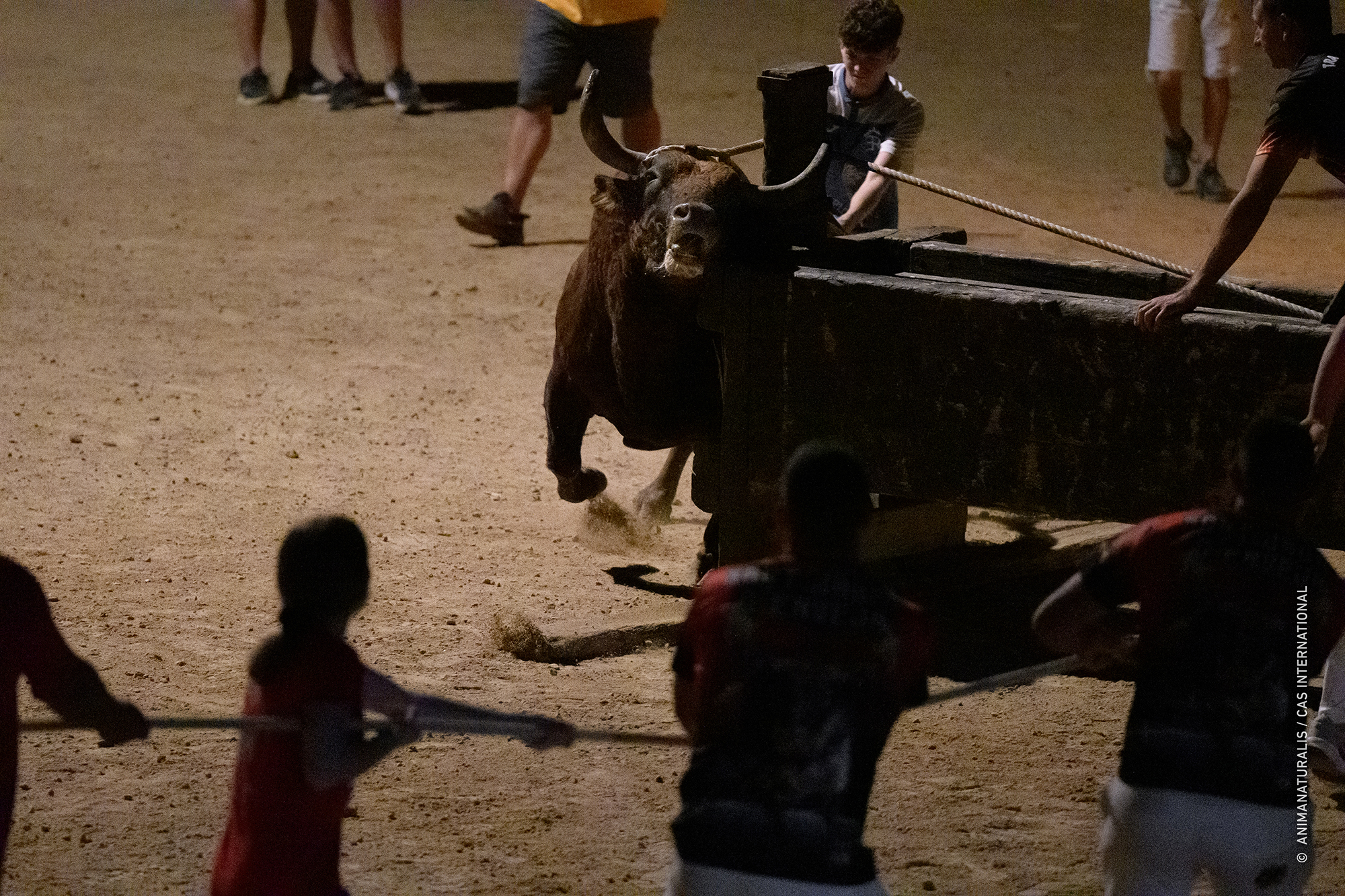
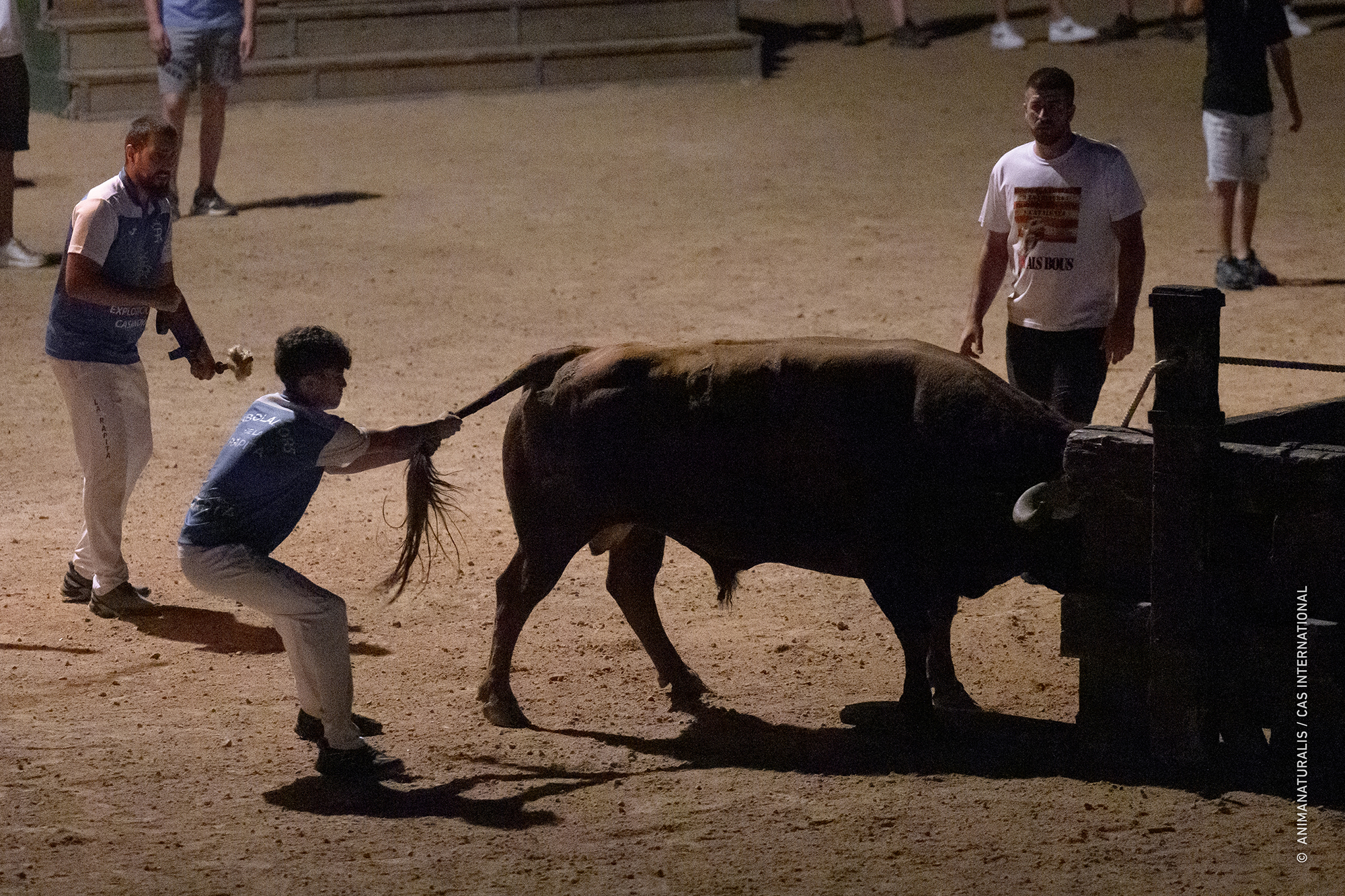
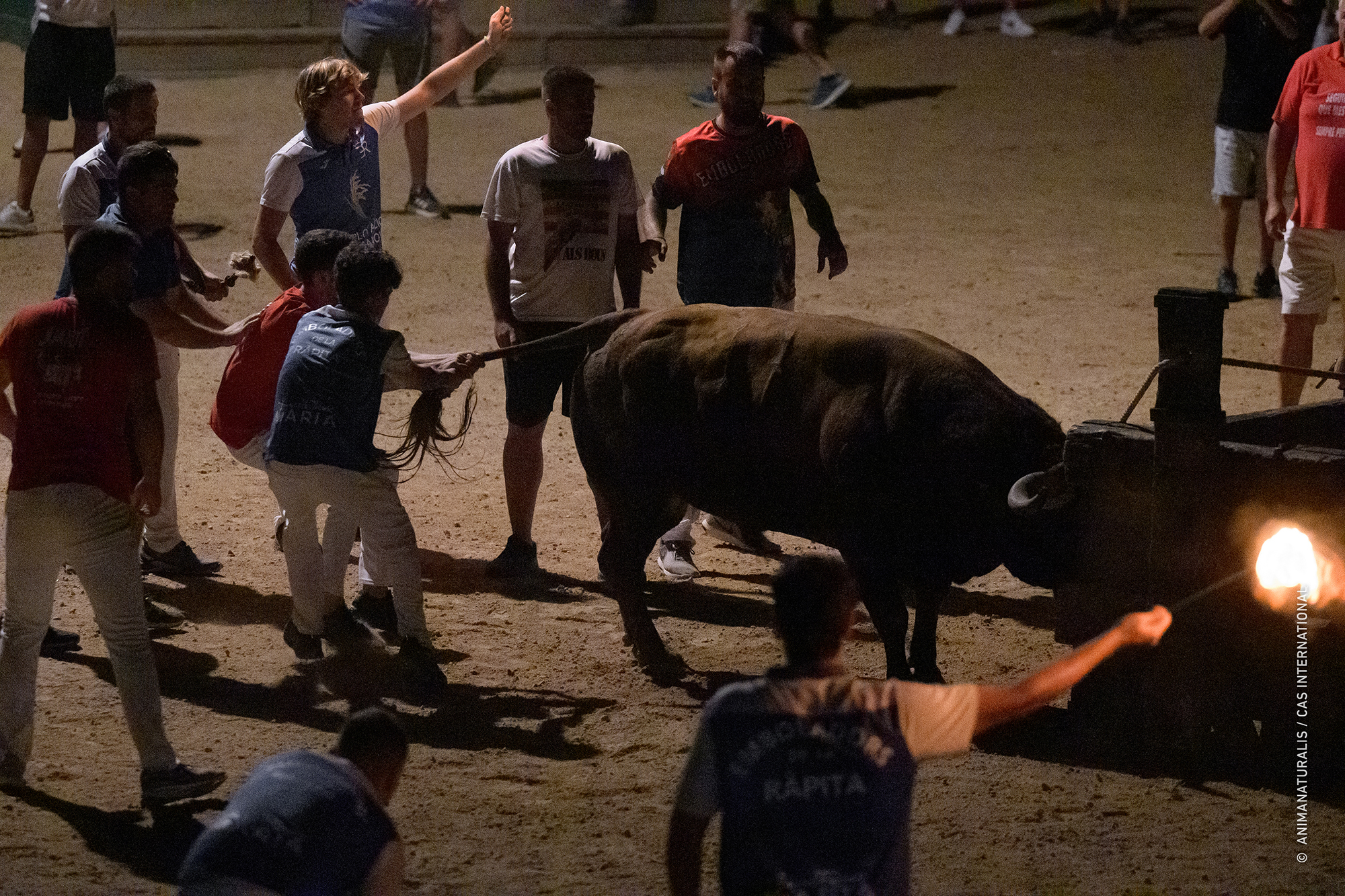
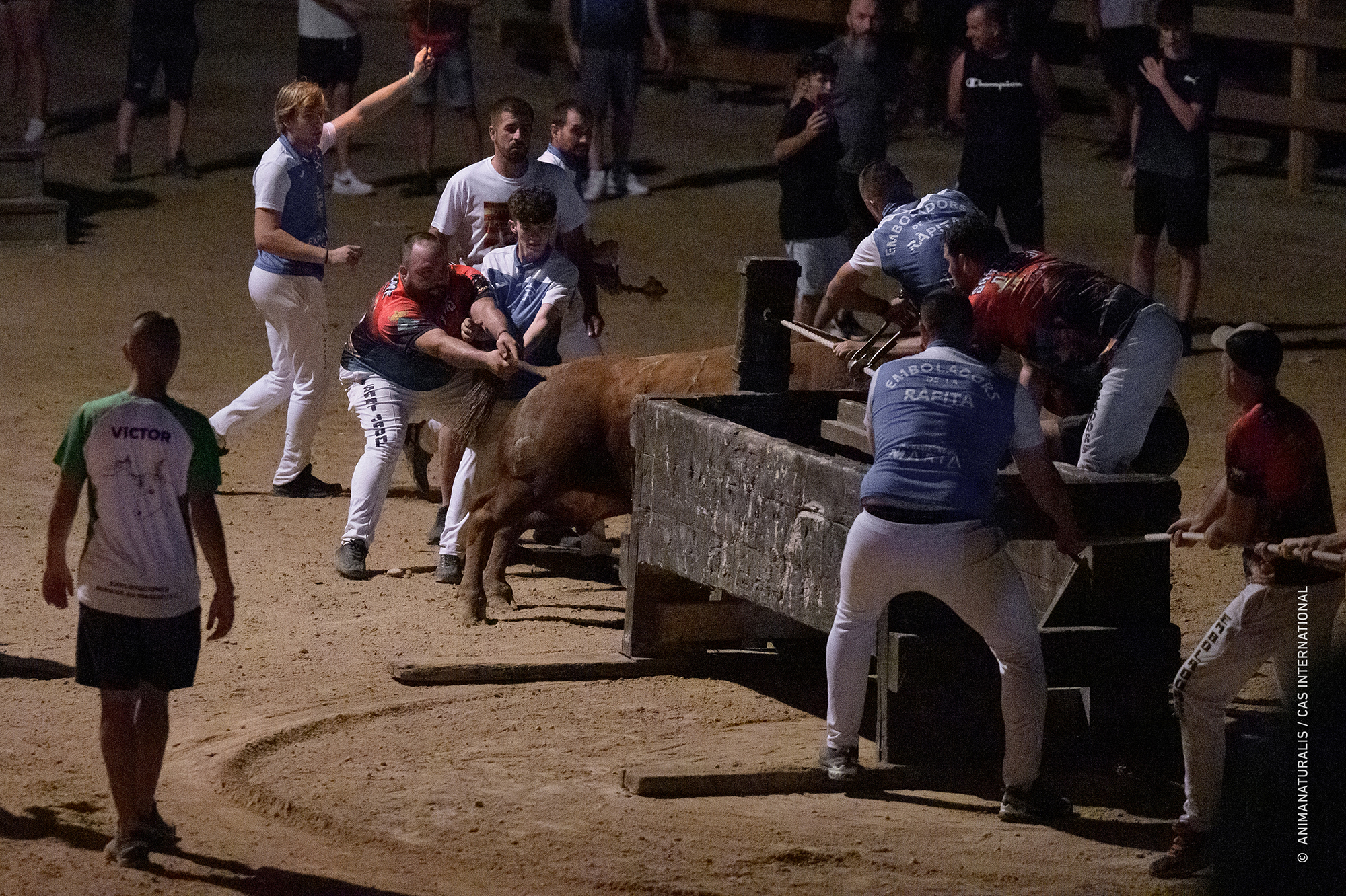
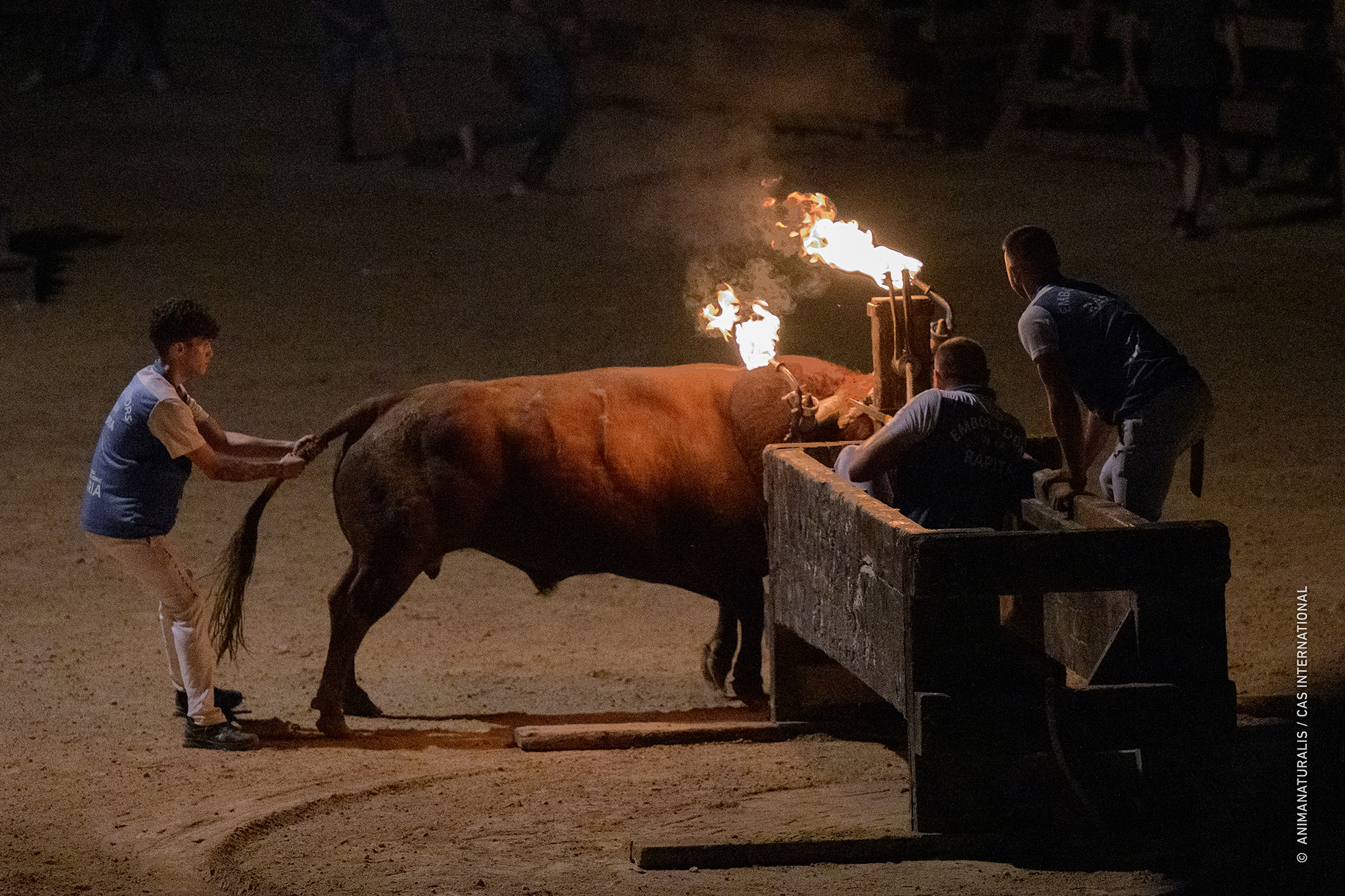
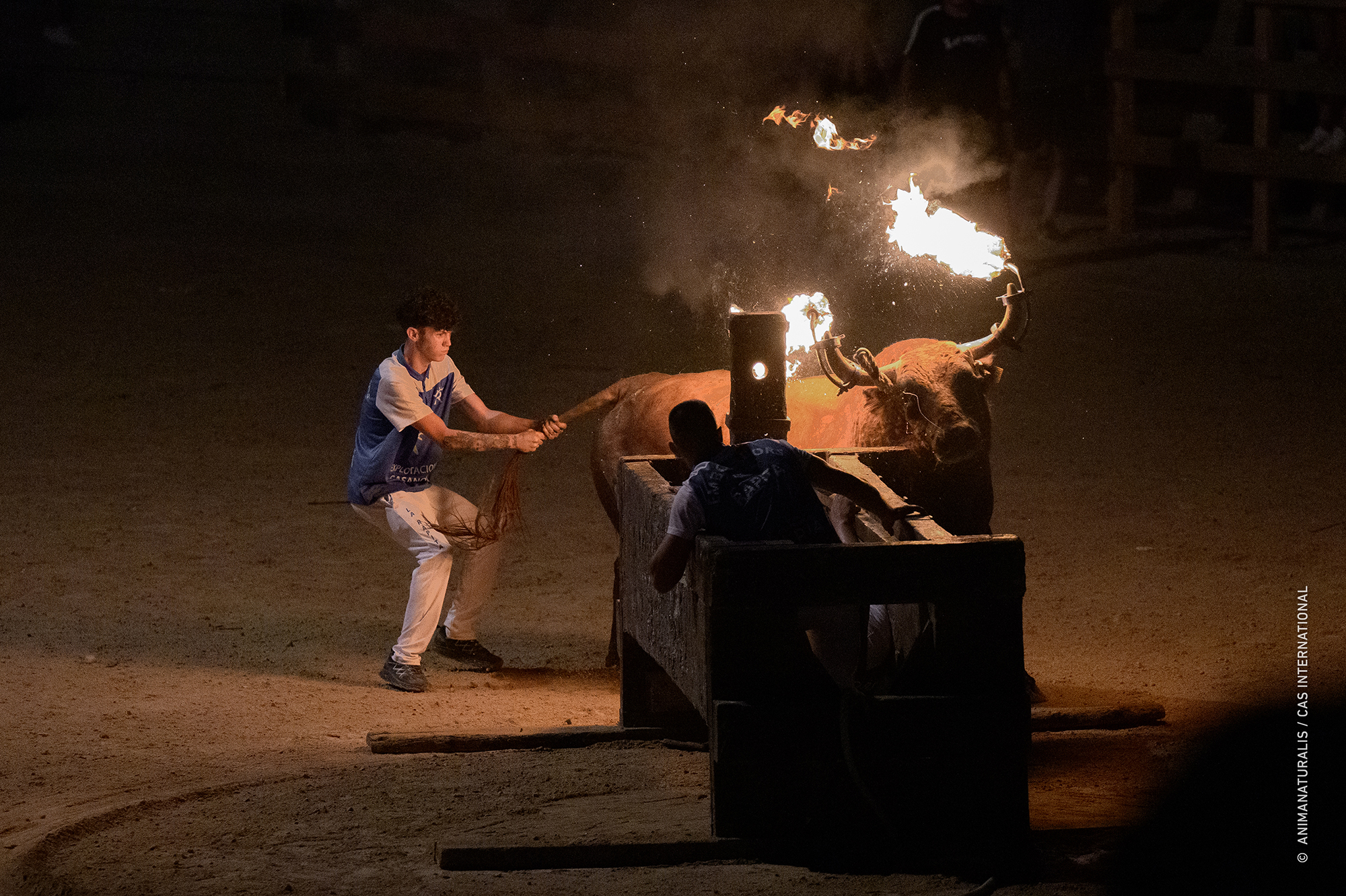
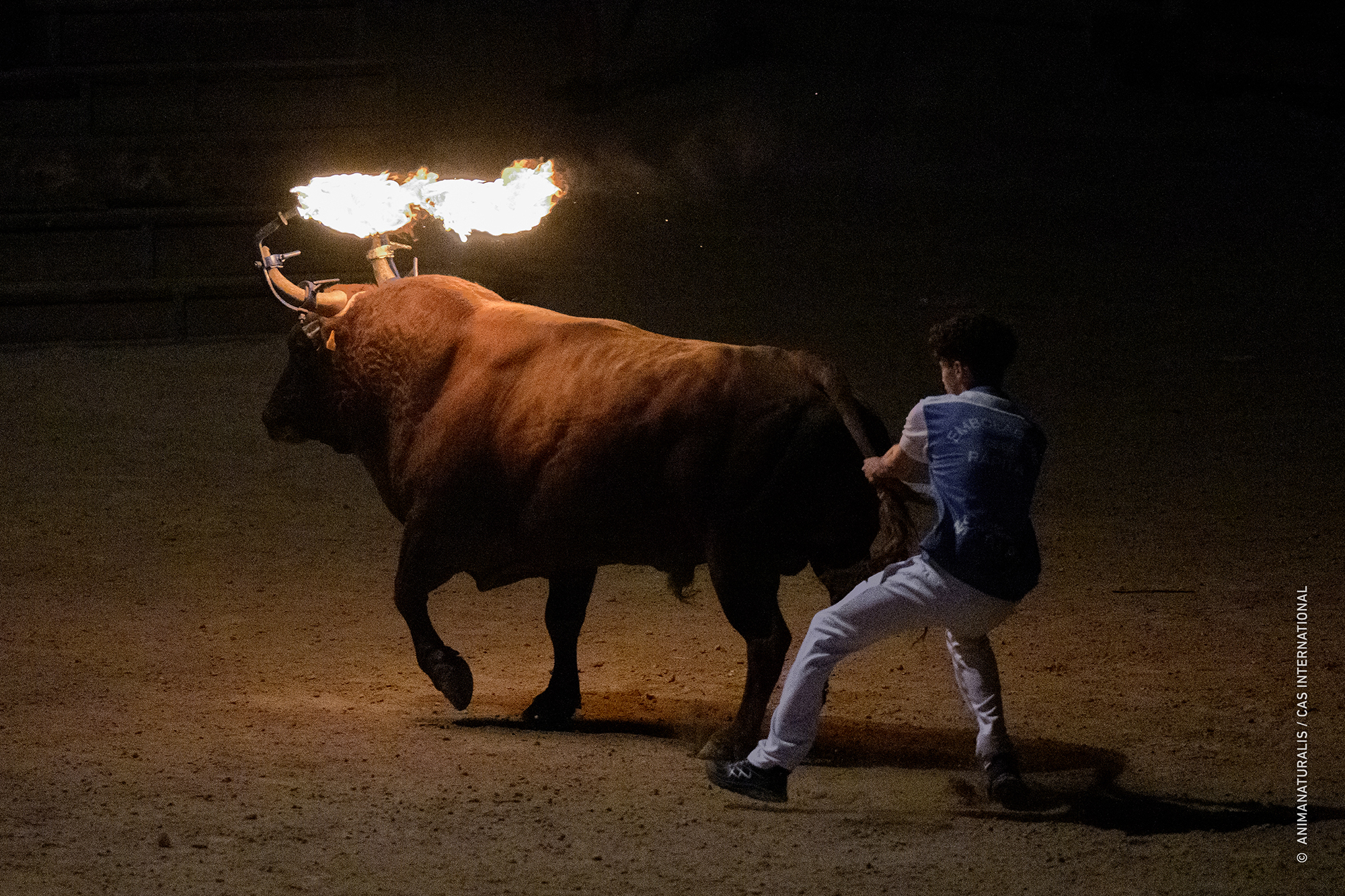
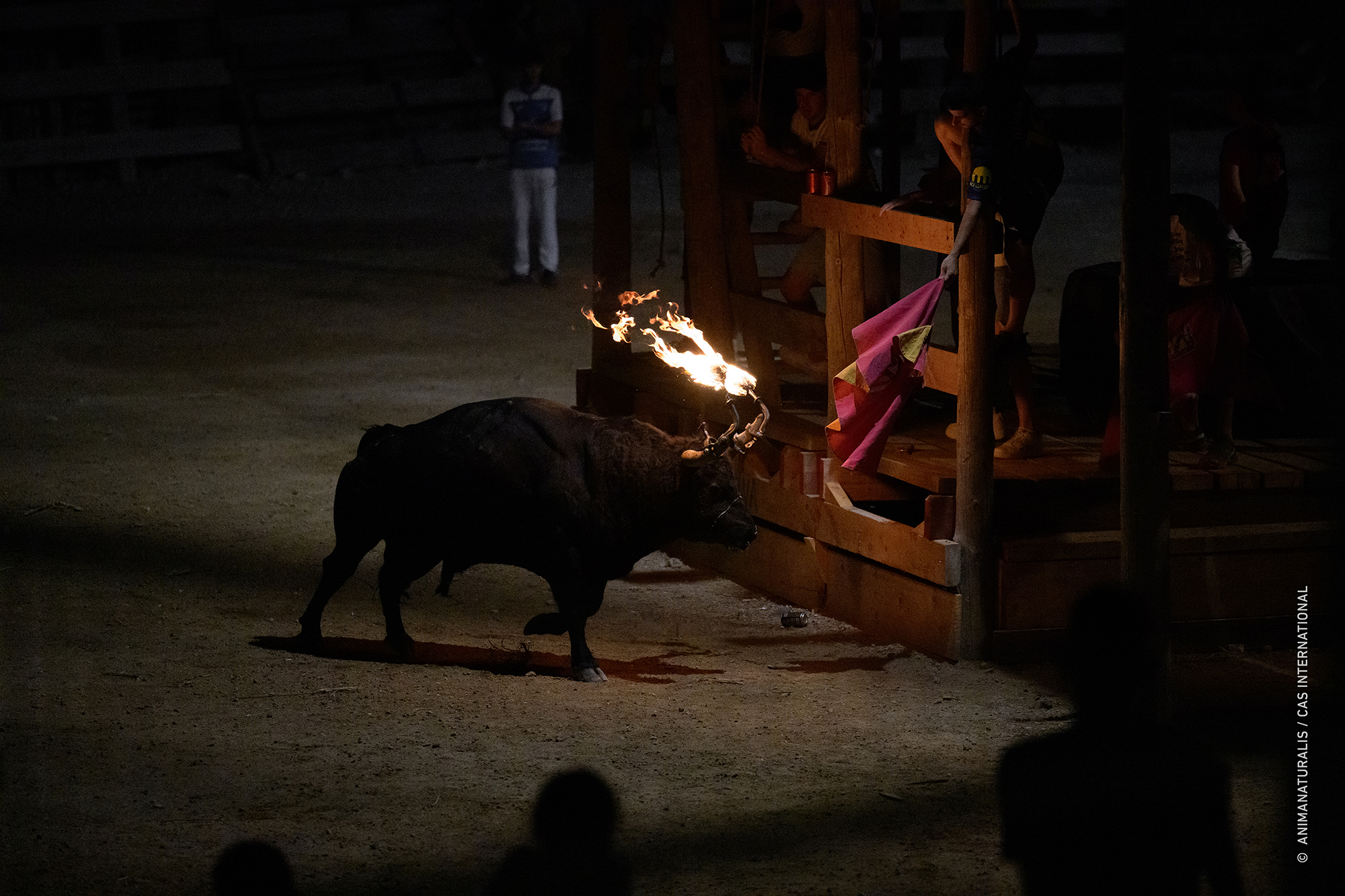
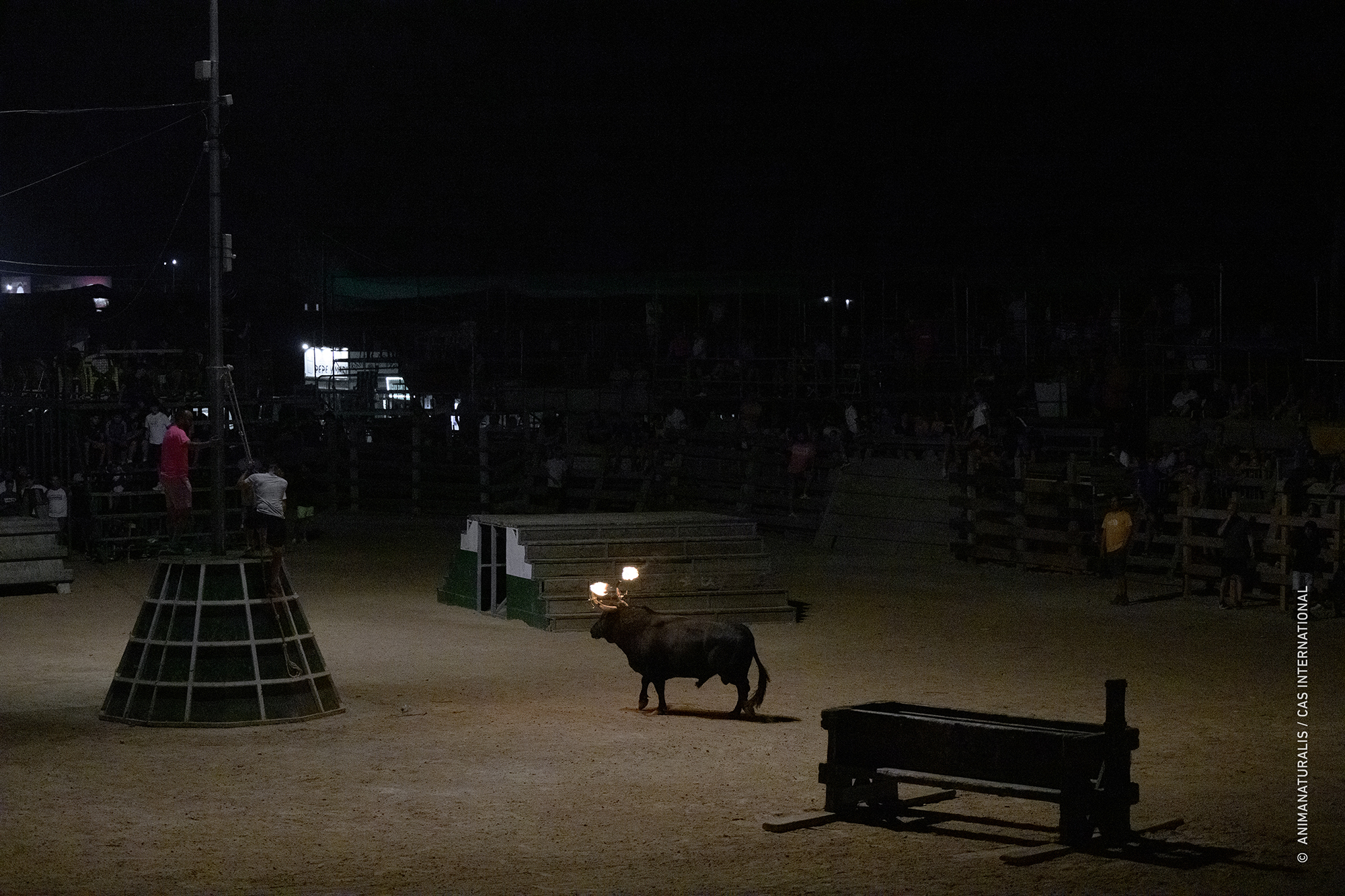
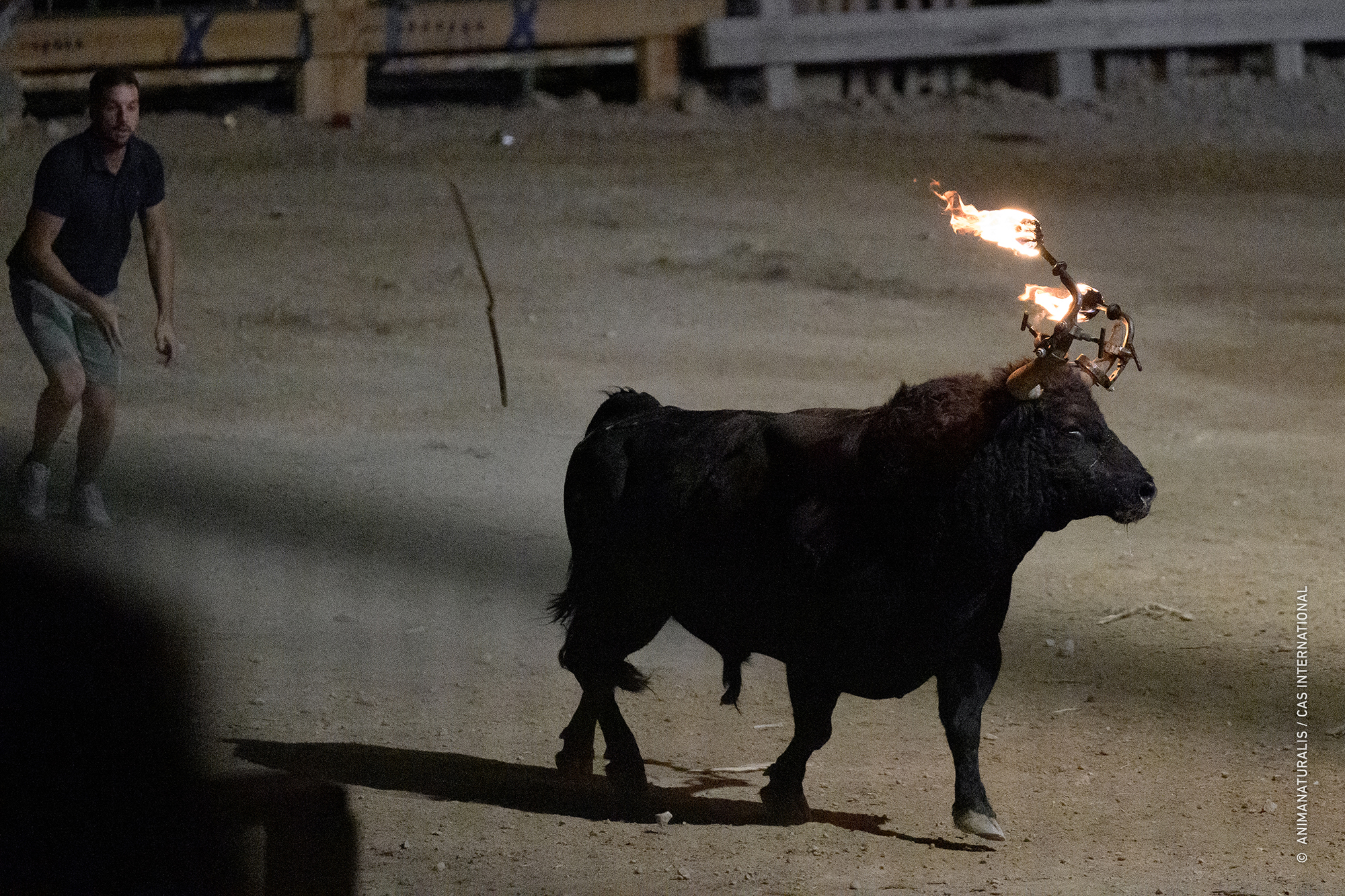
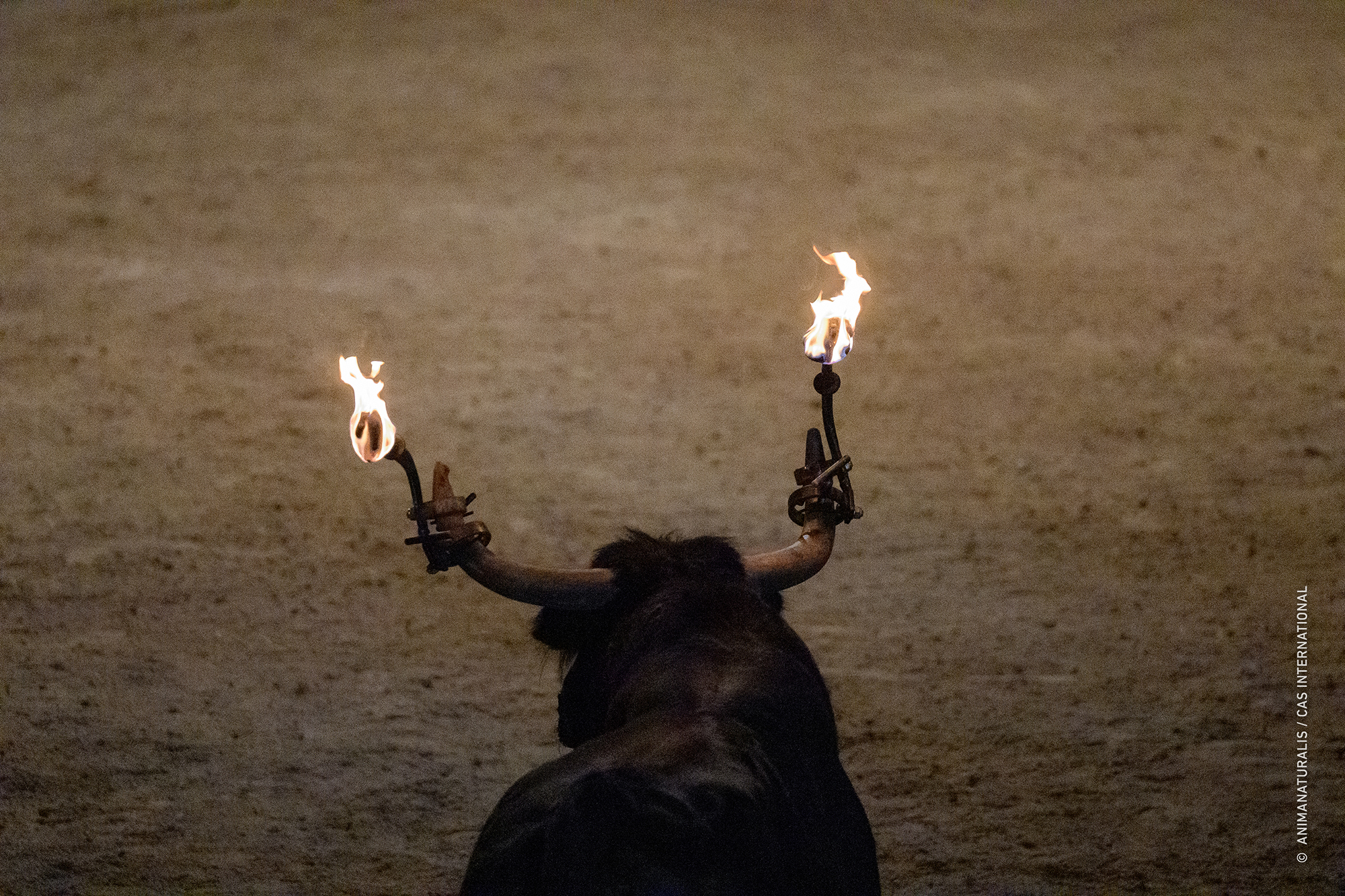
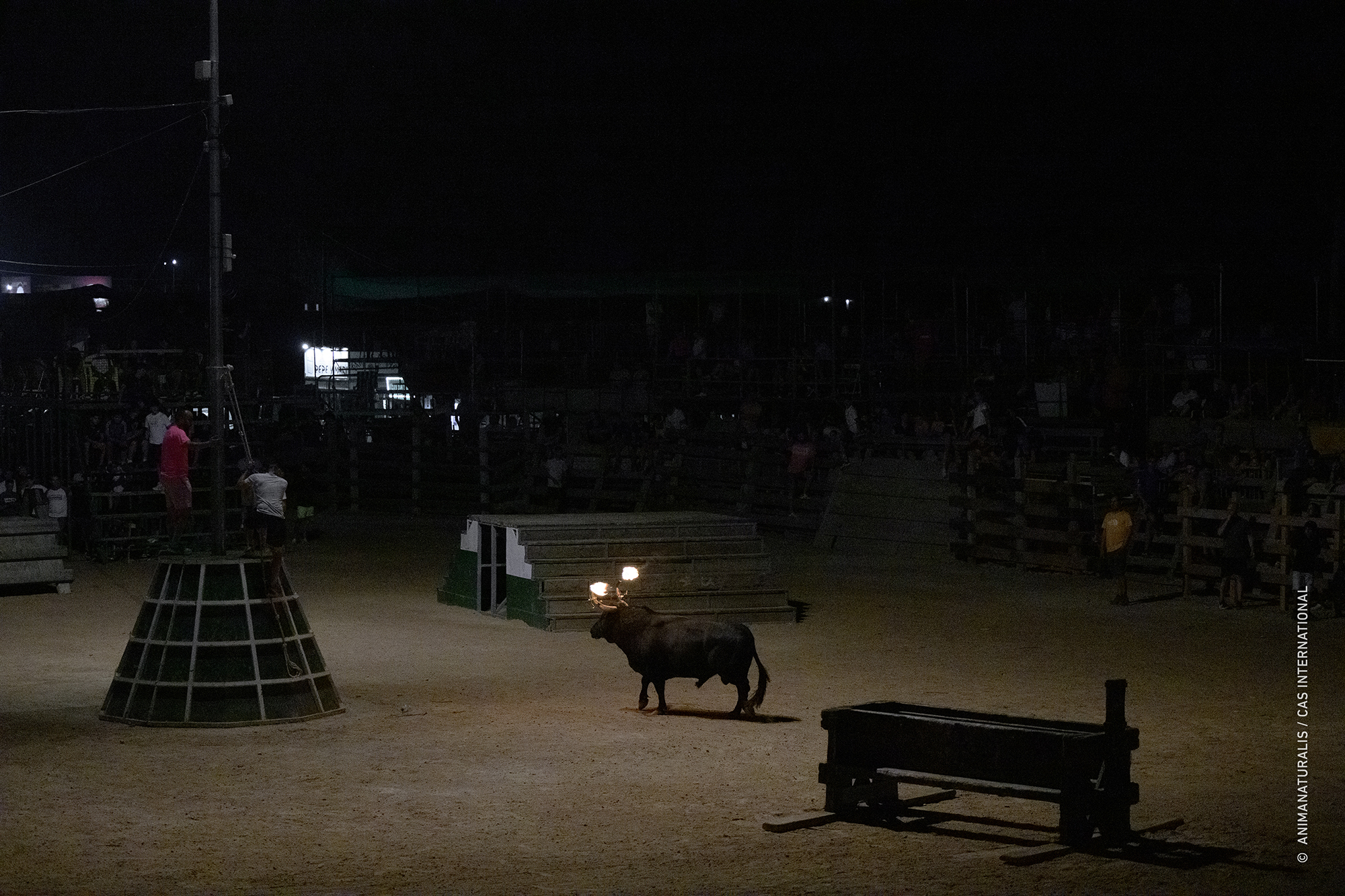
The images accompanying this article come from a recent report by our investigative team at the popular festivities of Sant Jaume d’Enveja (Tarragona) in early summer 2025.
The Typical Sequence
Although the rules vary slightly by location, the spectacle always follows a similar pattern. At night or at dusk, the animal arrives at the ring from a dark, narrow chute, panting in fear. A group of men pulls it out by a rope tied to its poll or horns and drags it to a wooden post placed in the center of the plaza.
To immobilize it, a thick rope is placed around its horns and they pull hard until the bull collides with the post. The rancher or a volunteer attaches a clamp (pinza) to the rope to secure the bull firmly to the post.
At that moment, the bull cannot move backward: it is paralyzed and terrified. During the fixation, the bull sometimes even becomes entangled or suffocates on the rope as it struggles desperately.
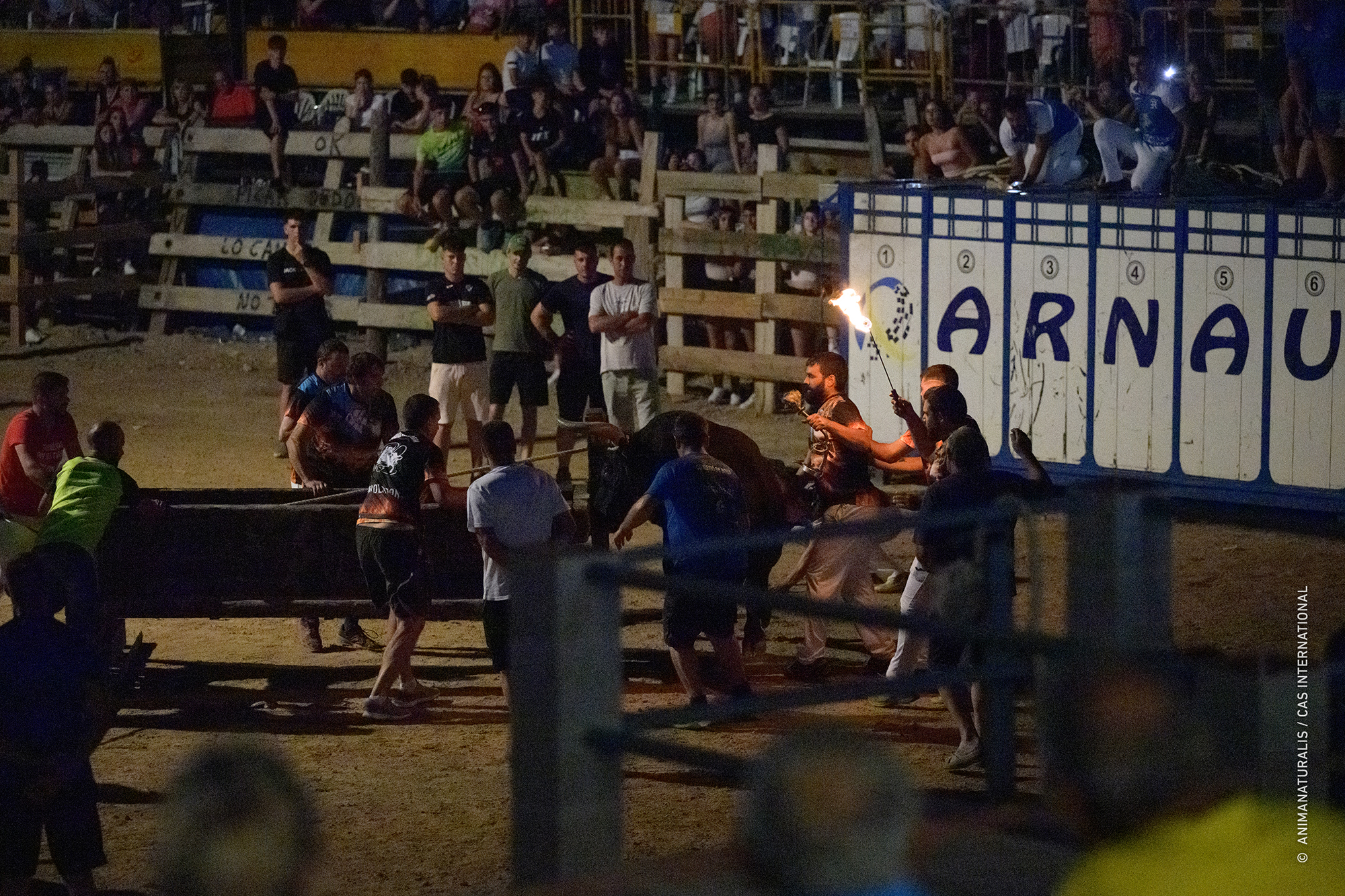
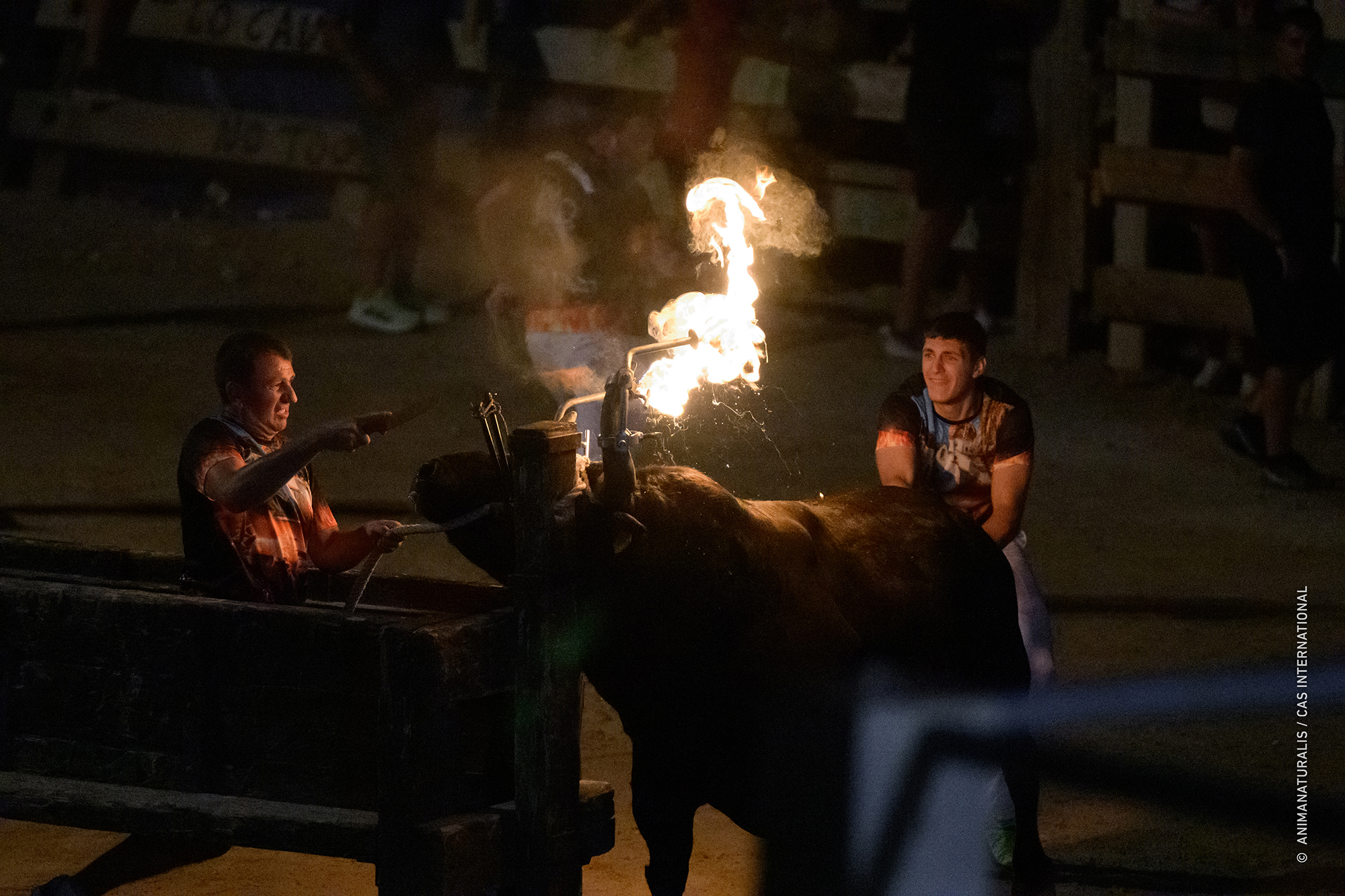
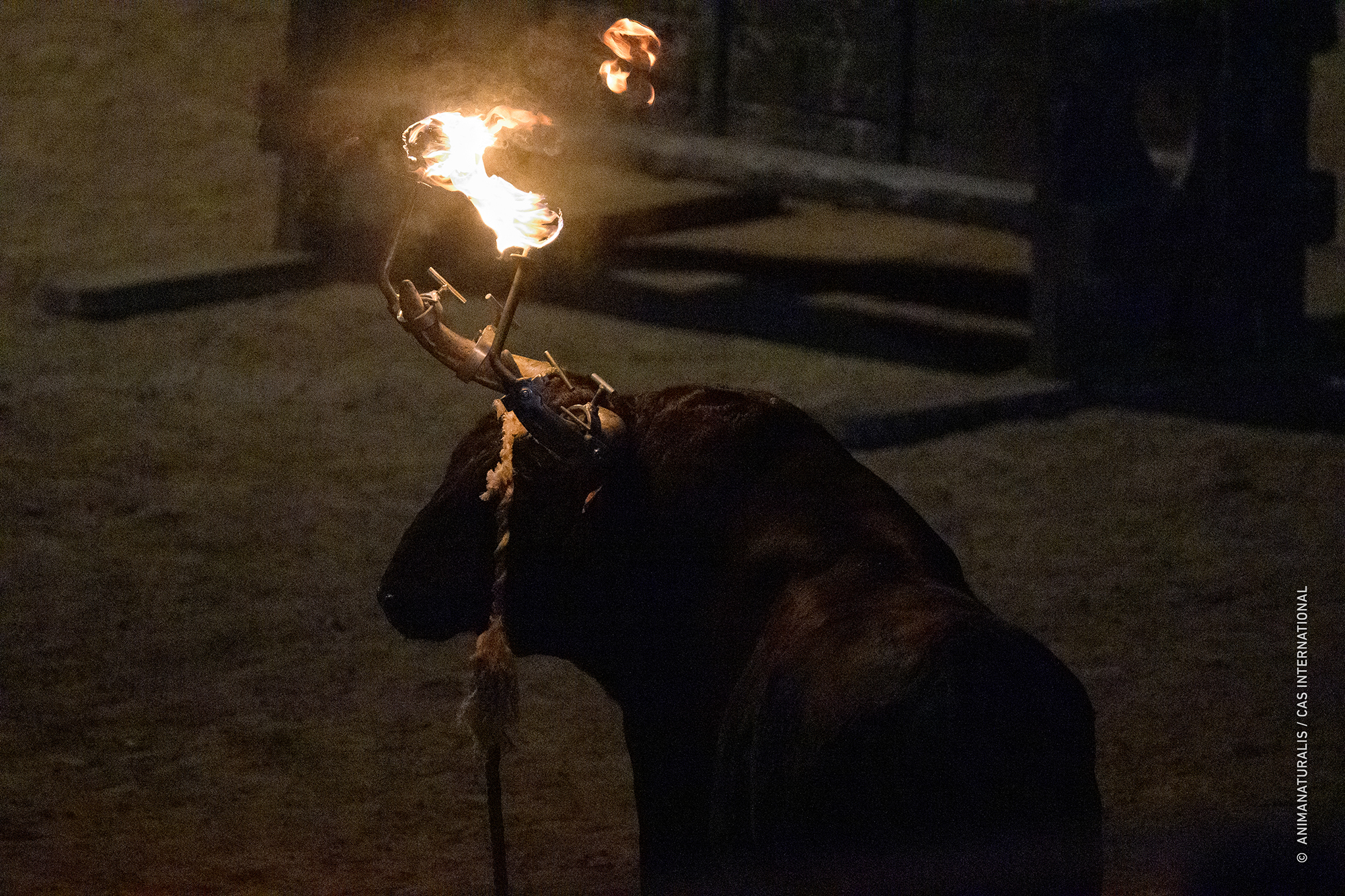
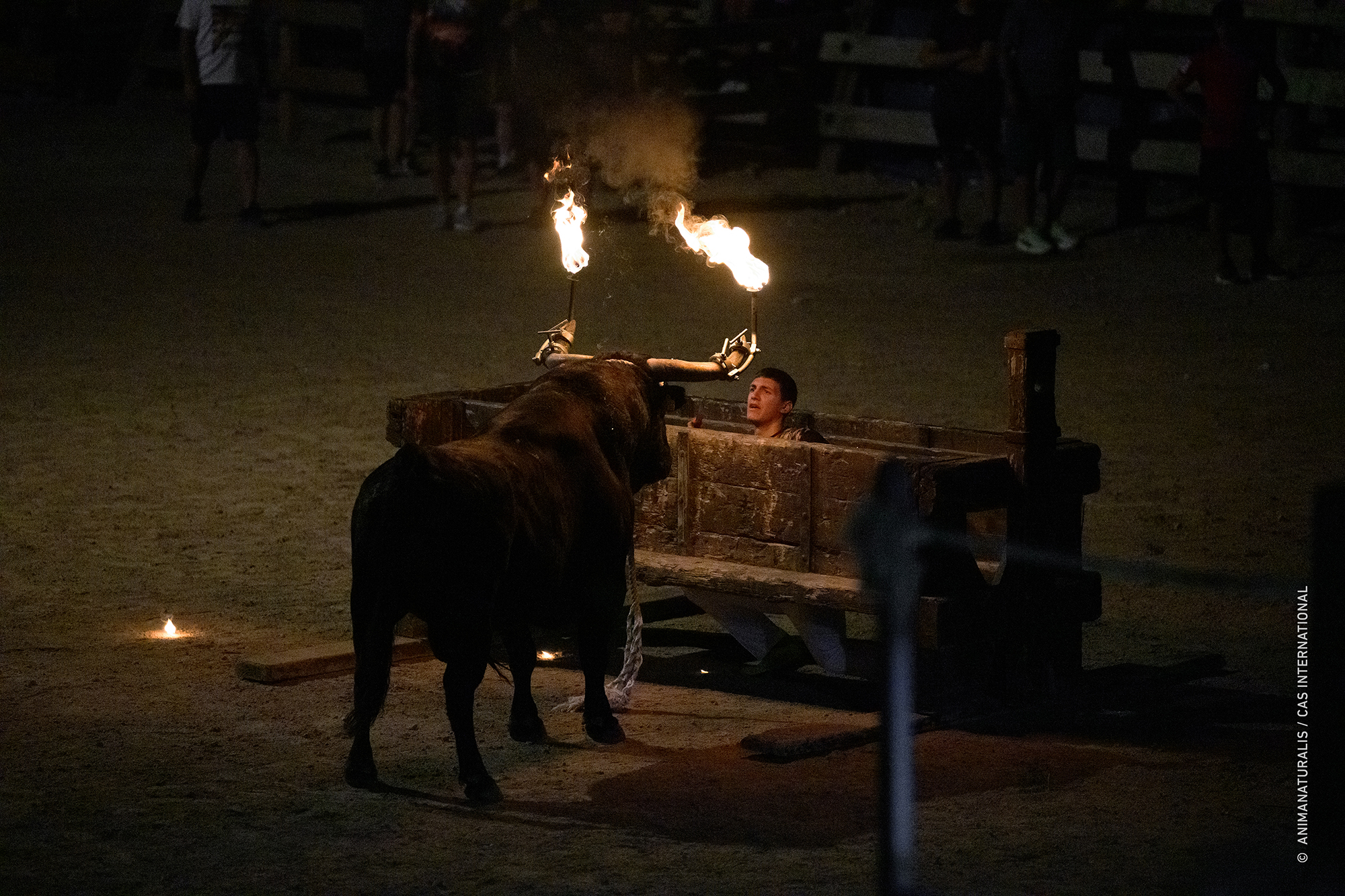
Next comes the team of emboladores. One by one, they screw or clamp two metal frames onto the base of the horns, like double pincers. These frames end in two balls of tow soaked in combustible fluid or resin.
All the while, the bull bellows and rams the post, trying to free itself, eyes wide and foam dripping from its mouth. Then, at the signal, the tow balls are lit with torches or flares. In an instant, the bull sees flames burning on its own horns. The rope is released again and the animal is free, but now with two blazing flames atop its head.
There is usually one last volunteer who holds it back by the tail so it does not rush forward and gore the person cutting the rope.
Once freed, the bull’s ordeal through the plaza or streets begins. The animal, with the balls still burning, runs in terror between wooden barriers marking its route. It tries to smash into any obstacle to knock them off, butts against gates and bellows in agony.
The aim is to further frighten the bull so it will charge the fences with fury. Everything happens mercilessly: the bull breathes heavily, nostrils flaring, mouth open and gasping. The chemical residue of the fuel and the heat burn its eyes and muzzle: its cries are genuine screams of pain and desperation. After several futile attempts to shake off the embers, the bull’s strength finally starts to fade.
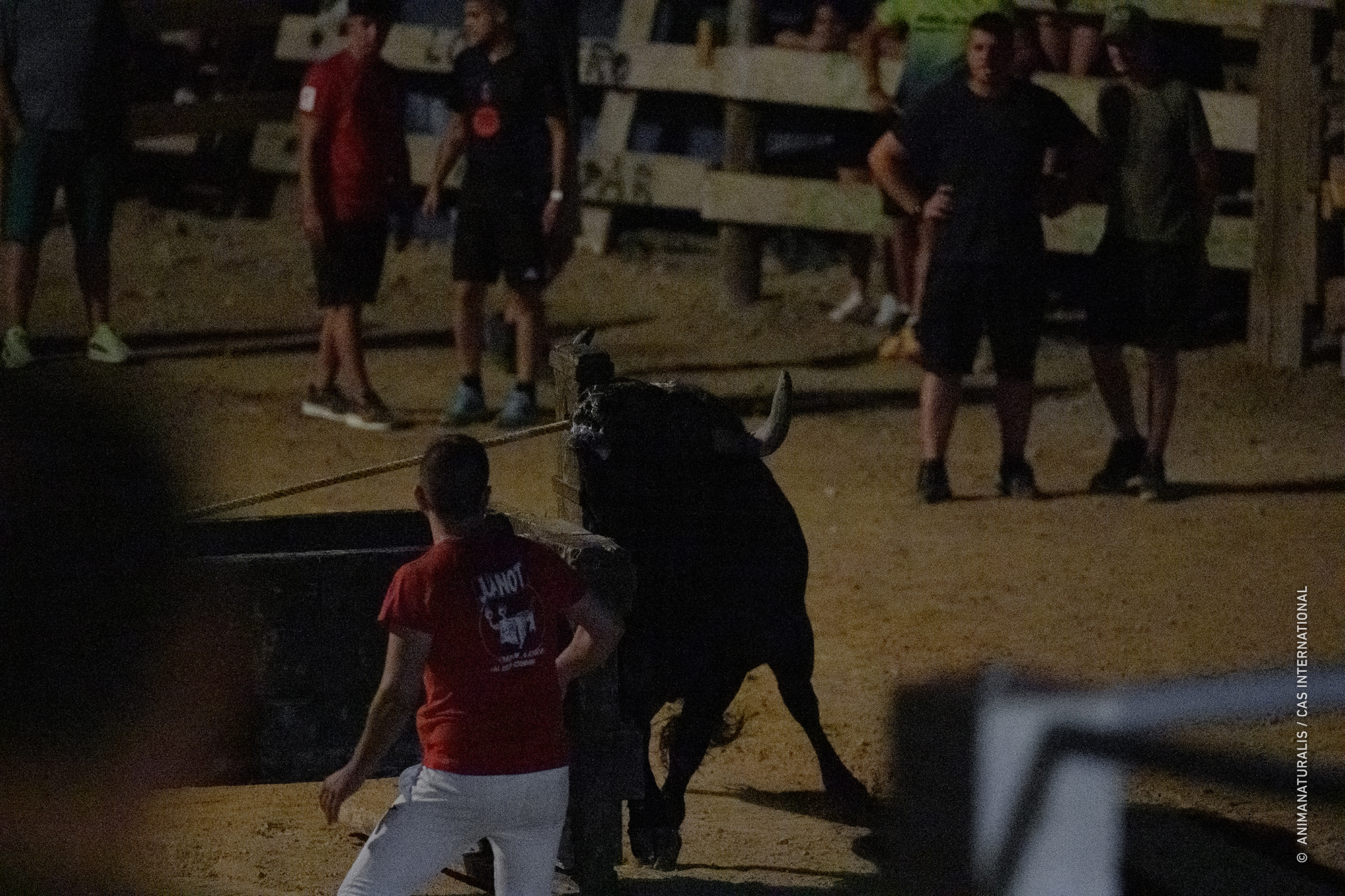
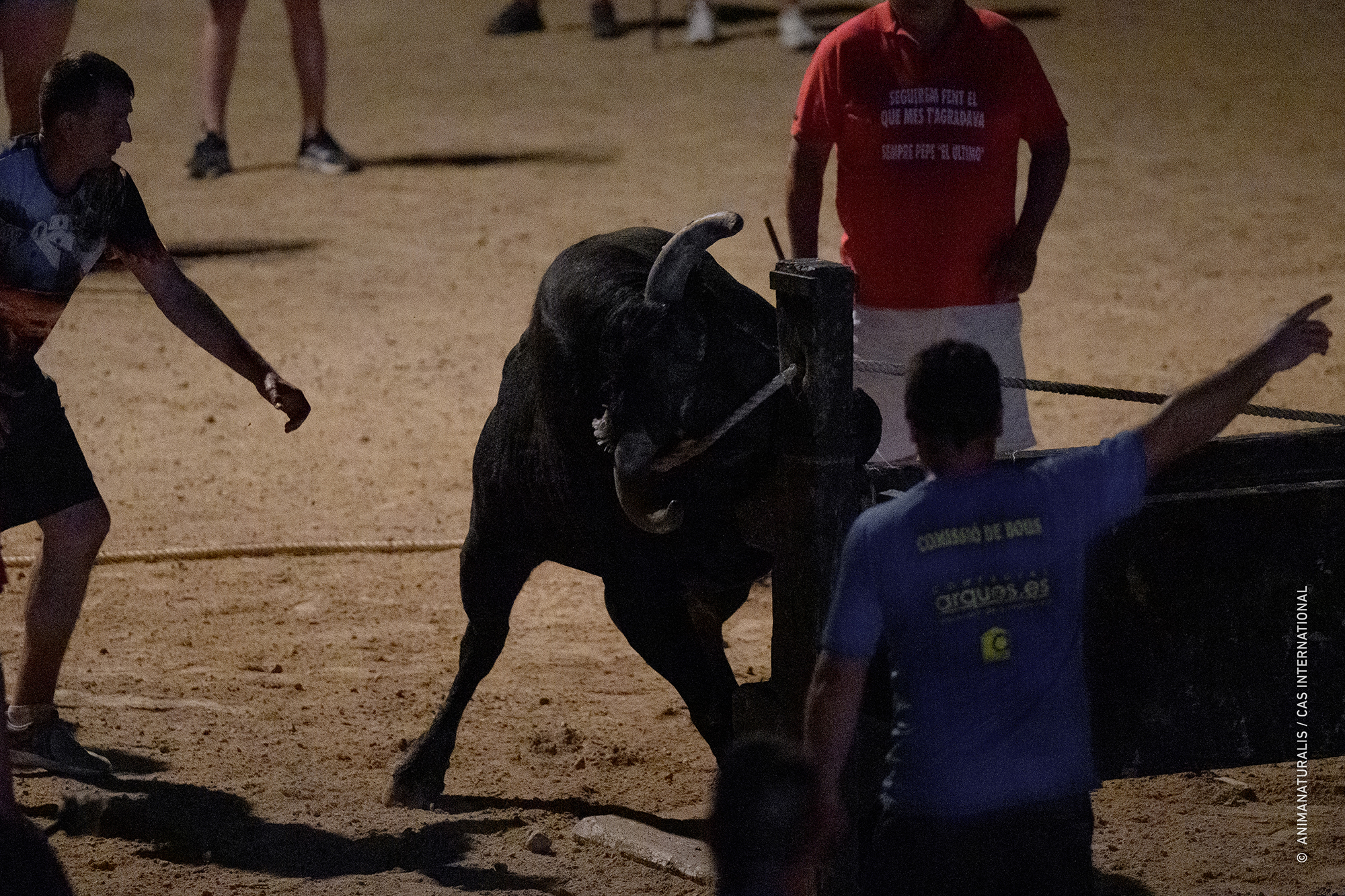
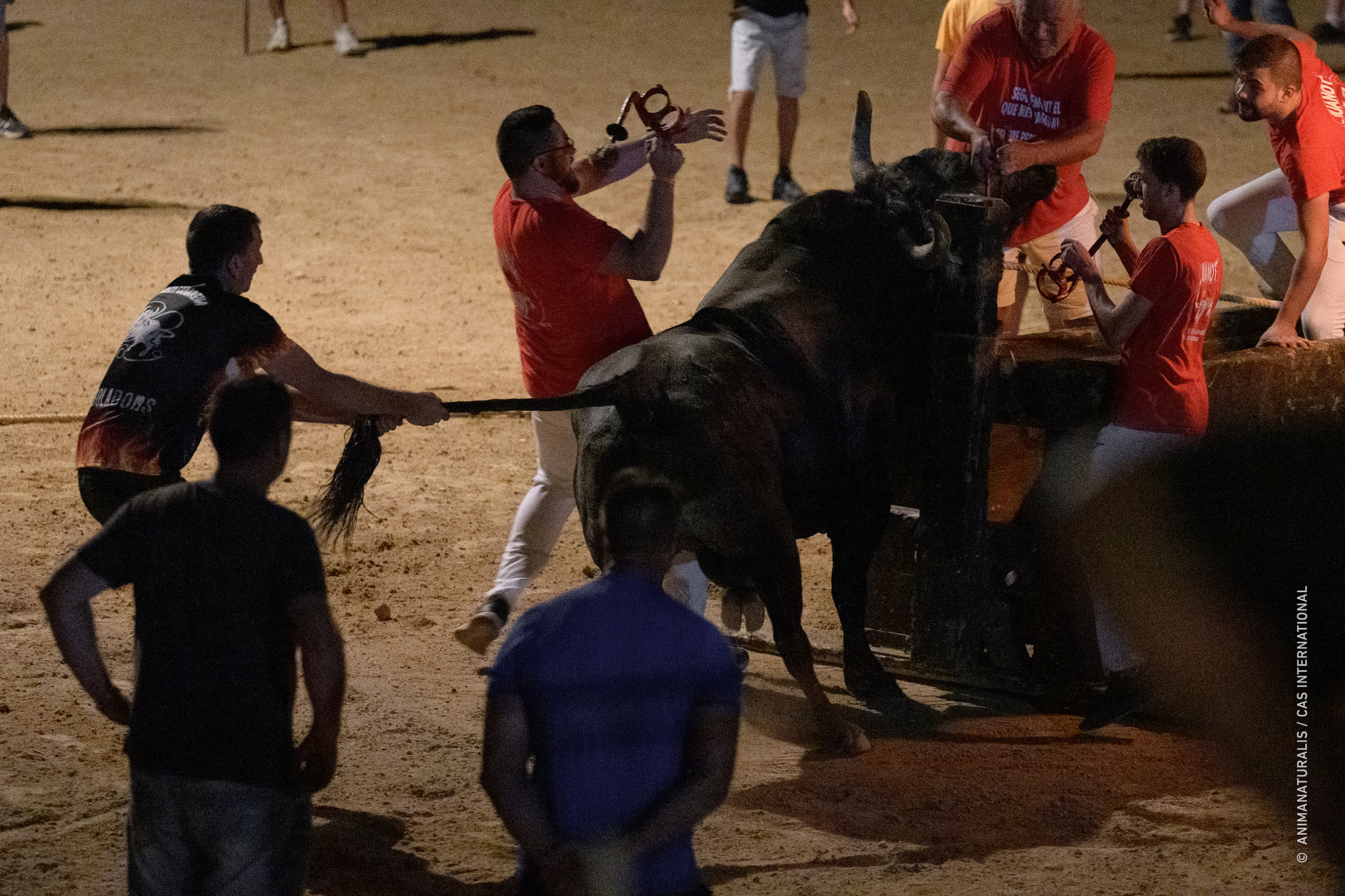
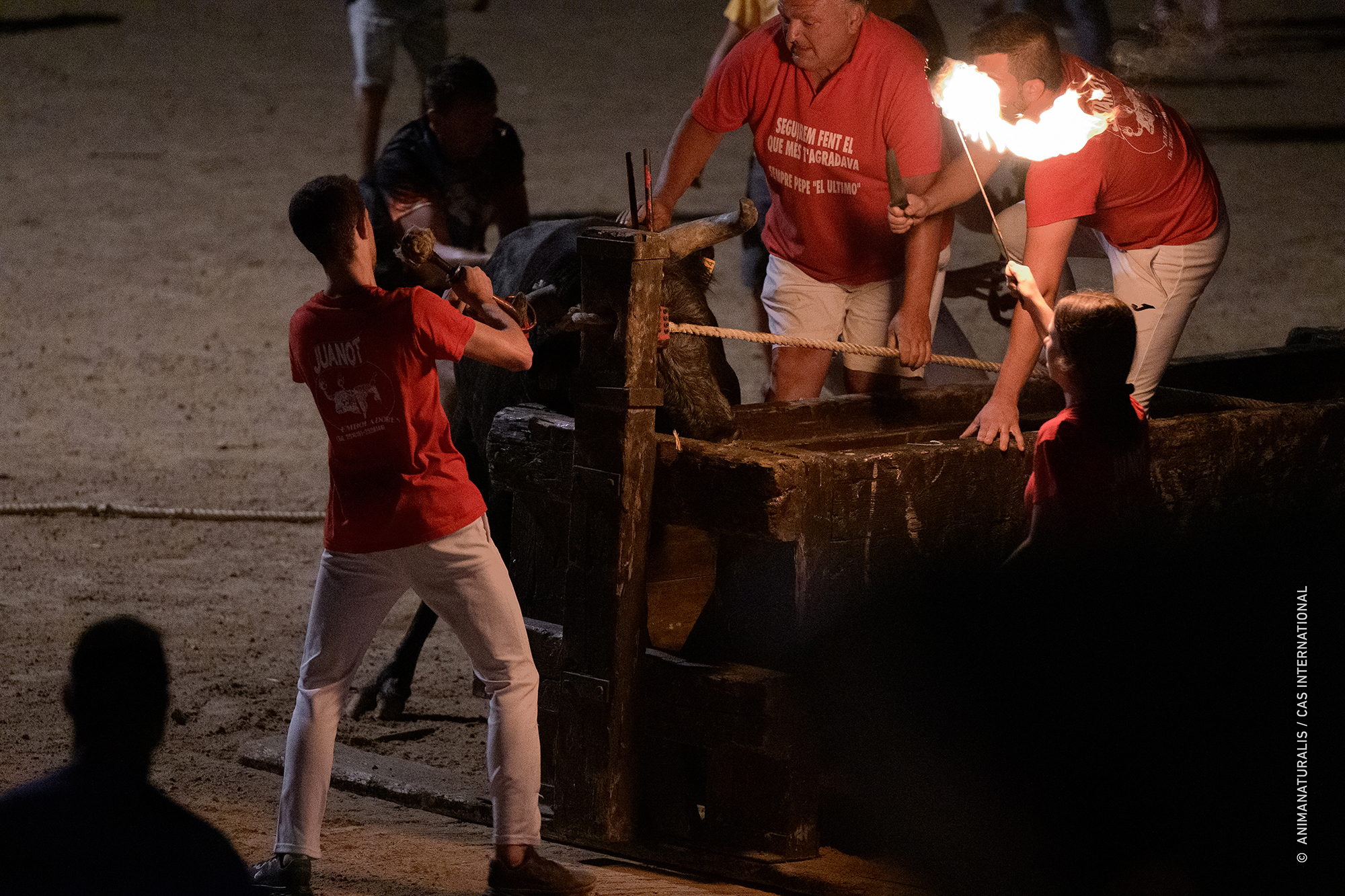
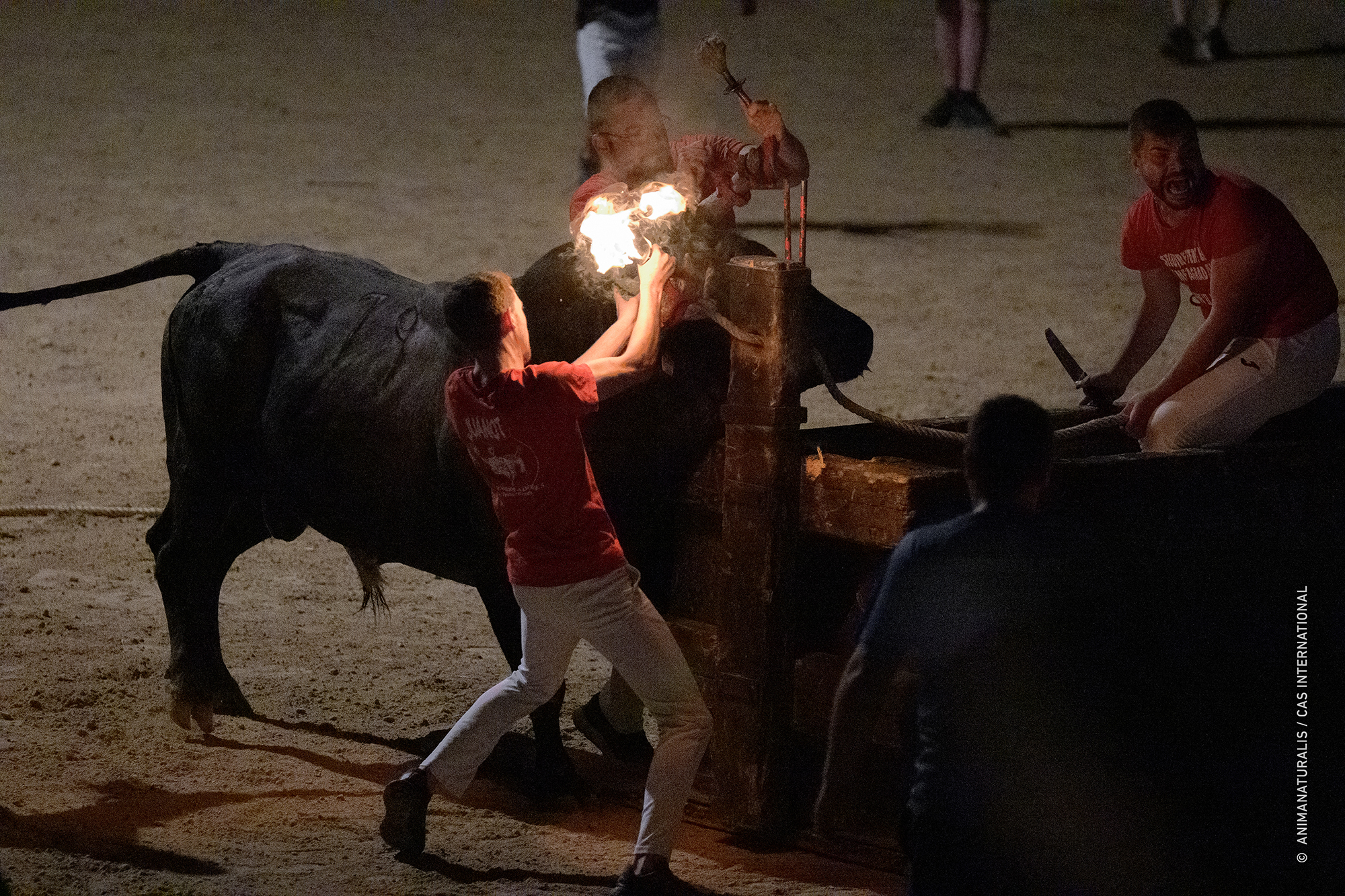
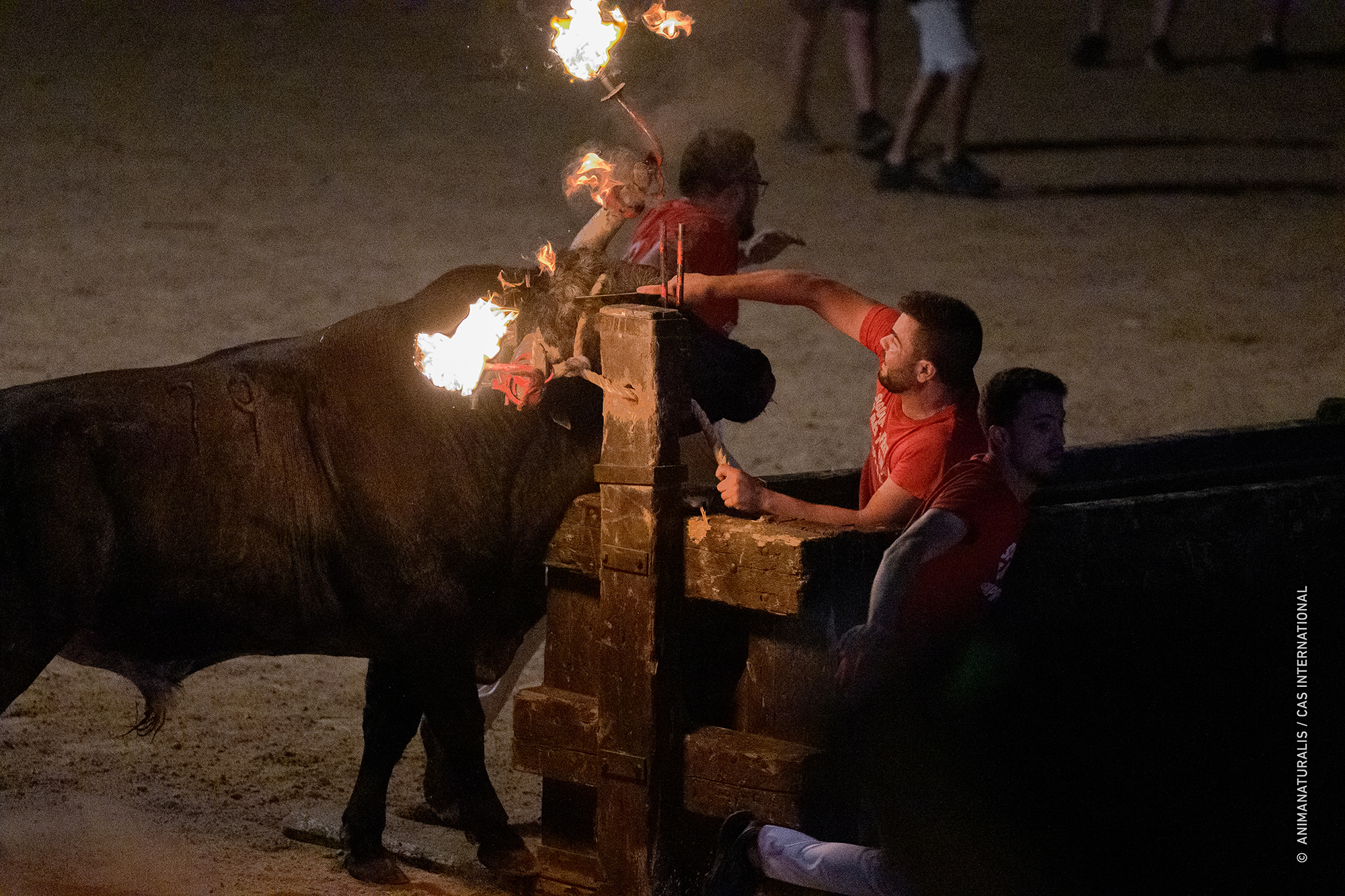
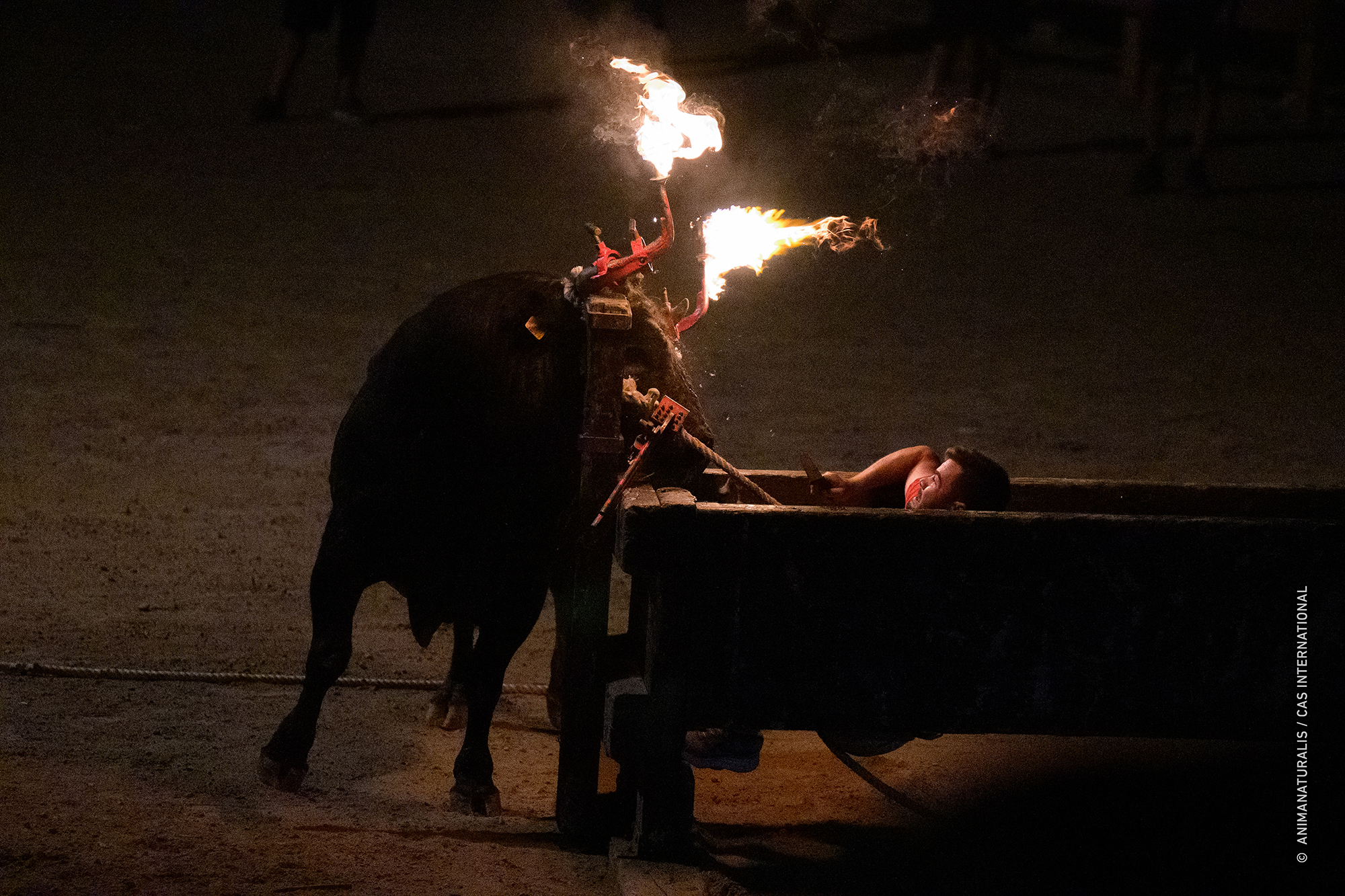
It pauses for a moment, gasping, horns still aflame, unable to move. The bull, believing it has spotted an escape, charges the boards again. The cycle repeats, flames licking its horns until, if fortunate, the tow is fully consumed. The spectacle usually lasts between 15 and 30 minutes until the exhausted bull is finally corralled again. The “embolada” ends with the victor’s applause from the crowd.
Many of these details align with the stark testimony of Aïda Gascón, director of AnimaNaturalis in Spain, who after documenting these festivities explains: “Nothing extraordinary… dragging the animal, pinning it to a wooden post, fastening tow-soaked balls to its horns and entertaining oneself while the animal runs in terror and flames… as if any of that were remotely normal.”
Indeed, organizers hail the bull embolado as “one of the great feats” of the festivities, but for the bull it is a true ordeal.
Regulation and Legal Limits
The permissibility of the bull embolado varies by autonomous community, as it does with other popular festivities. Below is a summary of the key points in the current legislation for each territory:
- Catalonia:
Governed by the Law 34/2010, of October 1, on traditional festivals with bulls. This regional law regulates the Catalan correbous and includes the bull embolat among its modalities. It requires prior authorization from the Catalan Government and sets certain limits. For example, it stipulates a maximum exhibition time of 30 minutes in the ring, of which only 15 minutes may be with the tow balls burning. Before the embolada begins, a veterinarian must examine the bull; afterward, they must issue a report on its condition. The law also sets a minimum age for participation: under-14s may only attend as spectators. Another key provision is that the same bull may participate in only one taurine event per day (with at least 24 hours between events). If the animal shows clear signs of exhaustion or injury, the event must be halted immediately at the veterinarian’s request. Despite these rules, they do not always safeguard the bull’s life post-festivity. In October 2023, the Catalan Parliament approved the processing of an amendment—proposed by AnimaNaturalis and other local groups—that explicitly bans the bull embolado (alongside bulls on ropes and bulls to the sea). However, early elections prevented the bill’s final debate and vote. - Aragón:
Until May 2023, regional regulations (Decree 226/2001 and its amendments) required embolados to have a “local traditional rooting” to be authorized. A recent Decree 71/2023 reformed the taurine regulations: any municipality in Aragón may now host bull embolados without demonstrating historical tradition. The fiery bull is classified as a “special event” alongside bulls on ropes and others, and requires specific permits. Safety measures are also defined: for instance, unlike other events, embolados may be released directly from the truck to the post (bypassing intermediate corrals). As in Catalonia, veterinarians must be present to monitor the bull before and after. In practice, Aragón’s regulations include embolados within popular bull events, but authorities must oversee them under administrative and health safety standards. Notably, over 2,500 popular bull events took place in Aragón in 2022 (though not all embolados), highlighting the region’s strong bull culture. - Valencian Community:
Since 2015, Decree 31/2015 of March 6 has governed traditional taurine festivities (the so-called bous al carrer), covering all Valencian modalities including the bull embolat. The decree sets out specific technical requirements to minimize harm: for example, the distance between the metal frame and the bull’s muzzle must be at least 15 centimeters to keep flames away from the head. The horn-fixing spikes may be no more than 3 mm thick, and the securing rope must be at least 2.4 cm thick to prevent cutting into the animal. Bulls and young cows must run within properly cordoned routes, and a veterinarian must be on site. In Valencia, a bull that has not participated in a previous event may only take part in one event per day—except for embolados within 24 hours afterward. After the festivities, animals are sent to slaughterhouses under sanitary regulations (ideally stunned outside public view, per animal-welfare slaughter laws). The Generalitat Valenciana aims to preserve the “identity” of the bous al carrer, but animal-welfare groups criticize that many towns ignore these rules—failing, for example, to maintain the 15 cm clearance or to allow veterinarians adequate time to inspect the animal. Nonetheless, Valencia’s legislation remains the most detailed regarding safety and bull welfare in embolados.
In summary, the current regulations in each region allow the bull embolado under specific restrictions, but activist documentation shows that these rules do not prevent the inherent cruelty of the spectacle. As Gascón laments, the bull’s pain and fear are “not considered extraordinary enough to warrant denunciation,” and sometimes the laws seem to encourage the tradition’s persistence.
Physical and Psychological Suffering
From a biological and ethological standpoint, the bull embolado is an episode of extreme psychological distress and stress for the animal. There is no doubt: the bull is a highly intelligent and sensitive mammal that feels pain, fear and frustration as acutely as any other.
Ethologists note that the bull experiences the event as a situation of total helplessness. Miguel Ibáñez Talagón, director of the Animal Behavior Medicine Center at the Complutense University of Madrid (UCM), explains that bulls endure “atrocious fear” and “general anxiety” when immobilized with no way to solve their predicament. The animal tries to free its head or take shelter, but the metal frames and rope prevent it. Often, it becomes tangled, struggles desperately, crashes into the post, and sometimes even “gores itself” trying to flee the danger. This clinical picture of “panic” or psychophysiological shock is comparable, experts say, to human victims of workplace or school bullying: a stress response triggered with no escape. In Ibáñez’s words: “A bull that gores itself trying to break free from sheer terror” demonstrates intense psychological suffering.
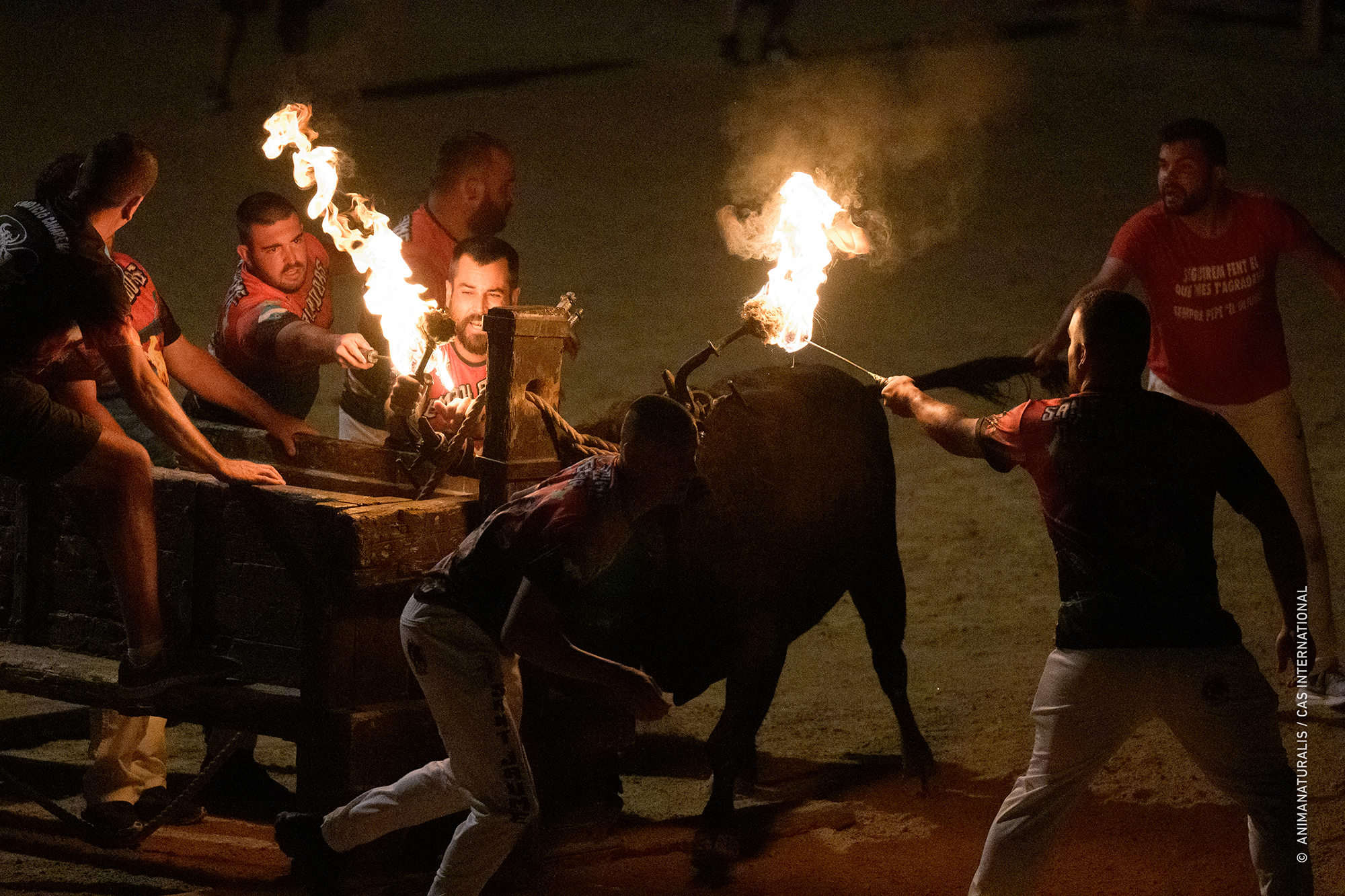
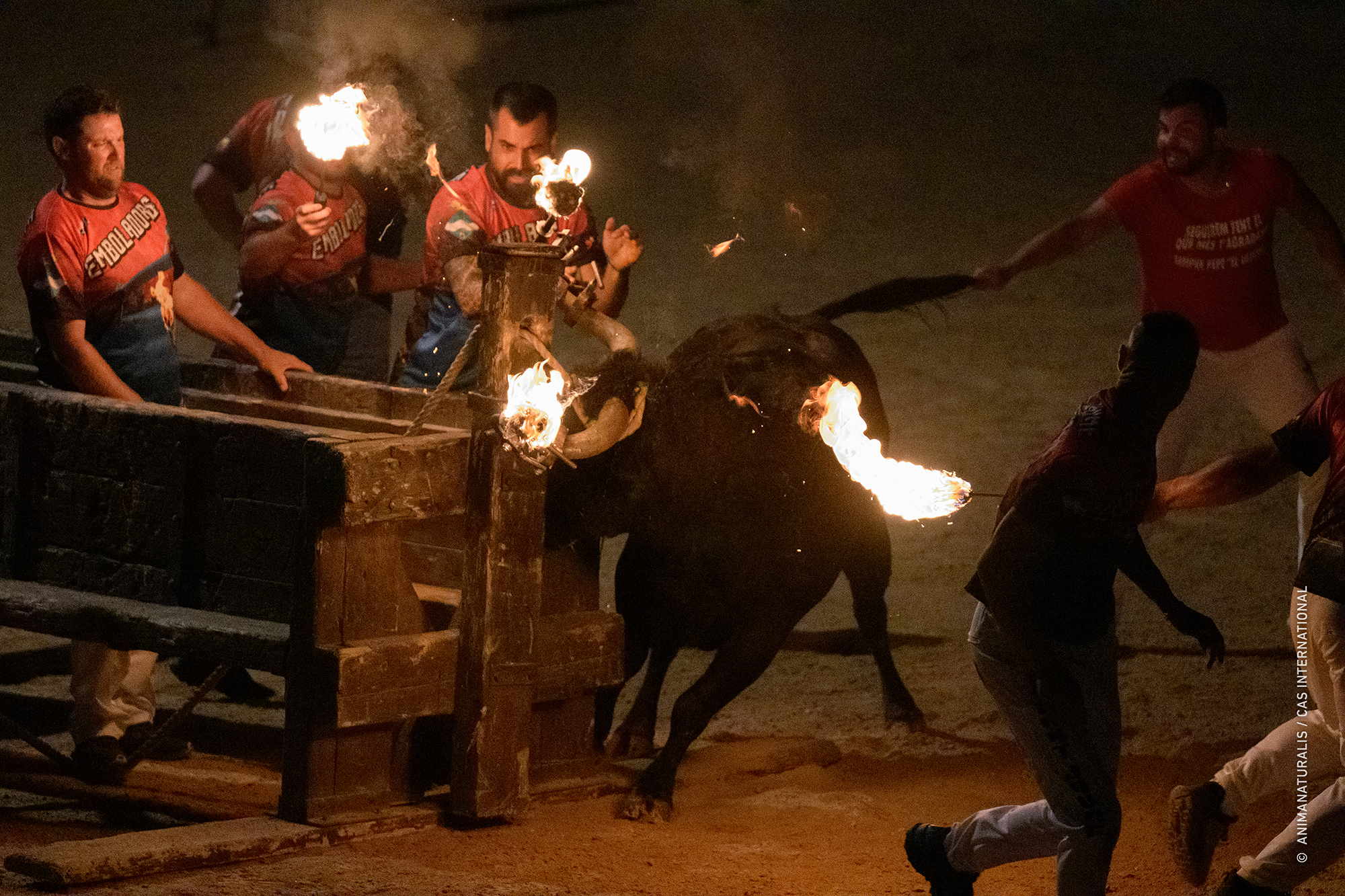
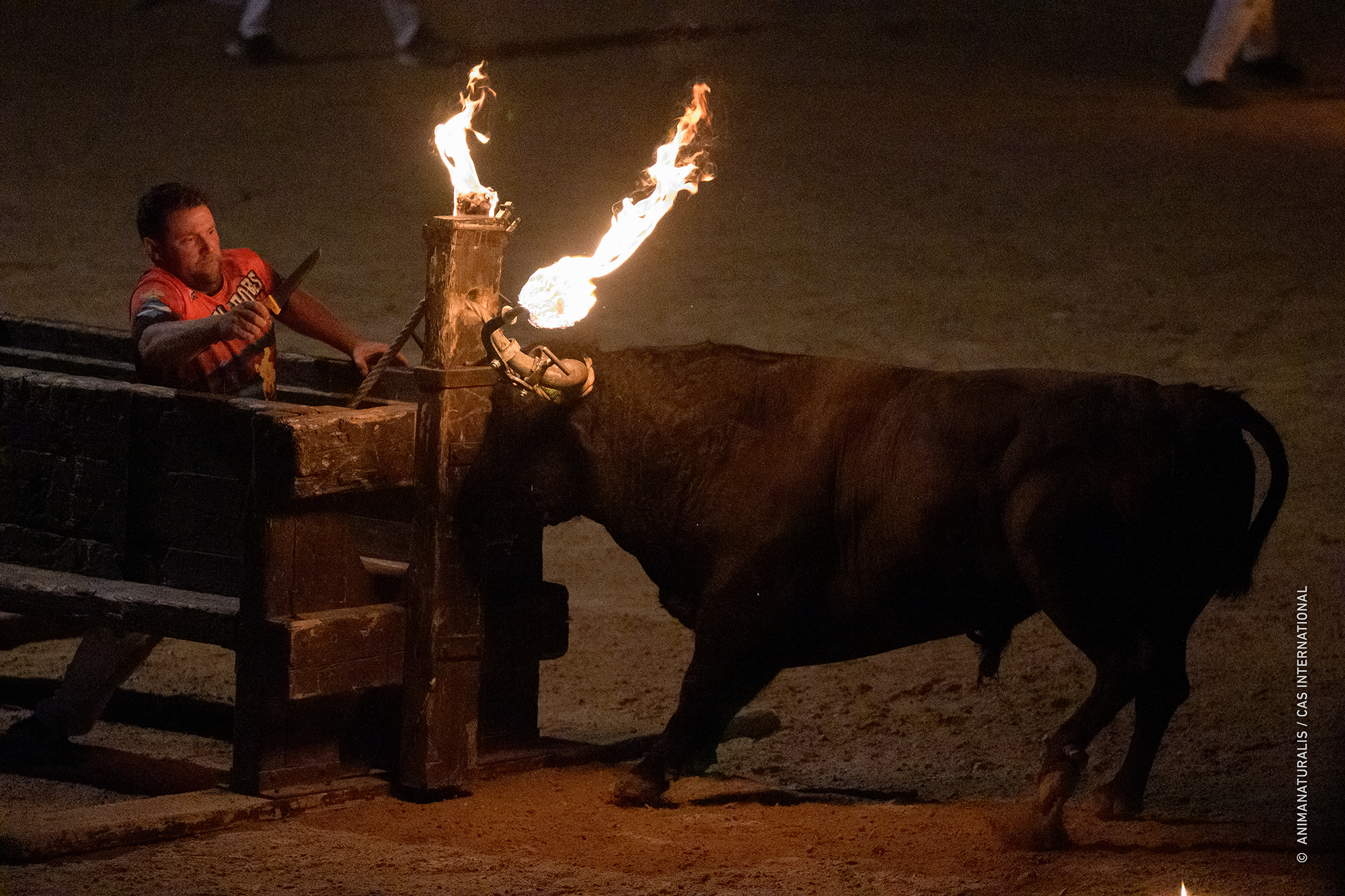
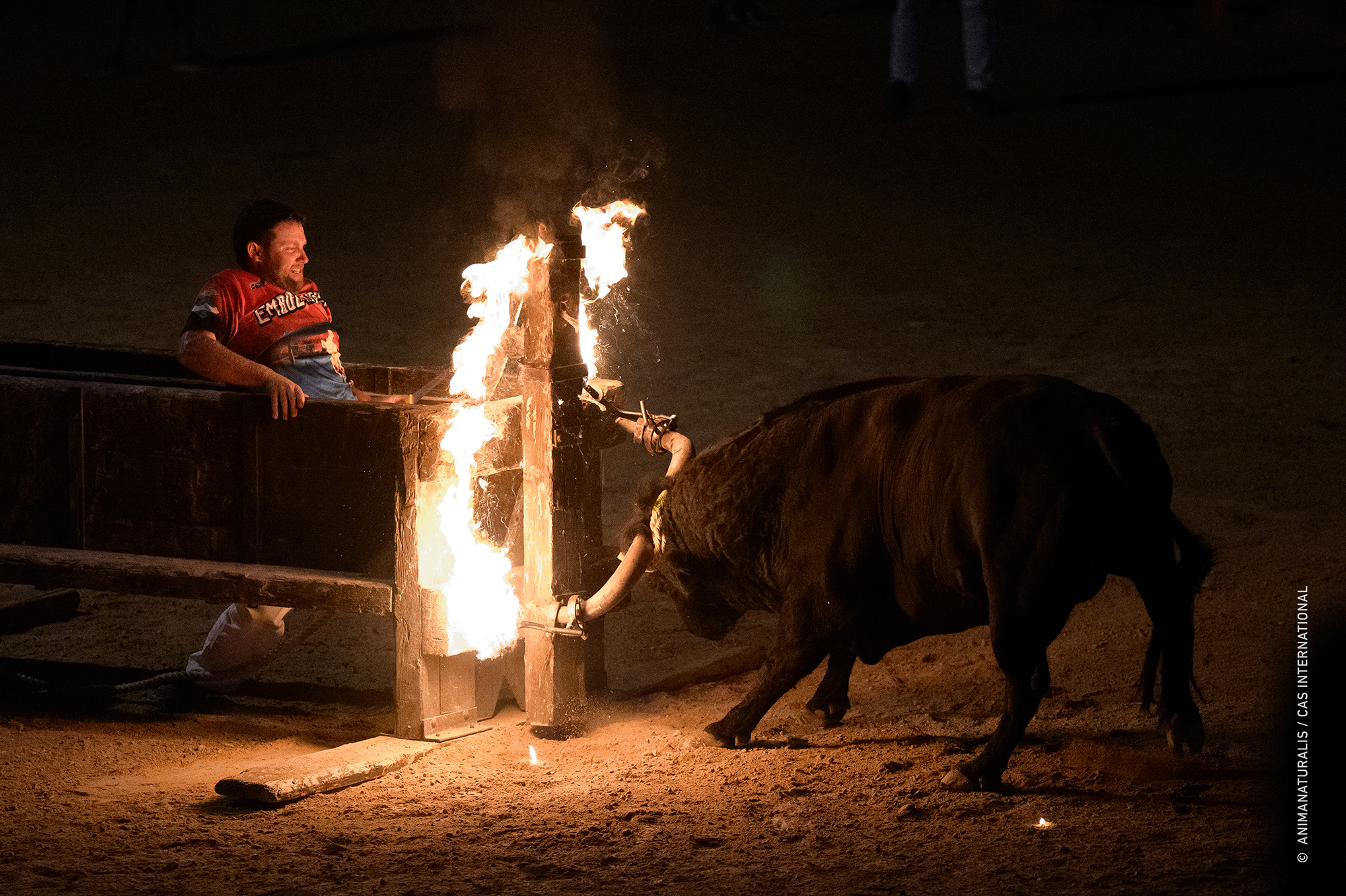
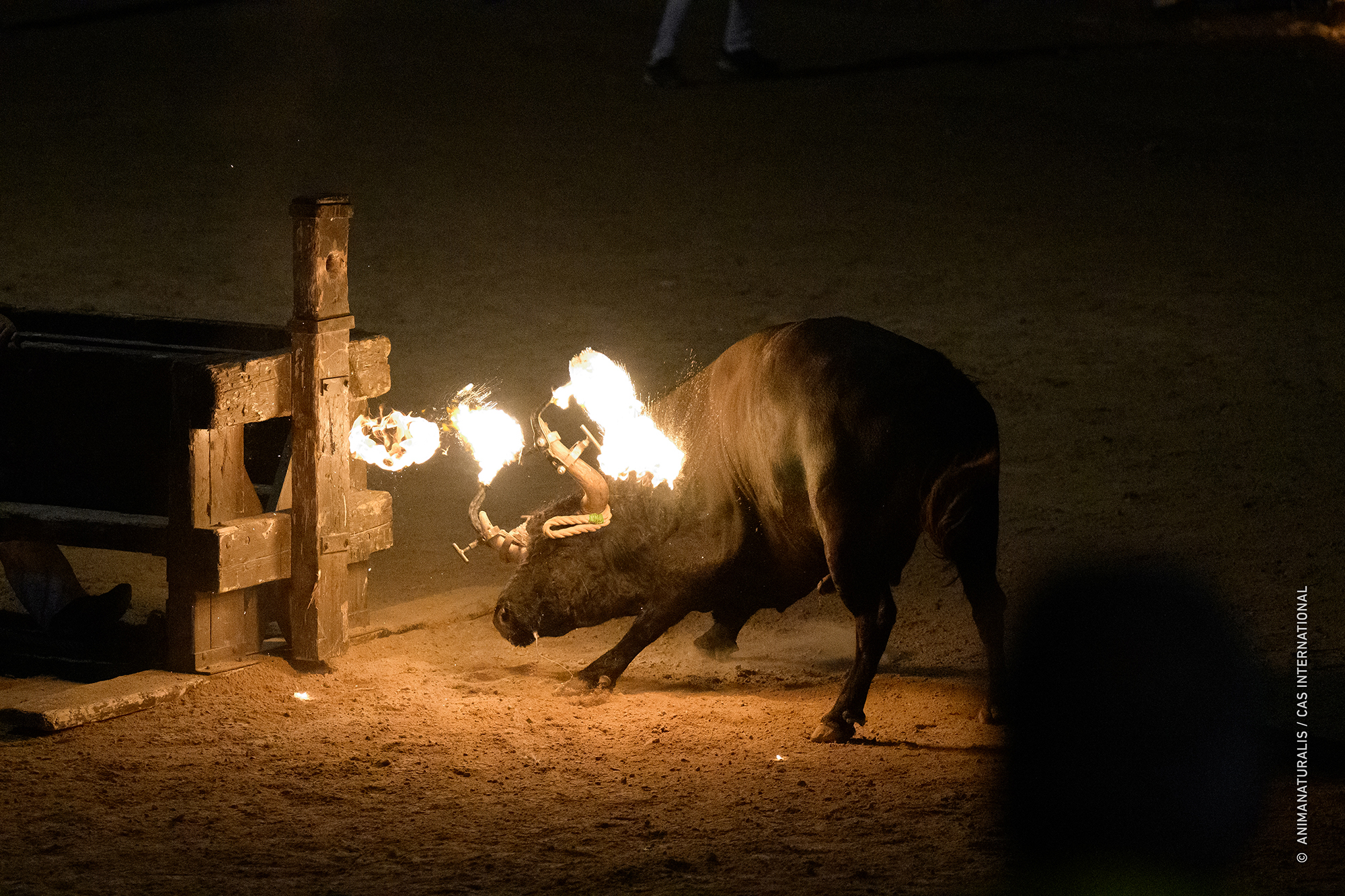
Physically, the bull embolado endures extreme exertion. Ethological and veterinary studies conclude that in any form of bullfighting the animal suffers “stress, exhaustion, injuries and/or may even die”, clear signs of suffering. Jordi Casamitjana, a zoologist and animal behavior expert, sums it up: “Bullfighting causes suffering, because by definition it stresses, exhausts and wounds the bulls.” This remains true even when lances or banderillas are not used: the very act of dragging, trapping and chasing a bull triggers an adrenaline response. Veterinarians measure these effects: the bull embolado experiences a sudden spike in stress hormones (adrenaline and cortisol), tachycardia and rapid breathing. In many cases, stress is so intense that bulls can suffer a heart attack during the embolada. Indeed, there have been recorded instances of bulls that “drop dead” in the ring from cardiac arrhythmia or respiratory arrest caused by panic. In short: the animal endures the pain of burning embers rubbing against its head, minor burns on its skull, physical fatigue from running in circles, compounded by the psychosis of confinement. Bulls have almost no coping mechanisms: they lack the “hope” humans use to endure adversity. As Gascón says, the bull “cannot imagine that the worst will end,” and lives the fire “as if existence itself were pain.”
The behavior of the bull embolado reflects it all: wide eyes, protruding tongue, low tail, utterly vulnerable to its human tormentors. Ethologists consulted note that the bull charges again and again simply hoping to escape, but each attempt usually ends in collision or further entanglement. This vicious cycle of charge-evade leads to muscle fatigue and internal injuries (bruising, sprains, even convulsions). Eventually, exhaustion prevails: the bull stops moving, resigned, until it is removed.
All of this confirms scientific warnings: “the bull suffers a general state of stress,” “suffering and pain” that do not vanish once it is released in the ring. Jordi Casamitjana reiterates that no style of bull spectacle is free from suffering: even though the bull is not killed in public at these popular events in Spain, “in every style the bull ends up stressed and exhausted.”
Consequently, veterinarians advocating abolition argue that there is no “safe” practice involving fire on a bull’s head, and that only total prohibition can guarantee its protection. Meanwhile, laws tend to settle for palliative measures: for example, requiring the flames to be extinguished after 15 minutes.
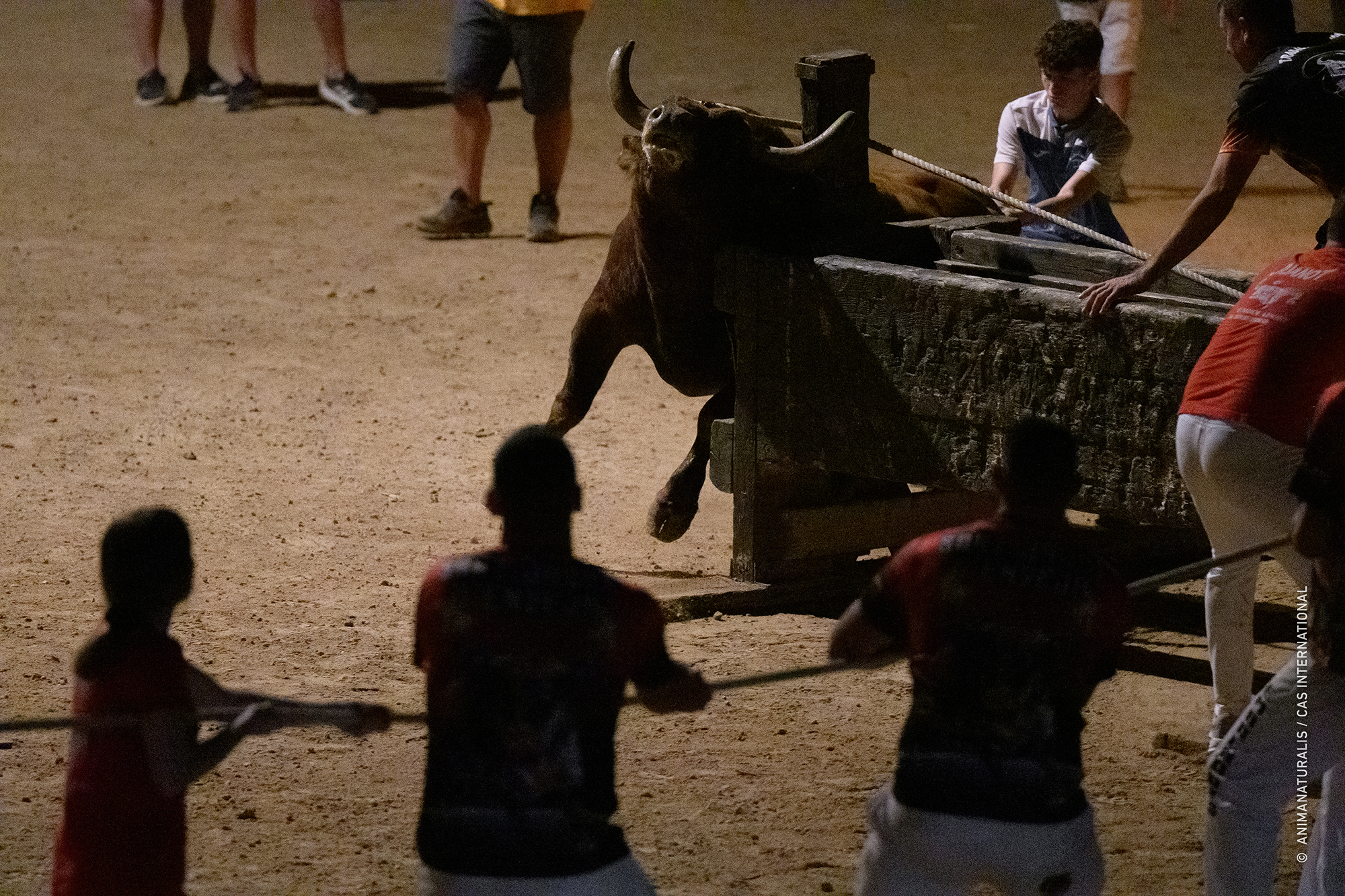
Public protest against the bull embolado has been growing for years. Organizations like AnimaNaturalis document dozens of abuse cases each summer. It is estimated that at least 2,500 bulls and cows are embolated each year in Spain, though no official data exists.
Local media report that the number of events remains high: in 2022 alone, there were 469 taurine spectacles in Catalonia (all types of popular bull events), 7% more than in 2019. Not all included embolados, but most of those in the Ebro region did. In Aragón, the regional government recorded over 2,500 popular bull festivals in 2022; while many are young-cow runs or encierros, events with bulls (including embolados) continue to feature prominently on the rural calendar.
Despite public opposition, the bull business remains politically backed as “tradition.” In Aragón, recent legal changes have swung in the opposite direction—loosening requirements to make bull embolados more accessible (releasing bulls directly from the chute to the post, or setting up portable rings without permanent infrastructure).
To witness this violence firsthand, the AnimaNaturalis team has filmed dozens of bull embolado events in southern Catalonia and beyond. Gascón describes the scenes with a heavy heart: she admits that after years of documenting torture, she sometimes thinks, “nothing extraordinary happened”—as if to anesthetize herself against such cruelty. But reviewing the footage, she wonders how anyone can tolerate “as if that were normal” scenes of a bull “running in terror and flames.” Gascón emphasizes that in nearly 25 years of documenting abuse, she has never seen anything more brutal.
According to her, the bull embolado meets all the criteria for torture: fear, pain and helplessness. Reports note that while the animal is confined without air in the chute, without food, alone in darkness, its agony already begins. Then, when it emerges shackled to the post, “once immobilized, terrified and assaulted, it bellows bitterly in pain and despair.”
Gascón highlights that all this unfolds before a crowd cheering and congratulating themselves on the “courage” of setting the bull ablaze. Phrases like “every life is extraordinary,” which she repeats to herself, underline the stark contrast between the “normality” some see in these festivities and the brutal reality for the animal.
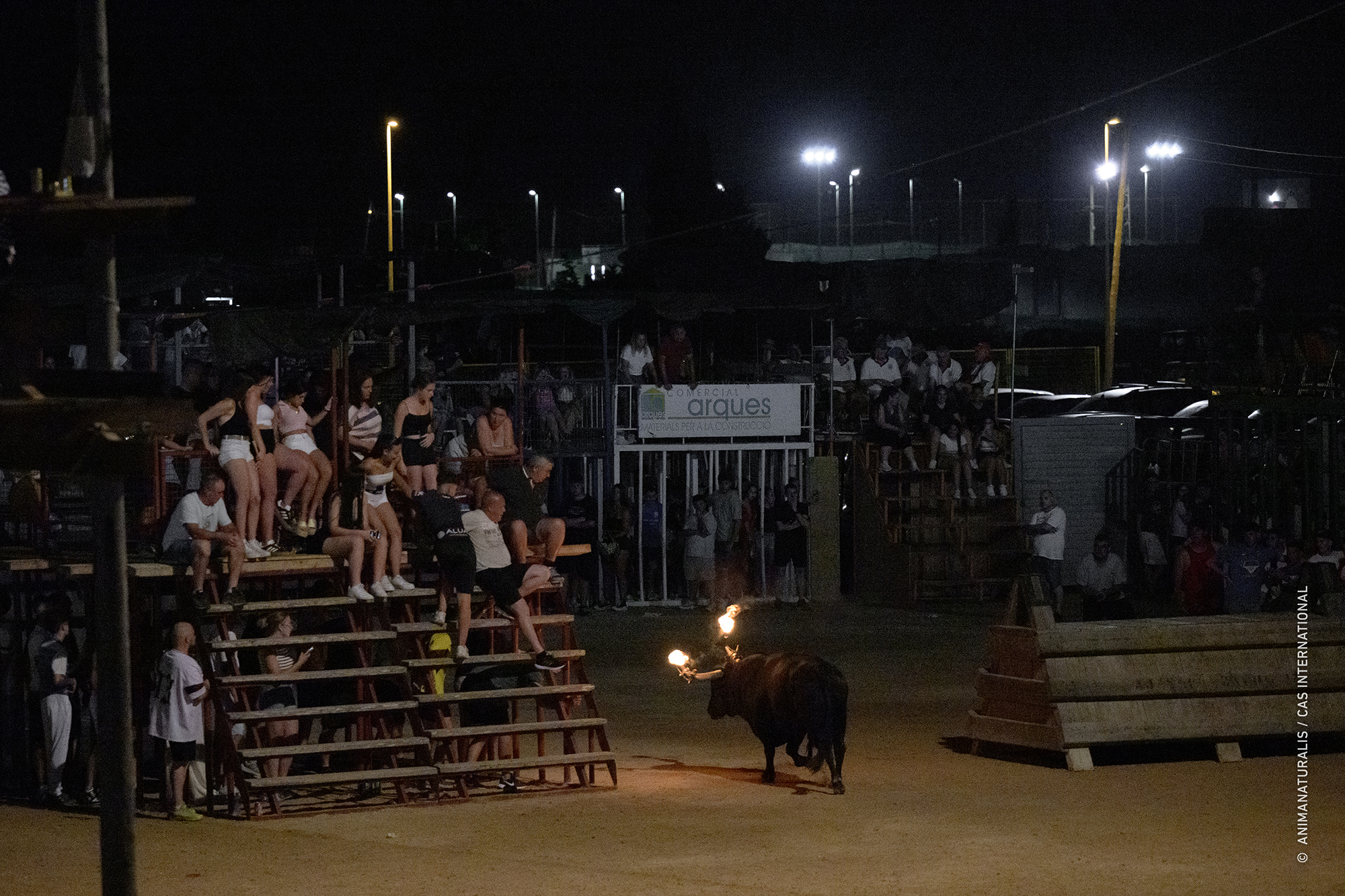
Meanwhile, animal scientists and ethologists confirm that the bull derives no pleasure whatsoever from the experience. An international ethological study concludes that in all styles of taurine spectacle the bull ends up stressed and exhausted. Physiological studies show sudden spikes in cortisol and catecholamines in fighting bulls; it is inferred that embolados provoke an equal or greater stress response. “All mammals seek to avoid stress, exhaustion, injury or death,” stresses Casamitjana, so forcing a bull to run with fire on its horns means subjecting it to traumatic stimuli. There is no indication that the bull “enjoys” the fire; on the contrary, it literally flees from it, as specialists’ observations show.
In short, scientific and activist voices agree: the bull embolado is cruelty. Neither the Catalan, Valencian nor Aragonese regulations succeed in making the act “dignified” or “safe” for the bull. Public opposition continues to grow. That is why the current focus is on legislative reform. In Catalonia, efforts are underway for a Catalan law to explicitly eliminate the bull embolado.
In Aragón, the new regulation without tradition requirements is already in force, but details on its implementation remain to be defined.
For now, the bull can only hope that “tradition” will one day give way to science and animal respect, as more and more lawmakers and citizens demand—thanks to the work of organizations like AnimaNaturalis. If you want to help end such events, you can sign and share the campaign at BloodFiestas.org and contribute to a better future for animals.