This past Monday, August 11th, was the deadline to submit objections to the draft of the new Regulations for traditional bull festivals in the Valencian Community (which implements the Regional Law 14/2010). Among the documents submitted, the one from AnimaNaturalis stands out, warning that this regulation represents a serious move towards crueler practices and a setback for animal protection.
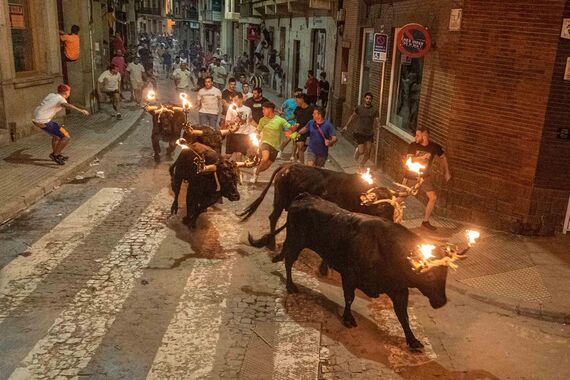
Specifically, the organization denounces that for the first time, regional legislation will introduce the possibility of authorizing bull runs with 'toros embolados' (bulls with flaming torches attached to their horns), a particularly controversial practice. AnimaNaturalis considers that this addition legitimizes and regulates a practice that significantly increases the stress, confusion, and risk of injury to the animals, and is a far cry from any effort to move towards less cruel forms of entertainment.
Popular bull festivals – known locally as bous al carrer (street bulls) – are omnipresent in Valencian culture. In 2024, 9,135 such events were registered in the Valencian Community. According to official statistics, 1,737 of these popular festivals corresponded to the toro embolado modality (bulls with flaming torches on their horns) and 915 were traditional bull runs. Other popular modalities include vaquillas (young cows), bou de corro (bull on a rope), recortes (dodging bulls), bous a la mar (bulls into the sea), toros ensogados (roped bulls), etc. All these variants – along with bullfights and novice bullfights – are covered by the national Regulation of Bullfighting Spectacles and require the corresponding regional permits. The Valencian Government, through its successive regulations (Decree 31/2015 and now the new 2025 draft), has been establishing the rules for organizing these events regarding safety, health, age, rest periods, etc.
The current regulation dates from 2015 (Decree 31/2015) and has been the regulatory framework for this decade. In April 2025, the Valencian government presented a draft of a new regulation to update it. This document, accessible on the citizen participation website, includes numerous technical changes. However, the most notable – and the focus of AnimaNaturalis's objections – is the explicit introduction of "bull runs with 'embolada' animals". Until now, although independent festivals with toros embolados and bull runs without fire exist, they were never regulated together.
The new article 16 of the project states that "bull runs with 'toros embolados' may be carried out provided adequate measures are adopted to avoid blows, burns, and other injuries to the animals during the 'embolada' phase." That is, the regulation approves that these fire runs can be authorized, conditional only on certain guarantees (veterinarian present, safety distances, etc.). For AnimaNaturalis, this provision represents "a serious setback in animal protection," because it "legitimizes and regulates a practice that significantly increases the stress, confusion, and risk of injury to the animals," in the words of their lawyer, Cristina Ibáñez.
The Added Danger of 'Toros Embolados' with Fire
Why is the combination of a bull run and fire so criticized? Urban bull runs are already very dangerous for the animals: they are transported in trucks, released into enclosed spaces with fencing, where they cannot escape. To this is added the additional trauma of the toros embolados: the tips of their horns are smeared with flammable liquid and fireballs are lit. Veterinary studies indicate that fighting bulls suffer immensely under these conditions. These animals, which are gregarious and highly sensitive to unknown stimuli, show signs of panic and exhaustion when they see the fire on their horns. According to veterinary opinion, once the balls or torches are lit […] the presence of fire produces true terror in the animal (as it is instinctively identified as a danger signal), greatly increasing its stress and anguish. Among the physical risks are burns on the head, eyes, and back of the bull if sparks jump from the fire on its horns. Even deaths of bulls due to fire or panic have been documented: for example, by throwing themselves against an urban fence and impacting it. In summary, combining a bull run with fire bulls creates a scenario of extreme stress and suffering for the animal.
"Some of the practices that this regulation seeks to normalize go against the minimal advances in animal welfare achieved in recent years", states Ibáñez. She insists that "it is unacceptable to normalize such a harmful combination without sufficient cultural, legal, or ethical justification". With these words, Ibáñez summarizes the position of AnimaNaturalis: it is not enough to demand supposedly palliative measures (veterinarian present, mobility restrictions) if the practice itself consists of exposing a brave animal to fire and street chaos.
Time Limits and Heat Risks
Another major criticism from AnimaNaturalis focuses on the lack of clear time limits in the draft. The NGO calls for the inclusion of specific clauses to avoid bull runs at midnight or under extreme heat, as other autonomous communities have done to protect both animals and people. The argument is compelling: in the midst of the Mediterranean summer, holding bull festivals during a heat wave poses a mortal danger.
As a recent example, press reports highlight that on August 12, 2024, during the patron saint festivals in El Puig de Santa María (Valencia), two bulls died from a suspected heat stroke after being handled during hours of maximum sun exposure. In that case, one animal died before being released into the run, and the other shortly after it concluded. According to ABC, both deaths were attributed to heat stroke while the bulls were waiting their turn in the holding pen ("chiquero"). This sad incident illustrates why AnimaNaturalis is asking for clear deadlines: they propose that the regulation itself should mandate the suspension of any festival if the State Meteorological Agency (AEMET) issues a red heat alert or if the temperature exceeds 40 °C (104°F) for more than two consecutive hours. This would avoid ambiguous interpretations or delays in decision-making, and would place the decision on whether there is a real risk to the animals in the hands of meteorological services and the administration (not the organizers).
Both animal defense organizations and pro-bullfighting sectors will be watching this debate closely. The Regional Minister of the Interior and Emergencies, Juan Carlos Valderrama, has already stated that his department will promote a "forward-looking" regulation for the *bous al carrer* with special emphasis on safety. However, the final vote and approval of the decree will correspond to the Regional Government ("Consell") and will require a majority. For now, animal welfare organizations like AnimaNaturalis have formally registered their rejection in writing. The next step will be the evaluation of these objections and possible modification of the text by the Valencian Government before its publication in the Official Gazette.