
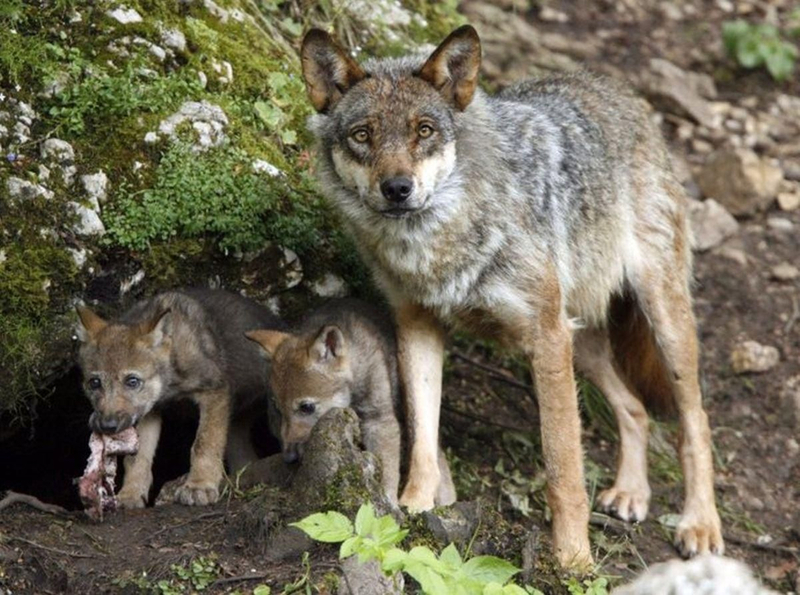
For the first time in a hundred years, the howl of wolf pups echoes through Catalan forests. The discovery of a wolf family—an adult pair and three young—in an area between Alt Empordà and La Garrotxa officially and historically confirms that the species has reproduced in Catalonia. This event, described as "historic" by the Department of Territory, is a turning point that forces the regional administration to move from merely detecting solitary specimens to actively managing a species that now goes from being considered "extinct as a breeder" to "endangered." This new status carries the legal obligation to draft and approve a specific recovery plan.
The path to this moment began in early 2024, when Rural Agents confirmed the presence of a wolf in the town of Cistella. In May, genetic analysis revealed even more hopeful news: it was a female. Soon after, a male was identified photographically in the same area. Meticulous tracking work observed that, although for months the two animals were located separately and at a great distance, in December they were captured by camera traps moving together. Given signs of a possible reproductive period, the agents opted for prudent stealth so as not to interfere in such a delicate process. Patience paid off this autumn, when the pups, already several months old, began following the adults, allowing confirmation of the existence of three new individuals.
For AnimaNaturalis, this natural return is a triumph of nature's resilience, but also a call to responsibility. "This is an event of capital importance. It is not a forced reintroduction, but the natural recolonization of a key predator that was unjustly exterminated from our ecosystems. Its return shows that, if given the opportunity, nature regains its balance," says Aïda Gascón, director of AnimaNaturalis in Spain. "Now, the ball is in the court of the Government of Catalonia. It has the legal and moral obligation to protect this family and guarantee its survival, away from interested pressures that seek its elimination," adds Gascón.
The Iberian wolf was considered extinct in Catalonia in 1929, after the violent death of the last documented native specimen in Horta de Sant Joan, in Terra Alta. Its slow return began in 2004, when the Government confirmed the reappearance of the species through specimens that were naturally expanding their territory from packs in northern Italy and southern France. In 2024, the wolf population in Catalan territory is estimated to be at least 10 to 11 individuals, distributed mainly in northern regions such as Alta Ribagorça, Pallars Sobirà, or Ripollès. However, until now, all of them were considered "lone wolves," without territorial stability or reproduction. The formation of this first pack radically changes the scenario.
This milestone is also a clear indicator of the transformation of the landscape and the health of Catalan ecosystems. When the wolf disappeared, populations of wild ungulates like deer, roe deer, or fallow deer were negligible. Today, these species have multiplied, providing an abundant and natural food base for large predators. According to reports from the Rural Agents, this new wolf family has so far fed on wild prey, with no recorded attacks on domestic livestock in the area, a fact that debunks many of the prejudices that haunt the species.
Nevertheless, the shadow of conflict with extensive livestock farming looms large. The administration is aware that coexistence requires proactive measures. The Government has already been promoting a damage prevention program that includes the provision of electric fences, the promotion of guard dogs, and economic support for farmers who carry out self-protection work. With the confirmation of breeding, these measures will be intensified. "It is essential that the authorities not only focus on protecting the wolf but also monitor livestock farms that often take advantage of the presence of these animals to demand aid for alleged losses. And such news only encourages those who enjoy killing animals under hunting or commercial pretexts," insists Aïda Gascón.
The immediate challenge for the authorities is twofold: to protect the security of the incipient pack from the curious and poachers, intensifying monitoring with maximum stealth, and to accelerate the processing of the recovery plan required by European regulations. The wolf has returned to Catalonia to stay. Its future, and that of the health of our ecosystems, will depend on our ability to accept that natural spaces are not a museum, but a living network from which, for too long, we had removed a fundamental piece.