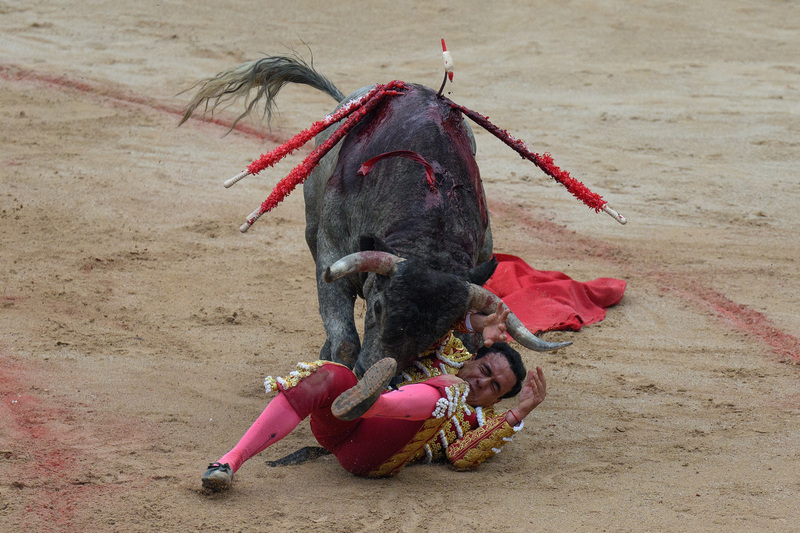
Last Tuesday, the Congressional Culture Committee rejected the non-legislative proposal from the PP that sought to promote the candidacy of bullfighting as Intangible Cultural Heritage of Humanity before UNESCO. The initiative was defeated with 18 votes against versus 17 in favor, in a vote that again highlights the profound contradictions of the PSOE on animal rights and the inconsistency of its position regarding a practice that tortures and kills thousands of bulls every year in Spain.
The vote against by Socialists, Sumar, ERC, and Bildu prevented an initiative from moving forward that, had it been approved, would have meant international backing for an activity questioned by more than 70% of the Spanish population, according to recent data. However, this decision contrasts dramatically with the stance the PSOE adopted just a month earlier, when its abstention was decisive in sinking the anti-bullfighting Popular Legislative Initiative (ILP) that sought to repeal the 2013 law that protected bullfighting as cultural heritage.
"The PSOE is playing a double game and that is profoundly disappointing for those of us who have been fighting for animal rights for years," expressed Aïda Gascón, director of AnimaNaturalis in Spain. "On one hand, they reject bullfighting being recognized internationally, but on the other they refuse to remove the legal protection that safeguards it in our country. This incoherence is no accident: it's pure and simple electoral strategy, and animals continue to pay the price for that political cowardice," added Gascón.
The Two-Faced PSOE
The argument that Socialist deputy Isabel María Pérez used to justify rejecting the UNESCO candidacy is as technical as it is convenient. According to Pérez, "this procedure does not depend on a discretionary political decision by the Government, but on a technical process," and added that initiatives going to UNESCO must have a "broad social consensus" which, in her opinion, bullfighting does not possess "either in Spain or in the international community as a whole."
However, this sudden concern for social consensus contrasts brutally with the decision the same party made on October 7th, when it abstained in the vote on the anti-bullfighting ILP which had more than 180,000 citizen signatures and the support of dozens of animal protection organizations. That abstention, calculated to the millimeter given the proximity of the Andalusian and Castilian-Leonese elections, allowed the PP and Vox to sink an initiative that would have returned the power to regulate bullfighting events to autonomous communities and town councils.
The PP spokesperson for Culture, Sol Cruz-Guzmán, did not miss the opportunity to point out this contradiction during the debate, asking the PSOE to "be coherent." She recalled that it was the former Socialist minister who formalized the registration of bullfighting in the general inventory of cultural heritage, and defended that this activity "is intimately linked to our language, our culture, our fashion, and the rest of the arts."
From Vox, José Ramírez del Río accused left-wing parties of acting like a "woke inquisition" and assured that bullfighting was never linked to any ideology. A statement that deliberately ignores that the torture of animals for entertainment is, precisely, an ethical issue that transcends any cultural or artistic consideration.
The Animal Rights Movement Does Not Forgive the Betrayal
The response from Sumar and the animal rights movement was forceful. The Sumar deputy Nahuel González attacked the PSOE during the debate: "We will continue to stand with the animal rights movement, with the common sense of animal rights. Let the Socialist Party reflect, because what they have done is very serious, and we will not forgive it. The shame is enormous. Until the last day of the election campaign in the smallest town, we will remember the Socialist Party's betrayal of animal rights."
González also dismantled the cultural argument for bullfighting by pointing out that it "is sustained based on subsidies" and recalling that "more than 70% of our country's population is against torturing an animal to death." This figure, which contrasts with the timid 8% of Spaniards who attended bullfighting events during the last year according to the Survey of Cultural Habits and Practices by the Ministry of Culture, reveals an unquestionable reality: bullfighting is a minority activity, in decline, and rejected by the vast social majority.
The PSOE's decision to abstain in the ILP had immediate consequences within the party itself. David Calvo, former deputy in Les Corts Valencianes and a high-ranking official during the last legislature, requested to leave as a Socialist militant on October 13th in protest of that abstention, highlighting the internal fracture this issue generates within Socialist ranks.
"What we have seen these weeks is confirmation that for the PSOE, votes weigh more than values," stated Aïda Gascón. "They recognize that bullfighting lacks sufficient social consensus to be a world heritage, but they keep intact a law that protects it as Spanish cultural heritage. It is a completely opportunistic stance that prioritizes electoral calculation over ethical coherence and the suffering of thousands of animals," concluded the director of AnimaNaturalis.
A Bittersweet Victory
The rejection of the UNESCO candidacy undoubtedly represents an important symbolic victory for the animal rights movement. Preventing bullfighting from obtaining an international recognition that would have further legitimized the systematic torture of animals is an achievement that must be celebrated. The PP's proposal, besides seeking that international backing, aimed to serve as a shield against future initiatives seeking to eliminate the legal protection of bullfighting, arguing that its rejection was used as "bargaining chips" to "build nationalist identities."
However, this victory is tarnished by the legislative reality: the 2013 law remains in force, bullfighting continues to be protected as cultural heritage, and bullfights continue to receive public subsidies while thousands of animals die each year in bullrings across Spain. The Minister of Culture, Ernest Urtasun, has taken some steps in the right direction by suppressing the National Bullfighting Award and excluding the sector from the Gold Medals of Fine Arts, but he has made it clear that, after the failure of the ILP, he will seek "other formulas" to hinder the Fiesta.
The paradox is evident: while defenders of bullfighting insist that it has a "broad social consensus" and represents values such as "intelligence, courage, or aesthetics," the data demonstrates the exact opposite. Attendance at bullfights is marginal, social rejection is majority, and the activity is only sustained thanks to public subsidies and the legal protection that the PSOE refuses to remove due to pure electoral calculation.
The Socialist spokesperson in Congress, Patxi López, and President Pedro Sánchez himself have described bullfighting as an "unresolved debate" within the party. A description that, in reality, is a euphemism to justify paralysis and ambiguity. Meanwhile, the organizations that supported the ILP It's Not My Culture and thousands of citizens committed to animal rights continue to demand political coherence and courage to end a practice that has no place in a society that aspires to be modern, ethical, and respectful of sentient beings.
The Road Continues
Despite the disappointment of the PSOE's inaction, the animal rights movement maintains its unwavering commitment. The battle for animal rights is not fought solely in Congress, but also in the streets, in education, in social awareness, and in every small victory that brings Spain closer to a more just and compassionate legislation.
The rejection of the UNESCO candidacy is a step, but the ultimate goal remains the repeal of the 2013 law and the end of public subsidies to bullfighting. Because, as Deputy González reminds us, no tradition, however ancient, justifies the torture and death of sentient beings. And because 70% of the Spanish citizenry already understands this: bulls are not culture, they are victims.