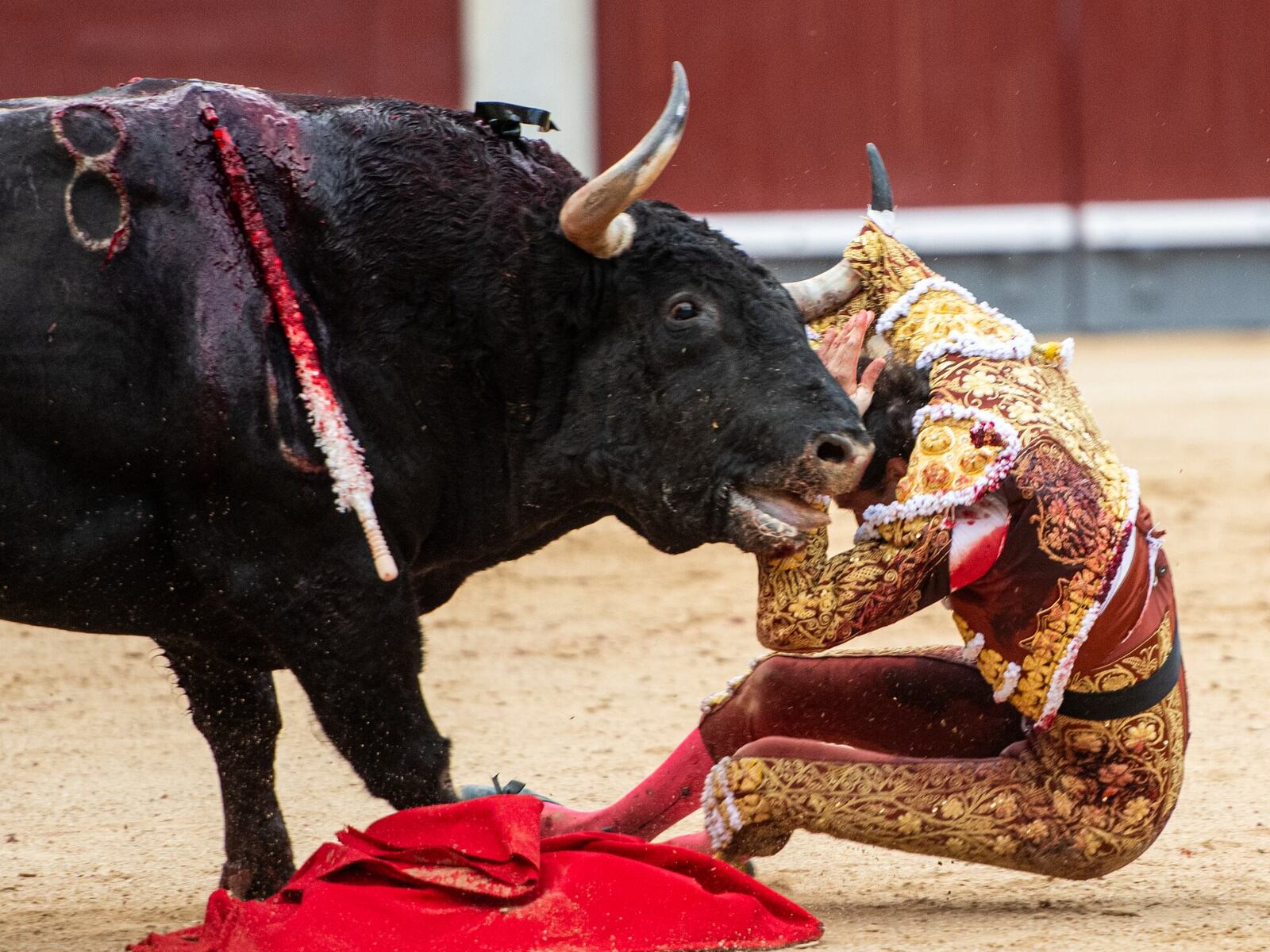
On February 5, 1946, the Monumental Plaza of Mexico City —officially known as Plaza México— opened its doors with a bullfight attended by more than 50,000 spectators. Luis Castro "El Soldado", Manuel Rodríguez "Manolete", and Luis Procuna fought six animals from the San Mateo ranch in what was celebrated as the inauguration of the largest bullring in the world. Eighty years later, on February 5, 2026, this anniversary arrives with a radically different meaning.
On March 18, 2025, the Mexico City Congress approved, with 61 votes in favor and one against, a reform banning violent bullfighting in the capital. The legislation, driven by a citizen initiative with more than 27,400 signatures and backed by Head of Government Clara Brugada, eliminated the possibility of injuring or killing animals during these events. The decree was published on March 25, 2025, in the Official Gazette of Mexico City, marking the end of an era of institutionalized cruelty.
"This 80th anniversary is bitter for bullfighting supporters because it represents the end of a model that for decades normalized the torture of sentient beings. But for those of us who defend animal rights, it is a moment to celebrate, because it marks the beginning of a new stage where the lives of these individuals have value beyond human entertainment", says Arturo Berlanga, lawyer and director of AnimaNaturalis in Mexico.
The new law establishes that bullfights, novilladas, and rejoneo must be carried out "without violence", meaning without causing injury or death to the animals. The use of lances, banderillas, swords, descabellos, and daggers is prohibited. Only the cape and muleta are permitted; the animal’s horns must be protected to prevent injuries, and performance time is limited to 15 minutes per individual, with a maximum of six per event. At the end, the animal must be returned to the ranch.
The plaza, built in just nine months between 1945 and 1946, designed by engineer Modesto C. Rolland under the project of entrepreneur Neguib Simón Jalife, has a capacity of 41,262 seats, and its ring lies 20 meters below street level. For 80 years, this monumental structure —blessed in February 1946 by the Archbishop of Mexico Luis María Martínez— has borne witness to the killing of tens of thousands of animals in the name of tradition and entertainment.
Now, the most important bullfighting venue in the world faces a void: it cannot celebrate its anniversary with the bloody bullfights that bullfighting entrepreneurs had planned. The bullfighting sector has stated that bullfights without killing "distort" the tradition and that they will not accept this "pantomime", according to statements by Raúl Pérez Johnston, president of the Legal Committee of Mexican Bullfighting.
Eight decades of institutionalized suffering
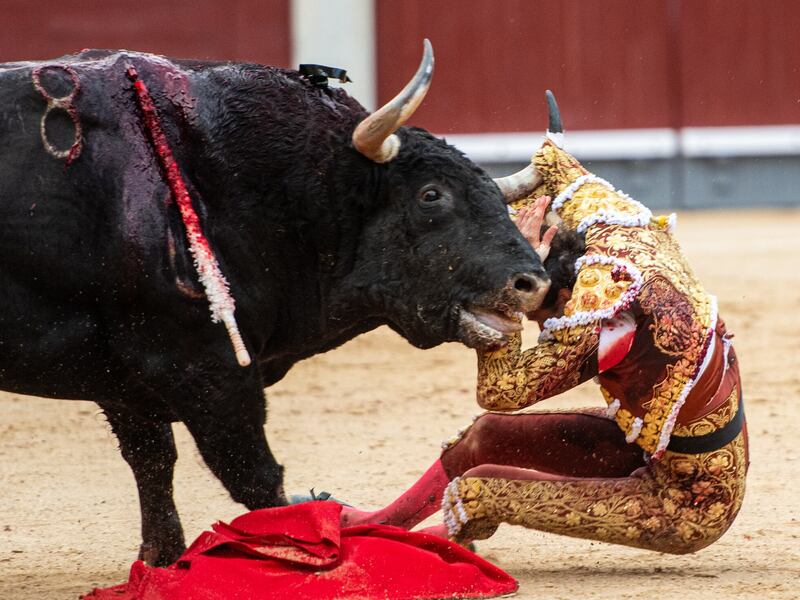
For 80 years, Plaza México has been the stage for a form of ritualized and socially accepted violence. Data from the study Animal Welfare in Bullfighting, conducted in 2017 by the Environmental and Territorial Planning Prosecutor’s Office of Mexico City (PAOT), documented that during a bullfight, animals suffer extreme physiological changes resulting from stab wounds and perforations that damage internal organs.
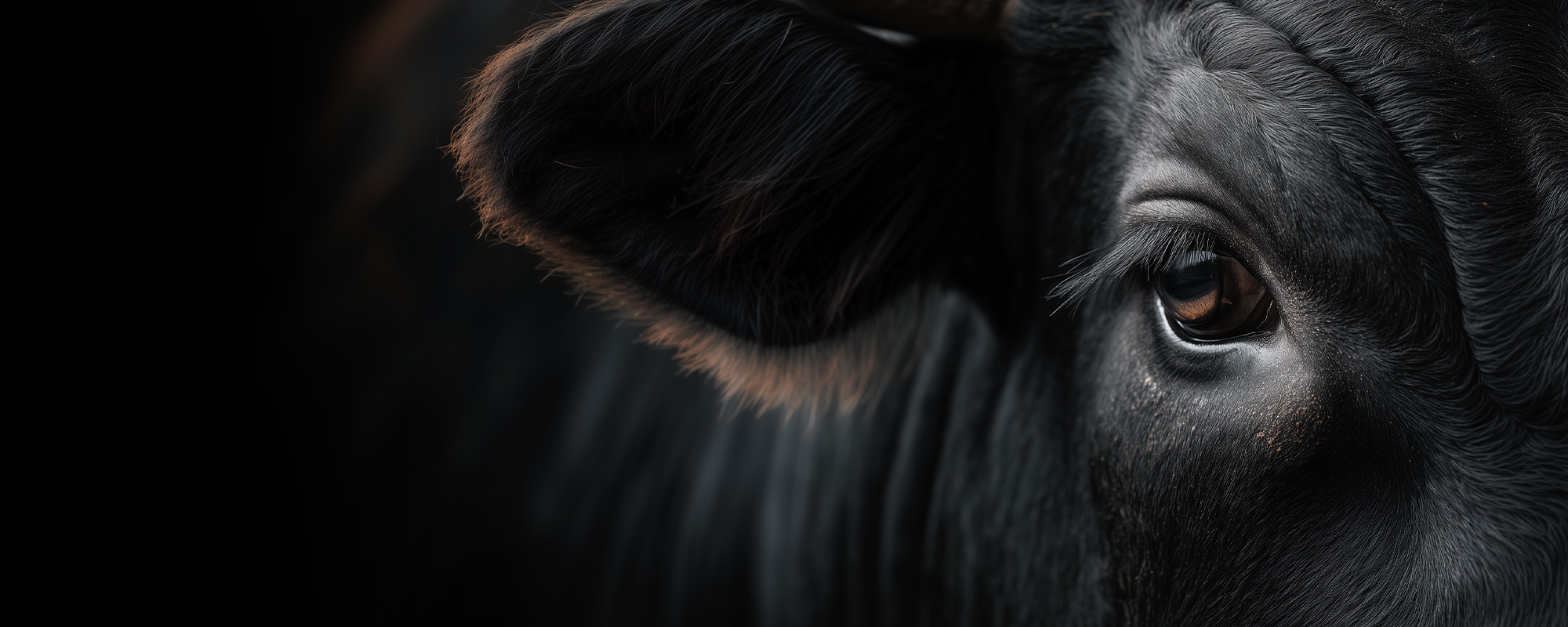
The investigation concluded that these individuals are subjected to harmful stimuli of pain and suffering in a systematic way, and that their death occurs by suffocation or blood loss, slowly and without loss of consciousness. In other words, each animal dies fully aware of its own suffering.
Beyond the physical pain during the approximately 20 minutes that a bullfight traditionally lasted, animals destined for these spectacles experience stress from the moment of transport. Confinement in narrow, dark trucks, exposure to a hostile environment with thousands of people shouting, and the constant fear of being injured generate a permanent state of distress that violates all basic principles of animal welfare.
"Bullfighting has always been illegal under the federal legal framework, as it violates the Official Mexican Standard on humane slaughter methods. What has allowed it to continue for decades is impunity and corruption, not legality", Berlanga maintains.
The director of AnimaNaturalis points out that the Mexican constitutional reform that elevated animal protection to constitutional status in 2024 made it clear that animals are sentient beings deserving of dignified treatment. However, he warns that the text includes ambiguous criteria that could be used by exploiters to justify practices such as bullfighting by considering the "nature, characteristics, and relationship with people" as a basis for protection.
The decision by the Mexico City Congress did not emerge out of nowhere. On June 10, 2022, Judge Jonathan Bass of the First District Court in Administrative Matters granted a definitive suspension of bullfighting following a process initiated by the civil association Justicia Justa. The organization argued that these practices constitute animal abuse and violate the Law for the Celebration of Public Spectacles in Mexico City.
However, in December 2023, the Second Chamber of the Supreme Court of Justice of the Nation overturned the suspension, allowing bullfighting to return in January 2024. This decision generated outrage among animal protection organizations and triggered an unprecedented citizen response.
On September 1, 2024, the Mexico Without Bullfighting movement, made up of 82 organizations, submitted a citizen initiative with 27,442 signatures validated by the Electoral Institute of Mexico City (IECM), far exceeding the required 0.25% of the electoral roll. This public pressure forced authorities to act.
A paradigm shift in Mexico and around the world
The ban in Mexico City is not an isolated case, but part of a national and international movement that is redefining the relationship between humans and non-human animals. In Mexico, six states had already fully banned bullfighting prior to the capital’s reform.
Sonora was a pioneer in 2013, becoming the first Mexican state to ban these spectacles through a reform of its Animal Protection Law. It was followed by Guerrero in July 2014 with its Animal Welfare Law, which also banned the use of animals in circuses and dog fighting. Coahuila joined in August 2015, when Governor Rubén Moreira Valdez prophetically stated that "the days of bullfighting in Mexico and around the world are numbered".
Quintana Roo joined in June 2019 by reforming its Environmental Protection and Welfare Law to ban bullfights, vaquillas, calves, and cockfighting. Sinaloa followed in January 2022, despite opposition from then-Governor Quirino Ordaz Coppel, who unsuccessfully attempted to veto the amendments.
The most recent advance occurred on April 2, 2025, when the Congress of Michoacán approved, with 19 votes in favor, nine against, and eight abstentions, a total ban on bullfighting, becoming the seventh state to take this step. The reform, promoted by legislator Giulianna Bugarini and supported by Mexico Without Bullfighting, amends the state’s Law on Animal Rights, Welfare, and Protection to eliminate exemptions that allowed these spectacles.
"Michoacán is a historic precedent because it is a state with a strong bull-breeding tradition. That they have taken this decision shows that Mexican society is evolving and rejecting the normalization of animal suffering as entertainment", Berlanga adds.
In addition to these seven states, several municipalities in states such as Veracruz (Xalapa, Fortín de las Flores, Teocelo, Boca del Río, and the port of Veracruz) have locally banned bullfighting. In Chihuahua, the state capital banned it by federal court ruling, although it remains legal in the rest of the state.
By contrast, states such as Aguascalientes, Tlaxcala, Hidalgo, and Zacatecas have declared bullfighting cultural heritage, highlighting the deep divisions that still exist in the country regarding this practice.
At the international level, the precedent set by Mexico City follows the model implemented in Quito, Ecuador, where injuring or killing animals in bullfights was also prohibited. However, the Spanish case of the Balearic Islands serves as a warning: in 2017, a similar law was passed limiting traditional practices, but in 2018 the Constitutional Court declared it unconstitutional, arguing that it encroached on state powers over cultural heritage.
Presidential backing and the voice of society
The role of President Claudia Sheinbaum has been fundamental in this process. On March 12, 2025, during her morning press conference at National Palace, Sheinbaum expressed support for a model of bullfighting that eliminates abuse and the killing of animals. "Culture changes. We can preserve traditions without causing harm. It is time to review our traditions and ensure they align with our current values and principles", the president stated.
Sheinbaum emphasized that the Constitution clearly prohibits animal abuse and stressed the need to align cultural traditions with constitutionally recognized principles of animal welfare and rights. Her stance was decisive in enabling Mexico City Head of Government Clara Brugada to secure the political backing necessary to push the reform forward.
Recognition of this work came in December 2025, when the organization PETA Latino named Claudia Sheinbaum Person of the Year 2025 for the animal protection reforms implemented during her first year in office. Alicia Aguayo, director of PETA Latino, stated: "If more leaders followed President Sheinbaum’s compassionate example and treated animal abuse as the serious threat to society that it is, the world would be a more humane place".
Public support for these measures is overwhelming. A survey conducted by Enkoll in March 2025 with 604 participants over the age of 18 in Mexico City revealed that 76% believe the ban on violent bullfighting should be applied nationwide, while 80% consider bullfighting an act of animal abuse.
These data stand in stark contrast to the arguments of bullfighting defenders, who claim it is a deeply rooted cultural tradition. The reality is that Mexico has attempted to decolonize its entertainment since the 19th century: in 1867, Benito Juárez vetoed bullfighting, arguing that "any spectacle or bullfights that degrade the animal or any living being should be abolished". In 1916, Venustiano Carranza banned it in the Federal District.
"Bullfighting is not part of our Indigenous identity; it is a colonial legacy that normalized violence as entertainment. Mexico has spent centuries trying to free itself from this degrading practice", Berlanga emphasizes.
Bullfighting arguments and their systematic dismantling
The bullfighting industry has responded to these bans with three main arguments: economic impact, cultural preservation, and the risk of extinction of the fighting bull. However, these arguments do not withstand rigorous analysis.
The economic argument claims that bullfighting generates jobs and significant economic revenue. Tauromaquia Mexicana, represented by Manuel Sescosse and José Saborit, claims that the 4,650 bullfights held annually in Mexico generate more than 800 million pesos in taxes and sustain 80,000 direct jobs. However, these figures have been questioned due to a lack of transparency and independent verification.
Berlanga cites a 2016 interview in which Miguel Alemán and Rafael Herrerías, then administrators of Plaza México, acknowledged that they had been operating at a loss for more than a decade. "We’re not saying it — they said it themselves. Bullfighting generates losses. It is the sadistic taste of a small group of very wealthy people", the director of AnimaNaturalis notes.
The 2022 Agricultural Census reveals that only 6,516 bulls (5.5% of the total) are sold annually for spectacles in Mexico. In Michoacán, for example, only three bullfights were held per year, generating revenues under 500,000 Mexican pesos — a marginal figure compared to other forms of entertainment.
The cultural argument, which presents bullfighting as intangible heritage of Mexico, has also been systematically refuted. UNESCO rejected the declaration of bullfighting as Intangible Cultural Heritage of Humanity in 2020. More significantly, the Supreme Court of Justice of the Nation established in 2018 that "any practice involving abuse and unnecessary suffering of animals cannot be considered a cultural expression protected by the right to participate in cultural life".
In 2022, the SCJN invalidated the decree in Nayarit that declared bullfighting and cockfighting as intangible cultural heritage, arguing that animals are "deserving of decent treatment". This decision set a crucial legal precedent: tradition does not justify abuse.
The argument regarding the extinction of the fighting bull is perhaps the easiest to dismantle. Fighting bulls are an artificially created breed through genetic selection (Bos taurus) for use in spectacles. They are not a wild species at risk of extinction, but the result of human intervention designed to produce animals with specific aggressive traits.
"The extinction argument is false. Fighting bulls are domesticated animals that can live perfectly well in sanctuaries or be reintegrated into meat or dairy farming. They will not disappear — they will simply stop being tortured", Berlanga explains.
Invisible suffering: beyond the blood
The reform in Mexico City, while celebrated as a significant step forward, has raised concerns among animal protection organizations because it allows the continuation of "non-violent" bullfighting spectacles. This legal category, although prohibiting injury or killing, does not fully eliminate suffering.
"Bullfighters will not accept a pantomime as part of their tradition, and animal advocates will not stand idly by either. This proposal satisfies no one, but we know that in politics the middle ground between right and wrong is often chosen. It is our job to continue pushing for a future without animal abuse", Berlanga warns.
Even in so-called "non-violent" spectacles, animals experience extreme stress. Transport under inadequate conditions, exposure to deafening noise, crowds, and harassment during the event generate a state of fear and distress that, although leaving no visible wounds, constitutes psychological abuse.
Roberto Vieto, Animal Welfare Advisor at World Animal Protection, stated following the approval of the reform: "The approval of non-violent bullfighting is an important step forward, but we cannot ignore the suffering bulls still endure in these events. Transport, stress, and exposure to a loud and stressful environment remain a serious problem".
Additionally, there is a risk of internal injuries and fractures that are not visible but cause significant pain. Sudden movements, turns, and charges can cause muscular, joint, and skeletal damage that the animal endures in silence. The physical pressure of 15 minutes of "spectacle" on an animal’s body can result in lasting physical consequences.
A national call to action
The 80th anniversary of Plaza México represents a historic opportunity for Mexico to complete its transition toward a model of entertainment not based on animal suffering. While seven states and Mexico City have taken significant steps, 25 states still allow bullfighting without restrictions.
"We know that bullfighting supporters will not stop using their influence to bring back bloody and cruel bullfights. On our side, we will not stop either until no animal is exploited and used as mere entertainment for a handful of people", Berlanga states.
The total ban on bullfighting in Mexico requires a federal-level reform that harmonizes laws across all states and eliminates inconsistencies that currently allow some animals to be protected while others continue to be exploited. It is also necessary to address other spectacles that, although they do not involve blood or visible injuries, cause stress, possible internal injuries, and fractures in the animals used.
The director of AnimaNaturalis emphasizes that violence against animals is a trigger for social violence, and that Mexico — which ranks first in Latin America for animal abuse according to organizational data — needs a profound cultural transformation that recognizes all animals as sentient beings with the right to a life free from suffering.
The journey from that inauguration on February 5, 1946, to this 80th anniversary without bloody bullfights demonstrates that change is possible. What was once normalized as legitimate entertainment is now recognized by a social majority as institutionalized cruelty. Plaza México, witness to eight decades of suffering, could become a symbol of a new era where compassion prevails over tradition.
Sign the petition: Make the ban nationwide
February 5, 2026 marks a bitter milestone for bullfighting, but a hopeful one for the lives of thousands of animals. However, the work is not finished. Thousands of individuals continue to be exploited in bullfights, jaripeos, rejoneo, and other spectacles in 25 Mexican states where these practices remain legal.
It is time for President Claudia Sheinbaum, who has demonstrated commitment to animal protection, to extend the ban on violent bullfighting to the entire national territory. Not only those involving blood and death, but also spectacles that, although leaving no visible wounds, subject animals to extreme stress, possible internal injuries, fractures, and psychological suffering.