
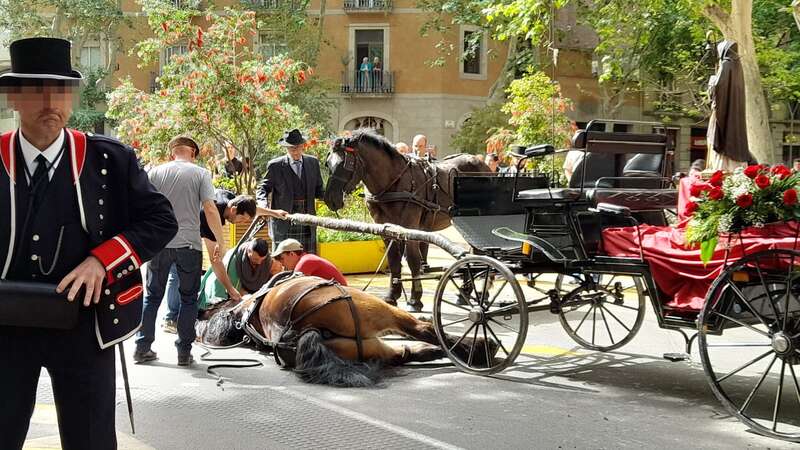
The Tres Tombs parade, which this year celebrated its 200th anniversary with a national gathering of 70 carriages, 200 horses and 600 traginers (carters) from 95 Catalan towns, was marked by tragedy. At 11:11 a.m., at the intersection of Parlament and Borrell streets in the Sant Antoni neighborhood, Santo —a horse pulling the carriage bearing the image of Sant Antoni Abat, patron saint of animals— collapsed and died. Despite attempts to revive him with water and the immediate intervention of Generalitat veterinarians, who certified a “sudden death without suffering,” the incident has reignited an uncomfortable debate: the use of animals in traditions that put their lives at risk.
Santo, bred in Cerdanyola del Vallès, had barely been in the parade for a few minutes when he collapsed. Witnesses told this outlet that the animal showed signs of distress before falling. “They tried to revive him by spraying him with water, but it was too late. They covered him with a red blanket and had to divert the procession along Manso Street,” explained an attendee who preferred to remain anonymous. Images of the horse lying on the asphalt, surrounded by a shocked crowd, went viral on social media, where users denounced “institutionalized abuse.”
Although the autopsy will determine the exact cause of death, everything points to a heart attack triggered by stress. “It is not normal for a young equine to die like this. These animals are exposed to chaotic urban environments, noise and crowds that generate extreme anxiety,” said Aïda Gascón, director of AnimaNaturalis in Spain. The organization canceled the pet blessing and the Gegants de Sant Antoni parade, but the gesture came too late for Santo.
Honored tradition, invisible suffering
The conflict between culture and animal ethics is not new. The Tres Tombs, awarded this year with the Creu de Sant Jordi for their “promotion of heritage,” are defended as a tribute to Catalonia’s carter history. However, behind the decorated carriages and applause as the horses pass by lies a far less idyllic reality: animals forced to walk for hours on hard pavement, pulling heavy loads and exposed to conditions far removed from their natural habitat.
“We are talking about accumulated stress. Many of these horses are transported from rural areas to the city, confined in trailers, disoriented by the noise… It is a silent form of torture,” denounced Gascón. This is not an isolated case: in 2017, another horse died during the same festival, and in previous editions there have been reports of exhaustion and injuries. Despite this, authorities still fail to regulate basic conditions such as weight limits for carriages, mandatory rest periods, or rigorous veterinary checks.
While Barcelona City Council praised the Tres Tombs as “a recognition of the past and the effort of those who keep this tradition alive,” animal protection groups pointed out the hypocrisy of blessing animals at an event where they are exploited. “Sant Antoni is the patron saint of animals, but this festival turns them into objects. There is no spirituality in subjecting them to suffering,” criticized Gascón.
The controversy goes beyond symbolism. In 2023, the European Parliament urged member states to ban the use of animals in spectacles involving physical risk or stress. However, Spain continues to allow traditions such as correbous, bull runs, or the Tres Tombs under the umbrella of “cultural exceptionality.” “It is unacceptable that in 2025 animals are still being used as a tourist attraction. Traditions must evolve or disappear,” insisted Gascón.
The time is now
From AnimaNaturalis, we urge institutions to take concrete measures:
- Ban the participation of animals in events involving crowds, excessive noise or harmful conditions.
- Promote ethical alternatives, such as symbolic empty carriages or theatrical representations with actors.
- Sanction organizers who fail to comply with animal welfare protocols.
To achieve this, we need an informed and mobilized public. Join the AnimaNaturalis Volunteer Network and become part of the campaign we are preparing to demand a ban on the use of animals in traditions and spectacles.
Santo’s death is not just an “accident.” It is the symptom of a system that normalizes the use of animals as tools for entertainment. As long as authorities continue to reward festivities that put them at risk, we will be failing as a society. “Progress does not lie in denying the past, but in building a future where culture and compassion go hand in hand. Animals are not heritage: they are sentient beings who deserve protection,” affirms Gascón.
We need your support
AnimaNaturalis exists because billions of animals suffer at human hands. Because they animals need solutions. Because they deserve someone to speak up for them. Because animals need change. Because at AnimaNaturalis we want to build a fairer world for everyone.
The donations of our supporters are the main source of our funds.