
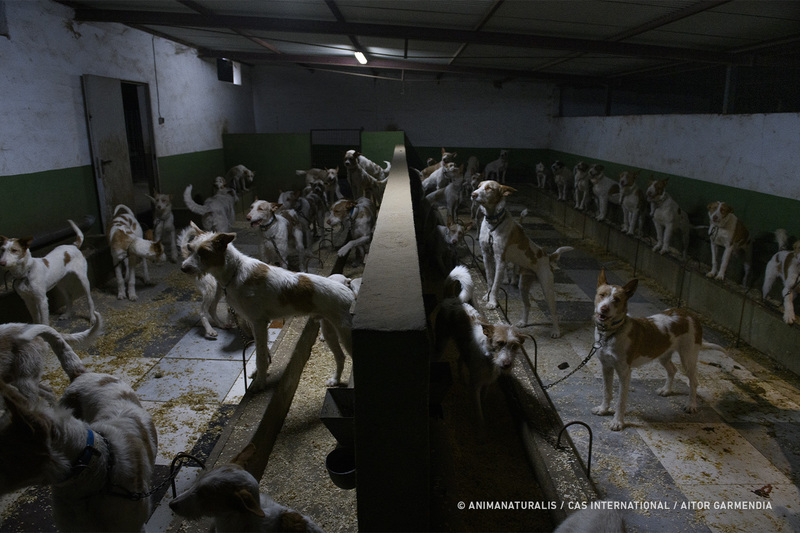
Spain today is home to two legal realities for the same animal. A Golden Retriever living as a companion animal in a Seville apartment is protected by Law 7/2023 on the protection of animal rights and welfare: it has a mandatory microchip, a legally responsible guardian, access to regional registries for domestic animals, and criminal protection in case of abuse. A Podenco living in a hunting kennel in Murcia — or a Greyhound hunting hares in Ciudad Real — has none of these guarantees. Law 7/2023 explicitly excludes dogs used for hunting from its scope of protection, classifying them alongside livestock production animals.
This division is not an oversight. It is a political decision with direct consequences for the lives of hundreds of thousands of dogs: a lack of systematic controls on their living conditions, zero traceability from the litter to their final destination, no oversight whatsoever, the practical impossibility of investigating abandonment or mistreatment, and an open door to the opaque trade in hunting breeds.
The European regulation to be debated on April 27, 2026 — the first that the European Union has specifically dedicated to the welfare of dogs and cats — has the potential to close this gap. Or to perpetuate it, if its exceptions and extended deadlines end up being an excuse to change nothing. "In Spain, the law distinguishes between dogs that matter and dogs that don't. Hunting dogs have no identification, no registered name, no guardian: they are simply instruments exploited in hunting activities. That is the framework that the European regulation can break... if it's truly applied," explains Aïda Gascón, director of AnimaNaturalis in Spain.
Traceability without categories
The European Commission's proposal, presented in November 2023, starts from a clear diagnosis: the lack of a harmonized system for the identification and registration of dogs and cats in the EU facilitates illegal trafficking, fraud, and animal suffering. Only 24 of the 27 Member States have mandatory dog registration; for cats, only 7. Existing national databases are not interoperable. And in countries like Spain, with tens of thousands of dogs in hunting circuits, opacity is almost total.
The Commission's original text proposed a solid foundational solution: microchipping and registration in a national database for all dogs and cats before their first marketing or supply within the EU, regardless of their intended use. The key was in that last clause: whatever their intended purpose. Hunting, herding, guarding: all included.
The amendments approved by the European Parliament on June 19, 2025, reinforce this principle with an explicit addition. The new paragraph 2 ter of Article 2 establishes that the identification and registration requirements of Article 17 "shall apply to all dogs and cats kept under the responsibility of natural persons," without exception. Furthermore, Article 3 includes, for the first time in EU law, a specific definition of dogs carrying out specific, work, or professional activities: those selected for activities such as hunting, herding, rescue, assistance, or sporting purposes.
The existence of this definition does not create a lower category: on the contrary, it formally incorporates it into the scope of the regulation, with all the welfare, identification, and registration obligations it establishes. Article 17 requires that dogs be identified by a subcutaneous microchip transponder, that the veterinarian register the animal in the national database within two working days, and that any change in ownership or responsibility also be registered within two weeks.
The system also envisions interoperable national databases — Spain will need to connect its REIAC and regional registries to a common European index managed by the Commission — a public system for verifying the authenticity of the microchip and registration, and the obligation for online sales platforms to require and display the microchip number before publishing any offer. "Traceability is not just a technical matter of databases. It is the minimum condition for a dog to be a subject with a history and a responsible person, not an object that can appear and disappear without anyone being accountable," adds Gascón.
What the regulation can change in Spain... and what it cannot
The contrast between what the regulation establishes and what currently happens in Spain is revealing. Today, Spain has the REIAC, but this registry is not uniform across the territory: the autonomous communities have their own systems (RIVIA in Andalusia, AIAC in Catalonia, and others with a lesser degree of development), and interoperability between them is partial and inconsistent. Furthermore, hunting dogs are excluded from the scope of Law 7/2023 and from the concept of a companion animal that organizes this registry system.
This means that, in practice, thousands of dogs used in driven hunts, hare coursing, and partridge packs have no accessible official record, no legally identified guardian responsible for their welfare, and their birth, transfer, and death are invisible to the authorities. When they appear abandoned at the end of the hunting season — as systematically happens every January with tens of thousands of Greyhounds, Podencos, and other hunting dogs — it is practically impossible to trace who owned them.
If the European regulation is applied without exceptions for hunting dogs, it would change this situation at its root. Every dog would have a microchip number linked to a responsible person in an official database interoperable at the European level. The structural impunity of hunting-related abandonment would, for the first time, face an effective regulatory response.
But there are warning signs in the Spanish legislative process itself. The prior public consultation that the Ministry of Social Rights, Consumption, and the 2030 Agenda conducted between July and October 2025 on the draft Royal Decree for the regulation of zoological nuclei received 2,204 contributions. Of these, 2,160 — 98% — explicitly demanded that hunting and working dogs be included as companion animals with the same standards of protection, controls, and traceability. The result: the draft still does not include them.
The Ministry of Agriculture, Fisheries, and Food (MAPA) is working in parallel on a specific Royal Decree concerning "traditional zoological nuclei" that could end up being the normative channel for hunting facilities, but with different and presumably laxer standards, as they consider hunting dogs to be production animals that do not have the same rights as dogs living in our homes.
The debate seems stalled on the legal definition of what a dog is... whether it is one because it belongs to that species or whether it is one according to the function we have arbitrarily assigned based on our human activities: guarding, herding, hunting, assistance, police, etc.
The case of mutilations
The EU regulation includes another critical provision for hunting dogs: a general ban on cosmetic mutilations. However, the amendment to Recital 36, approved by Parliament, introduces a specific exception: in the case of certain breeds, such as hunting dogs, procedures like tail docking may be allowed for prophylactic, diagnostic, or therapeutic reasons, and only if performed by a veterinarian. The same logic that for decades has justified treating these animals as instruments — not as individuals — is reproduced in the very law that supposedly comes to protect them.
The lesson is clear: the European regulation sets a minimum floor, but it does not automatically oblige Spain to reform its domestic legal architecture beyond the expressly harmonized requirements. Implementation deadlines of up to 7 years leave a huge window for transposition to be partial or hollowed out in practice.
Here's what you can do
The plenary debate on April 27 in the European Parliament is not the end of the legislative process — the text will return to committee for inter-institutional negotiations with the Council — but it is the moment when public pressure can have the most impact. Spanish MEPs are voting on behalf of all the dogs who have no voice of their own in that chamber.
- Write to your MEPs. You can find the list of Spanish MEPs and their contacts on the European Parliament portal. Ask them to defend: the application of identification and registration requirements to all dogs without exception based on use, the removal of the tail docking exception for hunting dogs in Recital 36, and reasonable transposition deadlines, not the maximum possible.
- Participate in the Spanish legislative process. The draft Royal Decree on zoological nuclei for companion animals is still being processed. The competent ministry needs to receive the message that those demanding the inclusion of hunting dogs were not a statistical curiosity, but the expression of a majority social demand with scientific and legal backing.
- Sign and share. AnimaNaturalis maintains active petitions specifically on the rights of hunting dogs and the removal of exceptions in European regulations. Every signature is one more argument that reaches the negotiators.
"Every time an administration decides that a dog does not deserve to be registered, it is also deciding that its suffering can be invisible. The European regulation gives us the opportunity to end that impunity. Let it not be wasted," adds Gascón.
We need your support
AnimaNaturalis exists because billions of animals suffer at human hands. Because they animals need solutions. Because they deserve someone to speak up for them. Because animals need change. Because at AnimaNaturalis we want to build a fairer world for everyone.
The donations of our supporters are the main source of our funds.