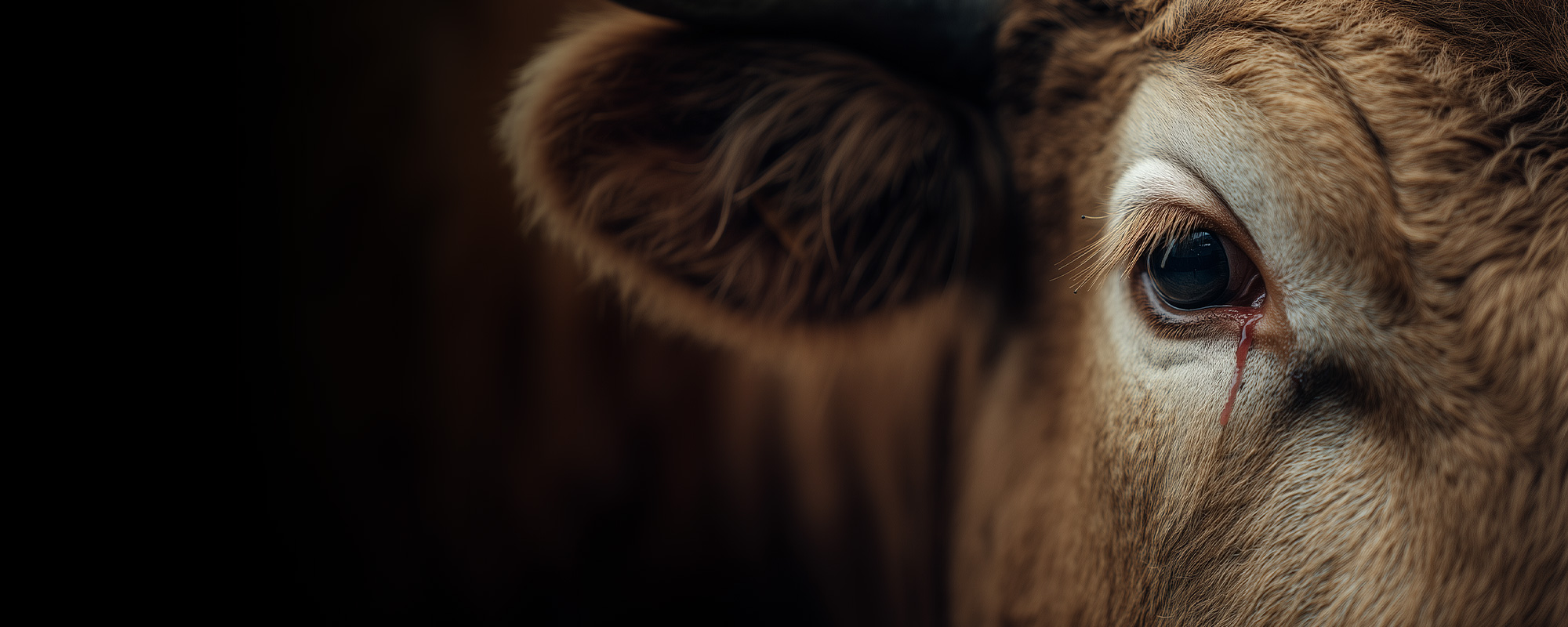
Dawn breaks over Elgoibar. The air, fresh and clean, soon fills with a hum of expectation. Barricaded streets, safety fences, crowded balconies. This is no ordinary day. It’s the day of the sokamuturra —a Basque term that, deceptively simply, translates to “bull with a rope.” Yet behind those words hides a reality of anguish, pain, and animal suffering documented in a groundbreaking investigation by AnimaNaturalis and CAS International.
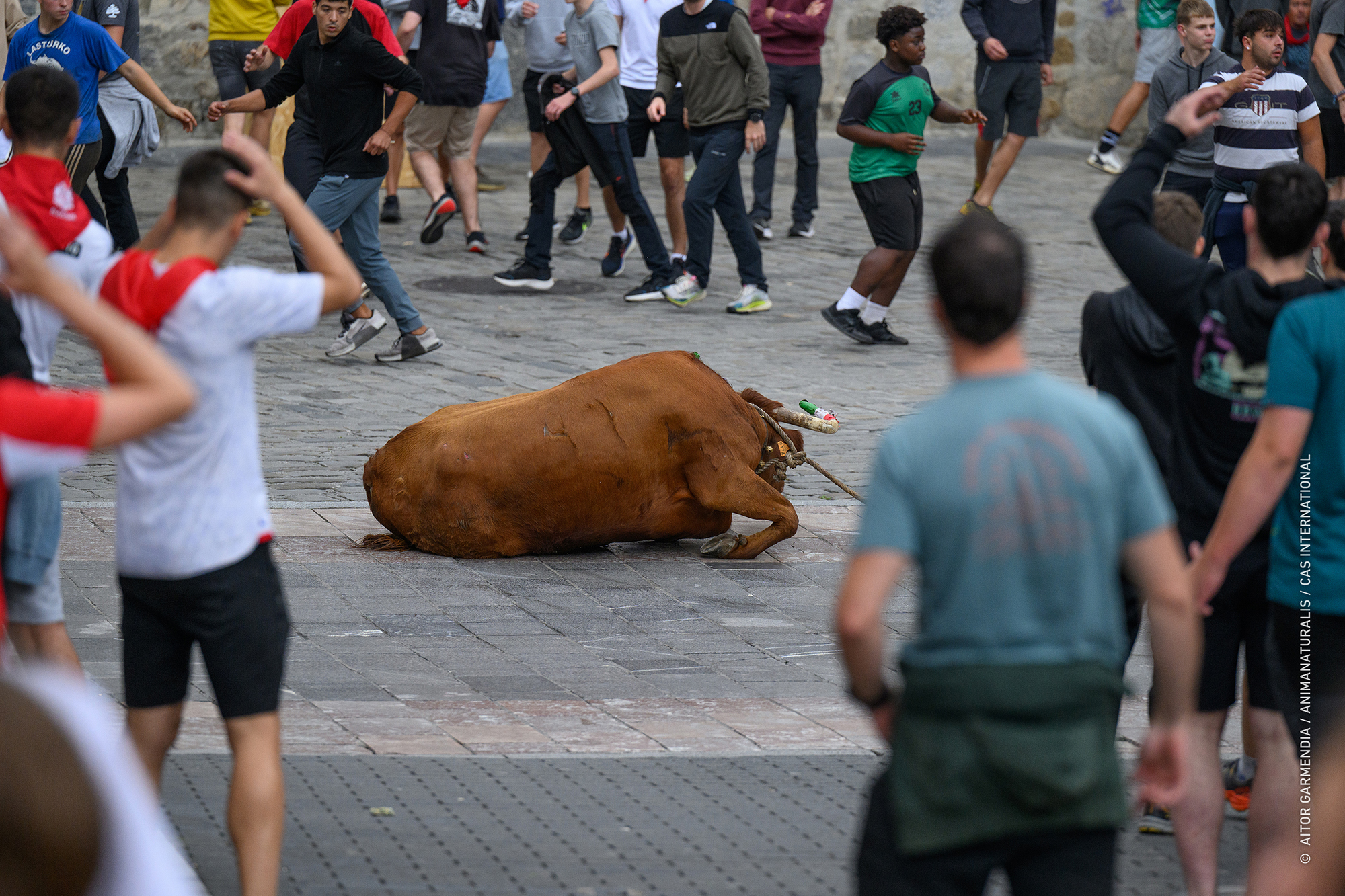
Our research team infiltrated the heart of these celebrations in Elgoibar, recording in painstaking detail every pull of the rope, every slip, every desperate gaze of the animals. The material —hours of footage and dozens of photographs— stands as irrefutable testimony to a spectacle where human amusement is built upon animal torment.
What is the Sokamuturra?
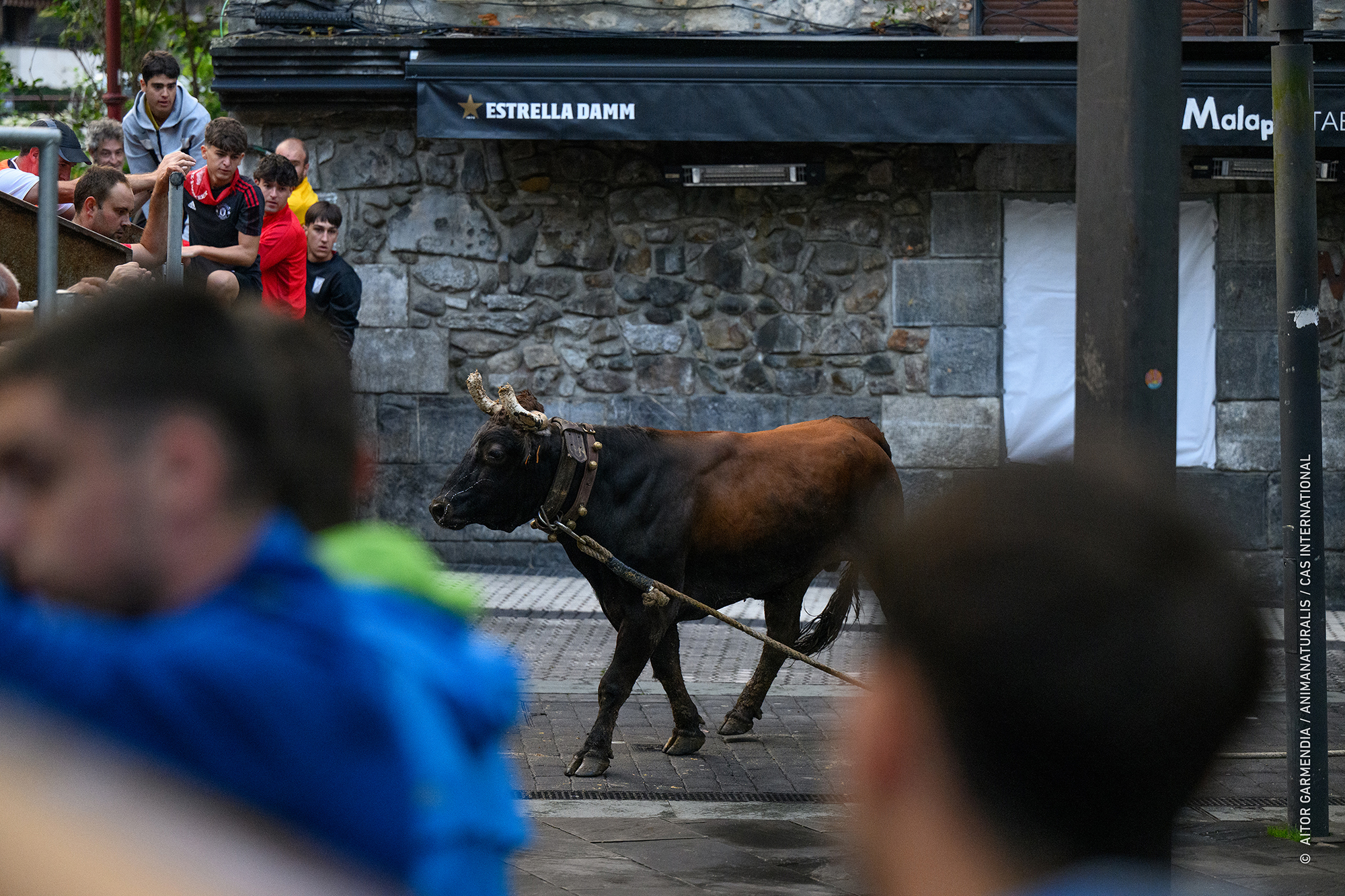
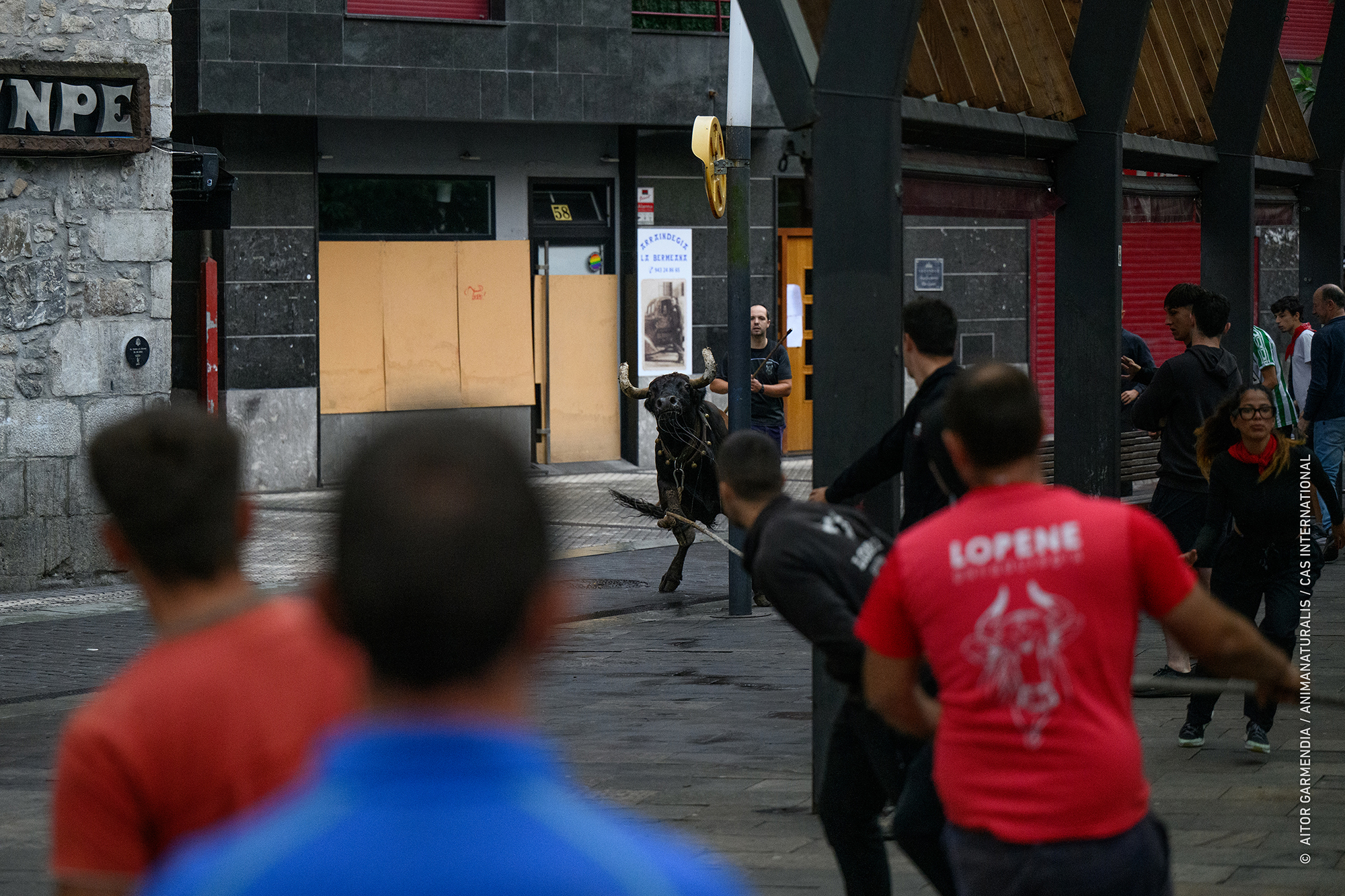
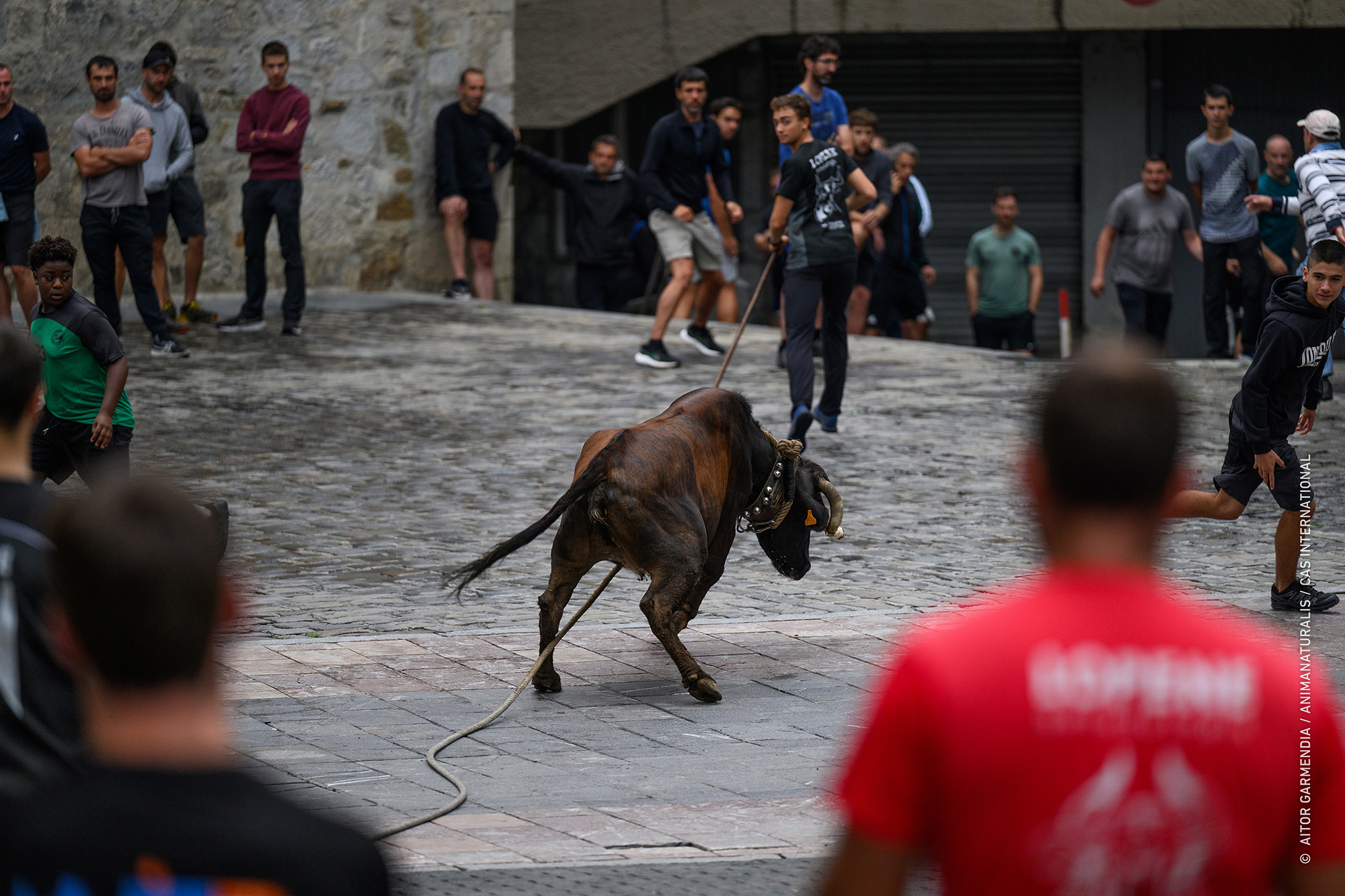
The *sokamuturra*, literally “snout of rope” in Basque, is a type of popular bull-related event in which a cow or young bull is tied by the horns to a long rope and released along a street circuit. The rope, up to sixty meters long, is controlled by a group of men, the “sokalaris,” who guide and restrict the animal’s movements while a crowd of runners teases, provokes, and chases it. The animal is forced to charge, run, and twist in an unnatural environment —on slippery pavement and under extreme physical and psychological pressure.
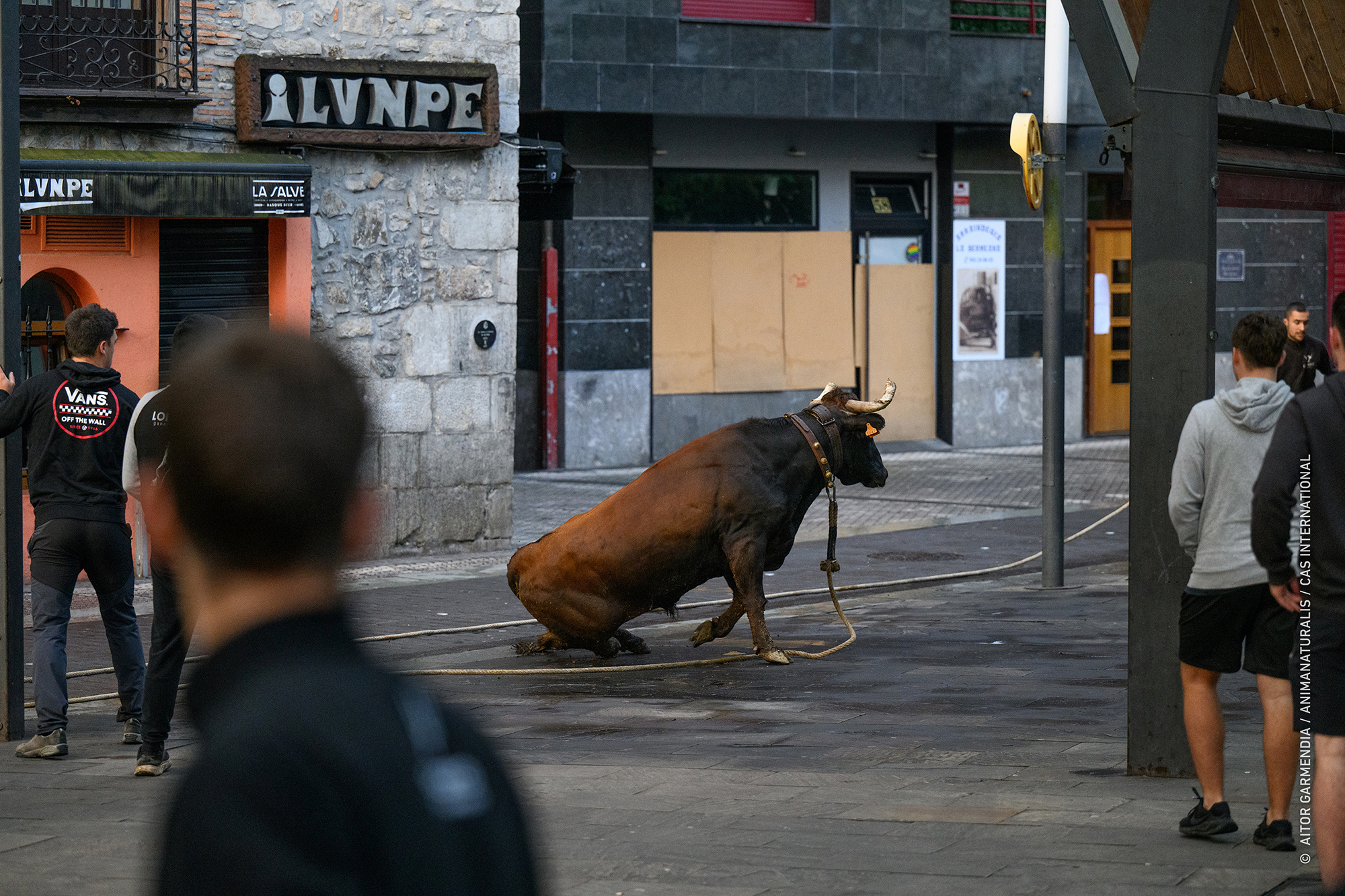
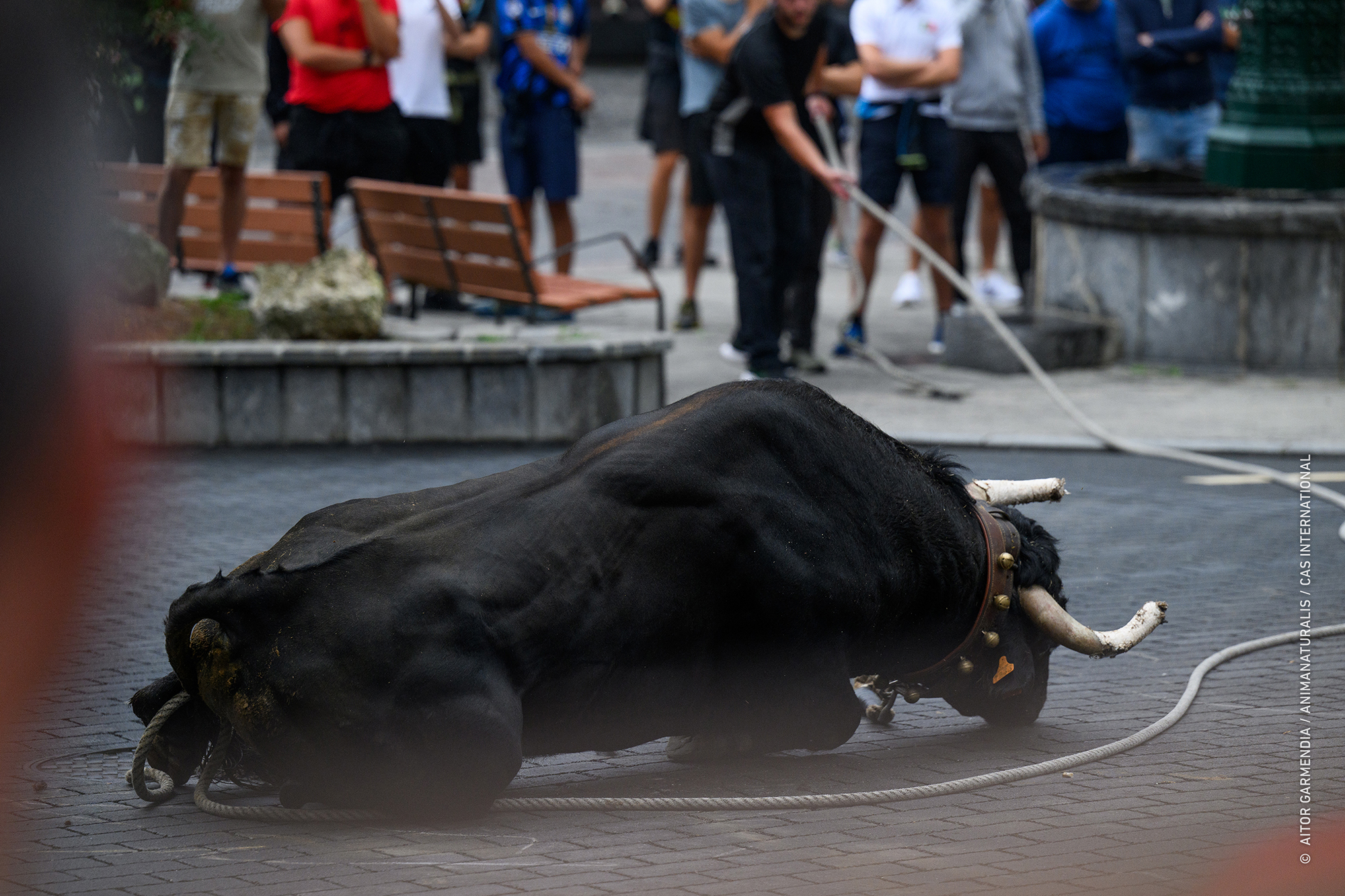
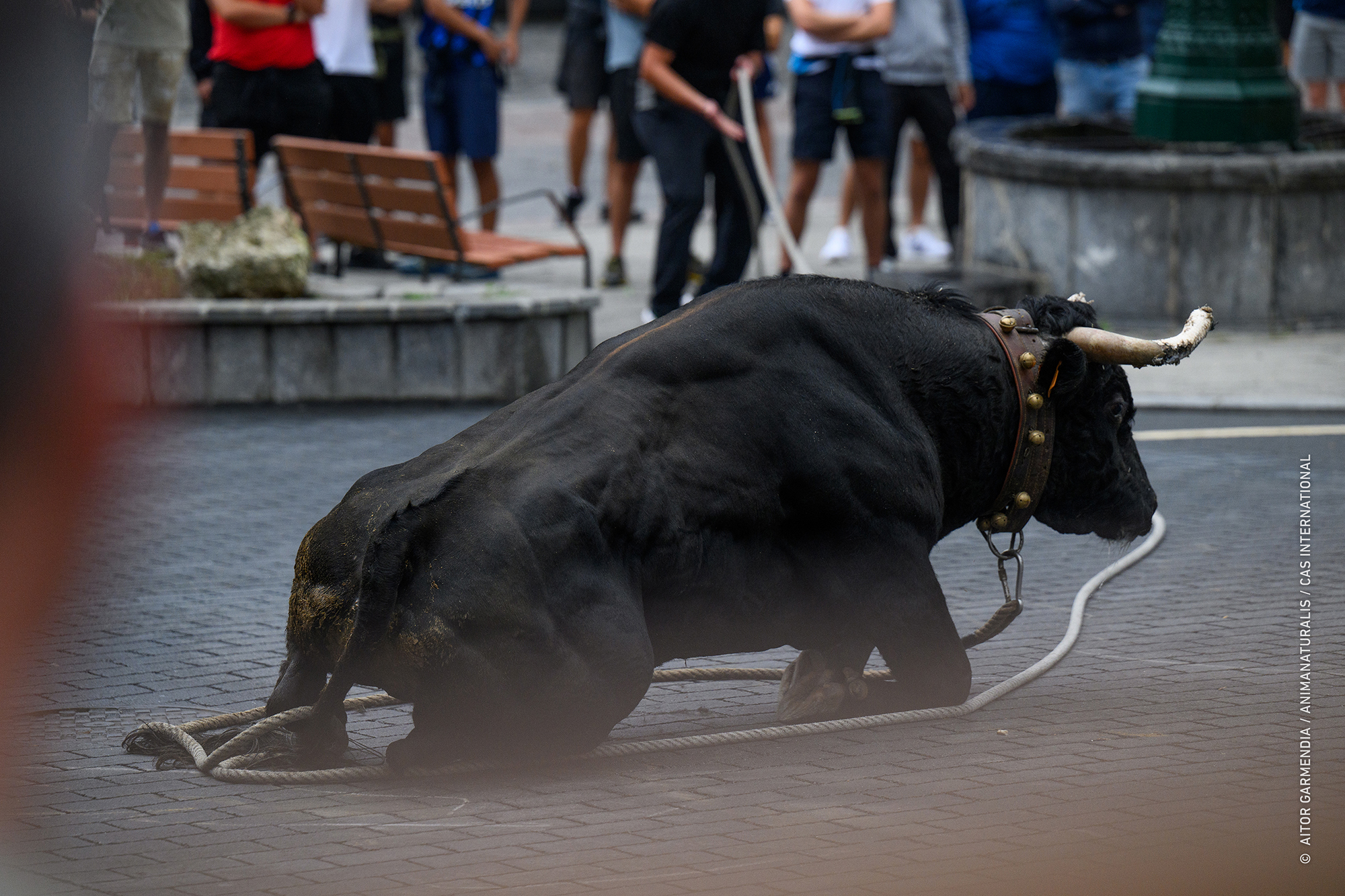
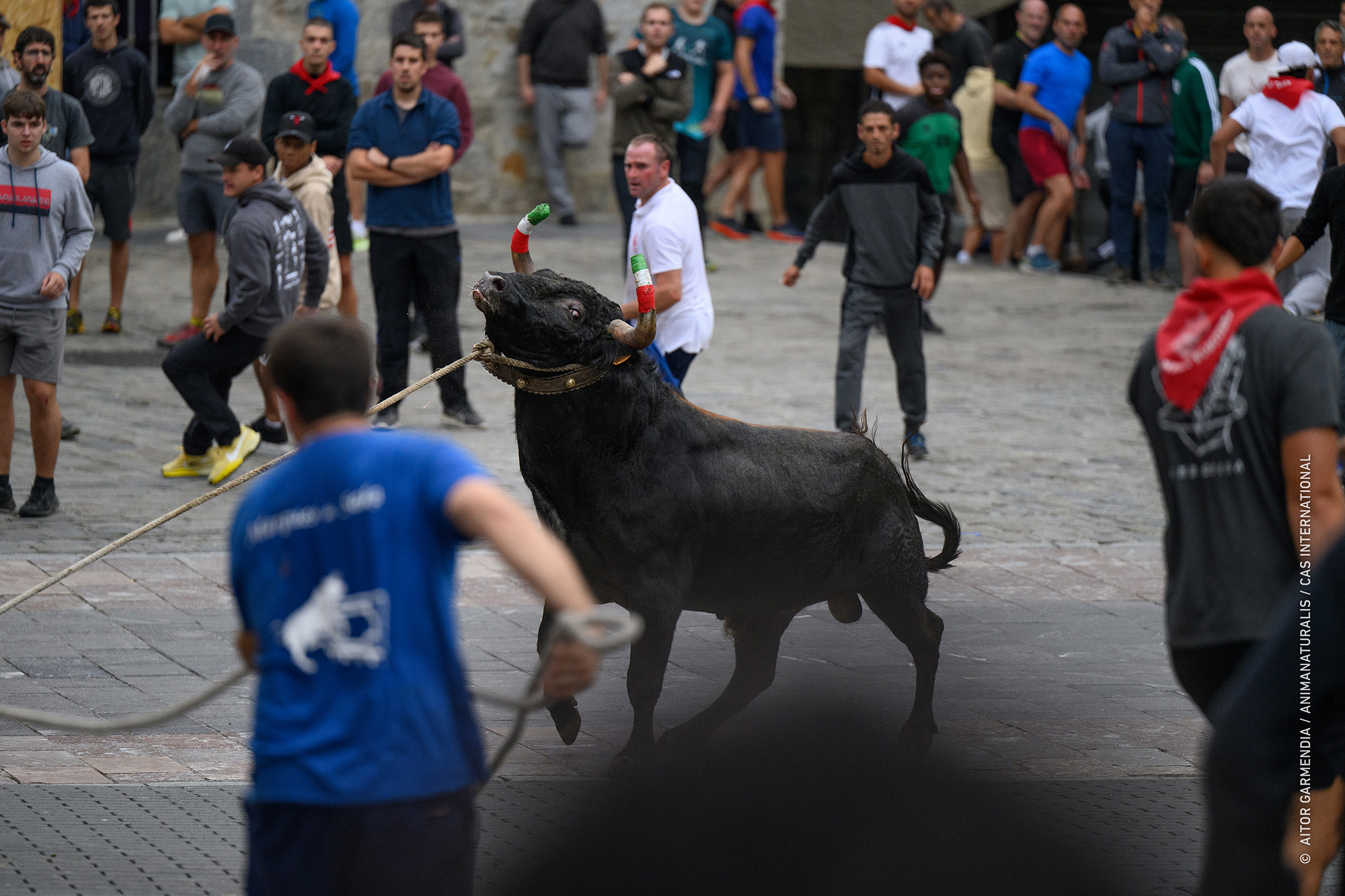
“What we documented in Elgoibar is not an exception —it’s the rule. It’s the institutionalization of cruelty as entertainment,” says Aïda Gascón, director of AnimaNaturalis in Spain. “We saw pure fear. We saw how the amusement of a few is built upon the agony of a living, sentient, terrified being. Calling this culture is an insult to the evolution of our society —a barbaric relic that refuses to die.”
The spectacle is repeated across many Basque towns throughout the summer and festive periods, lasting for hours, with each animal subjected to several minutes of torment. Elgoibar is one of the localities where the *sokamuturra* remains a prominent part of the festivities for Saint Bartholomew and other local celebrations. These events usually take place early in the morning, with routes running through the town square and surrounding streets, attracting hundreds or even thousands of spectators and participants.
In recent years, some councils have tried to regulate the event with barriers, balconies, raffles to watch from municipal buildings, or contests between breeders. Yet the staging, the crowds, and the street dynamics expose animals to extreme physical and emotional stress.
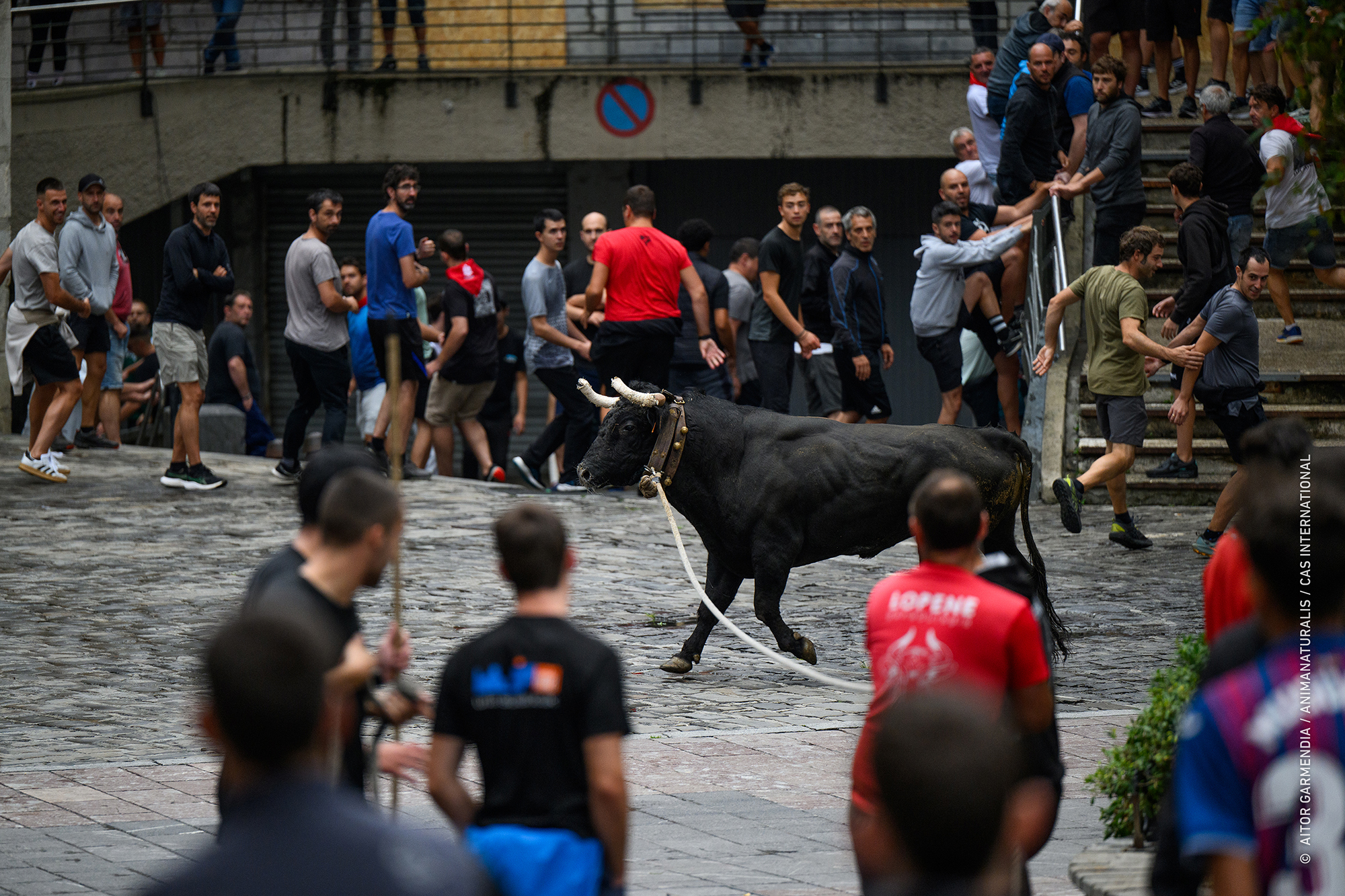
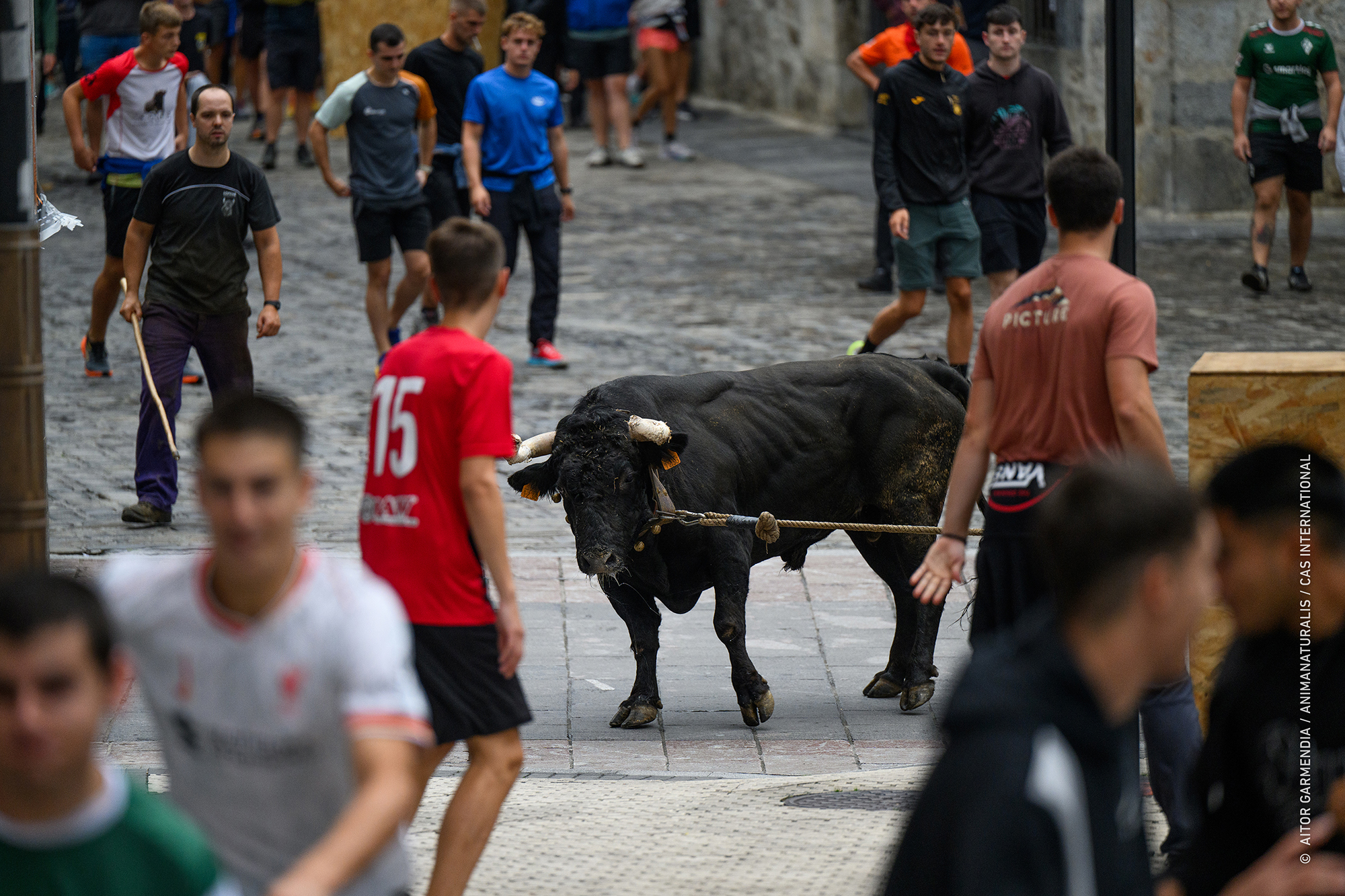
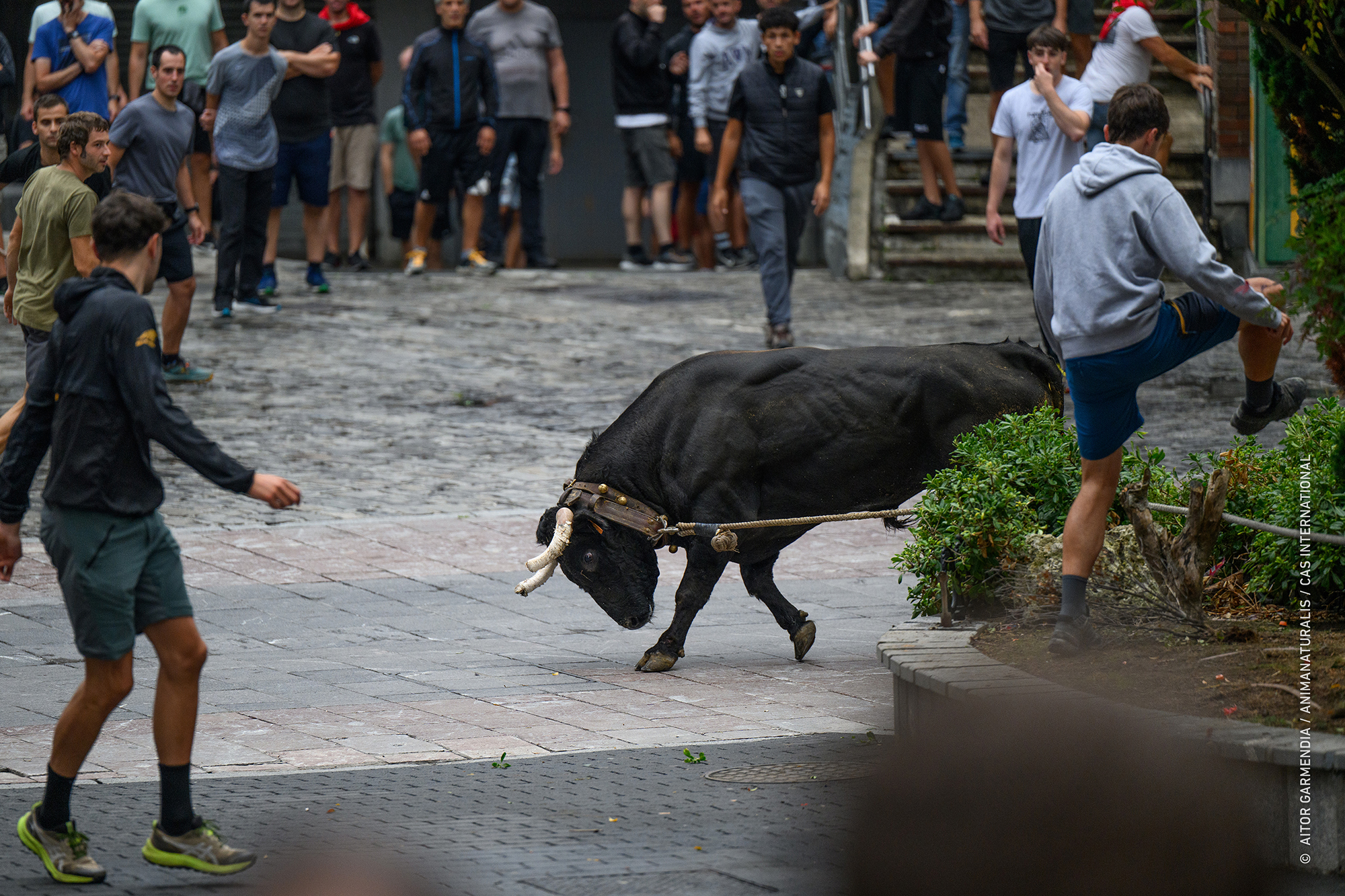
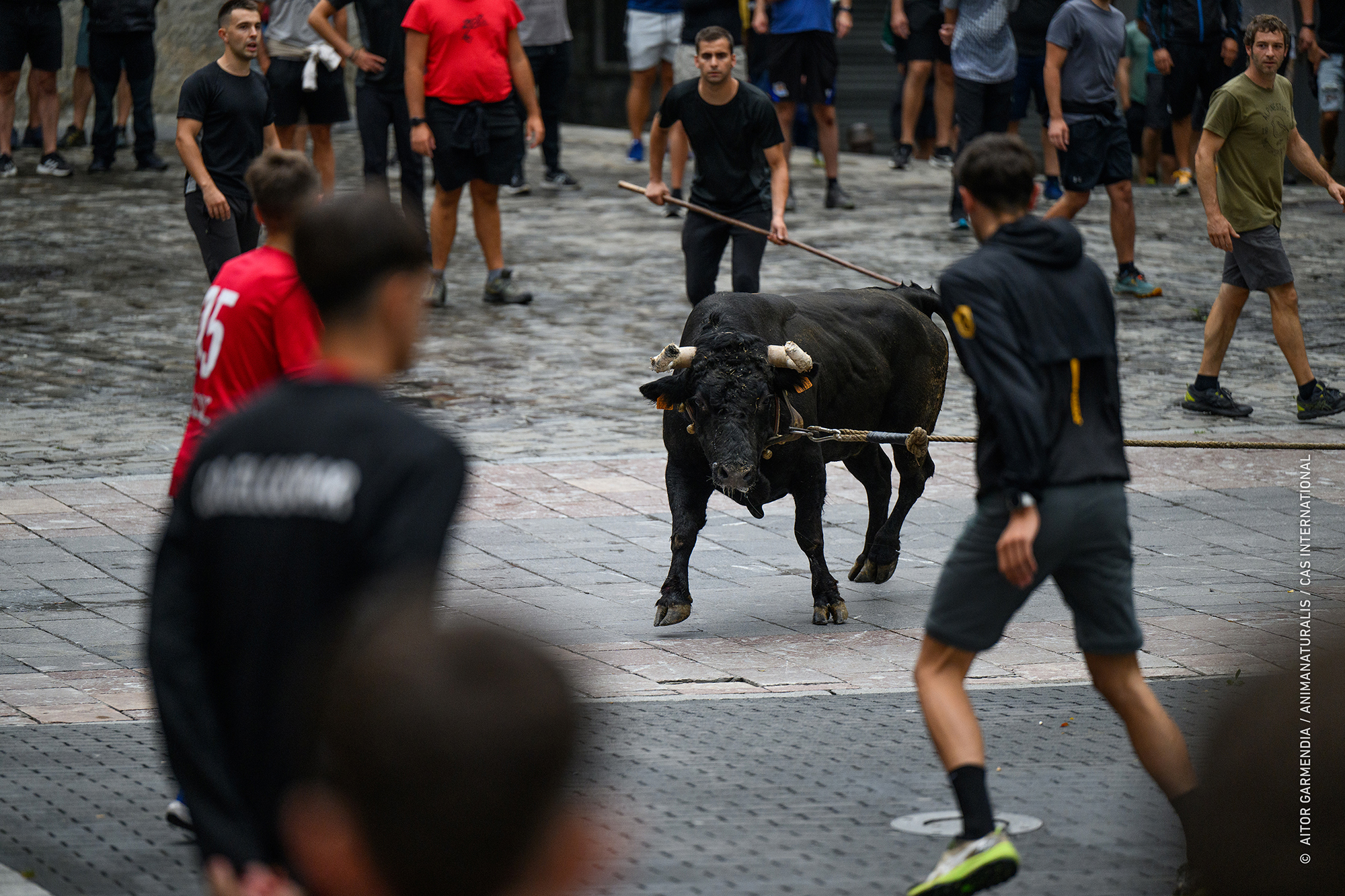
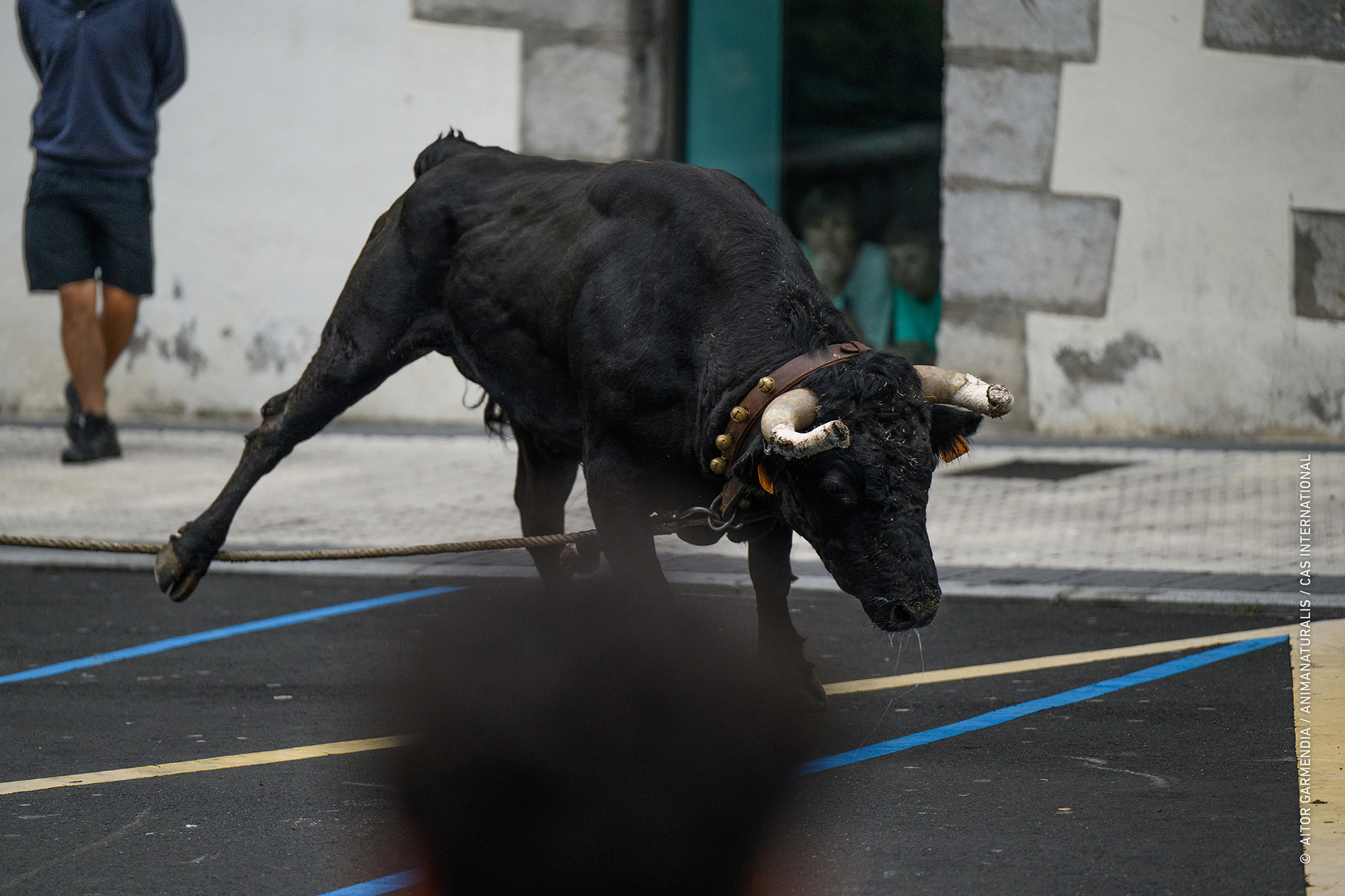
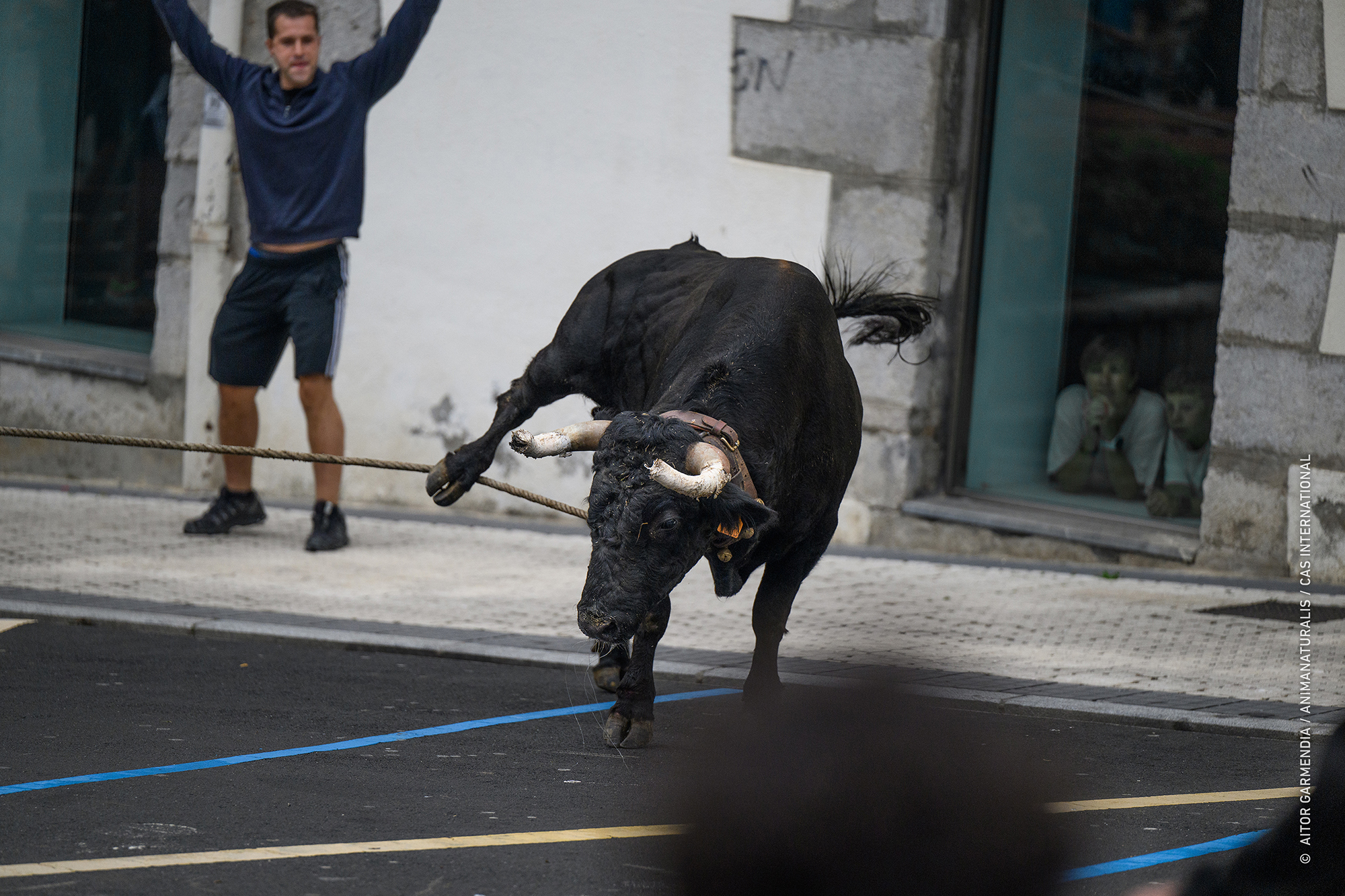
“We’re talking about persecution, not celebration,” says Gascón. “There’s no ritual, no art, no courage here. Only the brutal disproportion of a mob against a young, frightened, utterly vulnerable being. The rope is the symbol of total control over its body and will. It’s the thread that binds executioner and victim —and every pull is an act of senseless violence. When you see their eyes, wide and dark, you see nothing but boundless panic, utter incomprehension of why they are being subjected to such torment. It’s staring into the abyss of animal despair —and it breaks your soul.”
Pain and fear in calves and heifers
Contrary to the bullfighting image of the powerful, mature bull, the victims of *sokamuturra* are almost always immature animals —young bulls and heifers between one and two years old, barely a third of the size and weight of an adult bull.
“We’re talking about babies, in comparative terms,” explains Gascón. “Their skeletons aren’t yet fully ossified, their joints are fragile, and their muscles undeveloped for such brutal exertion. They’re chosen precisely because of their vulnerability —more manageable, less dangerous, and therefore seen as ‘safer toys’ for the crowd. It’s an act of cowardice. Submission is sought through the weakness inherent to youth.”
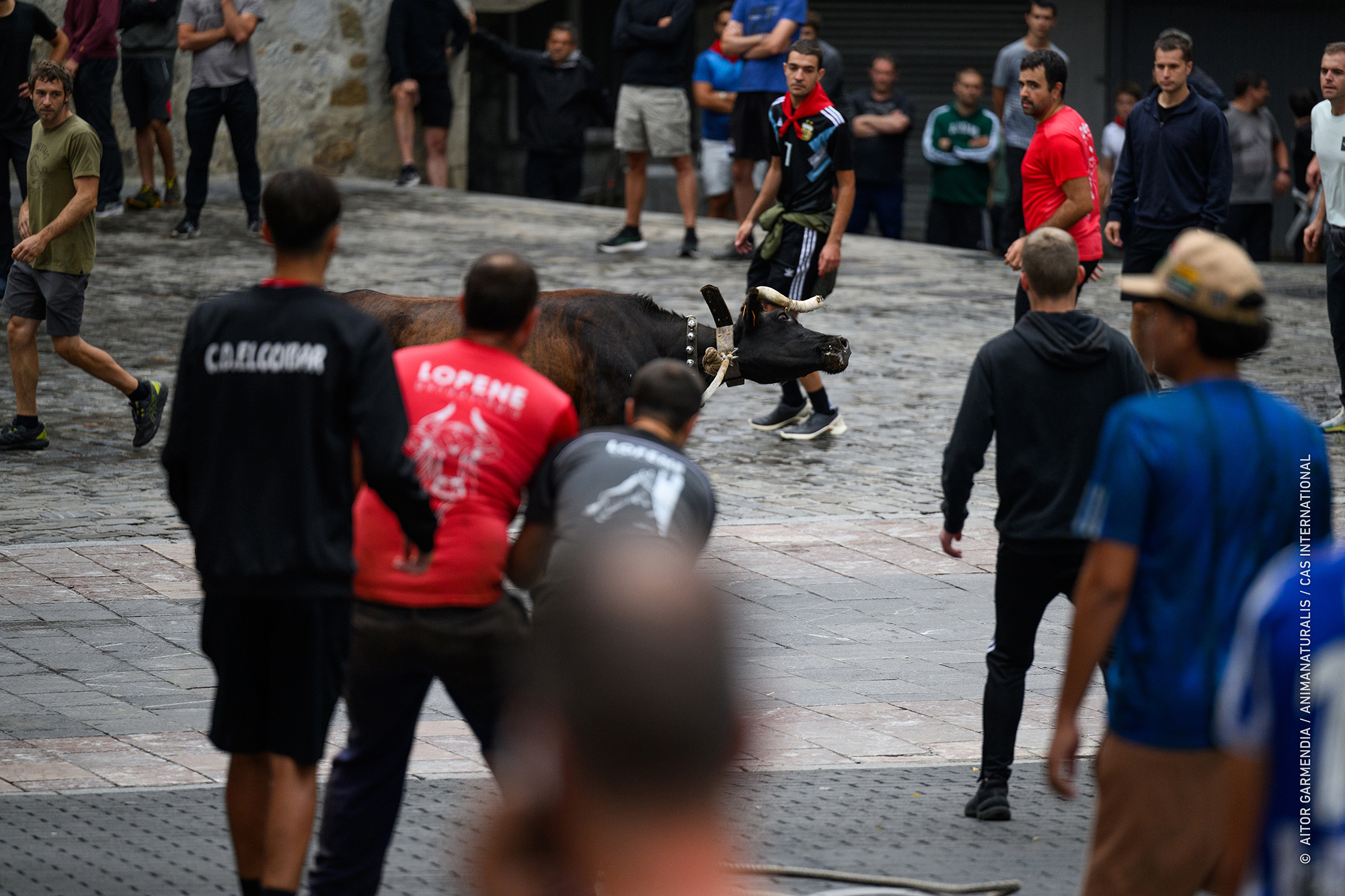
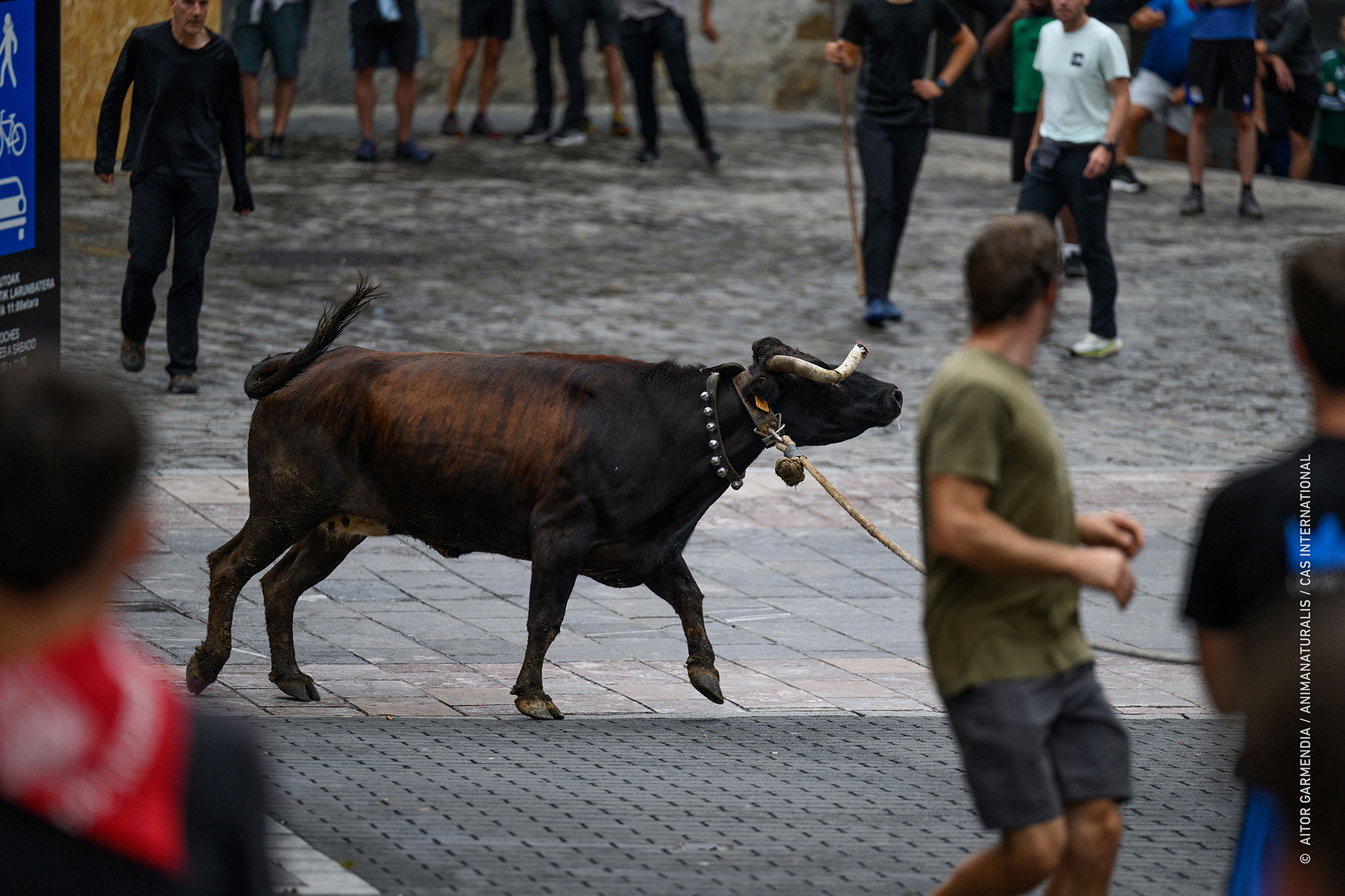
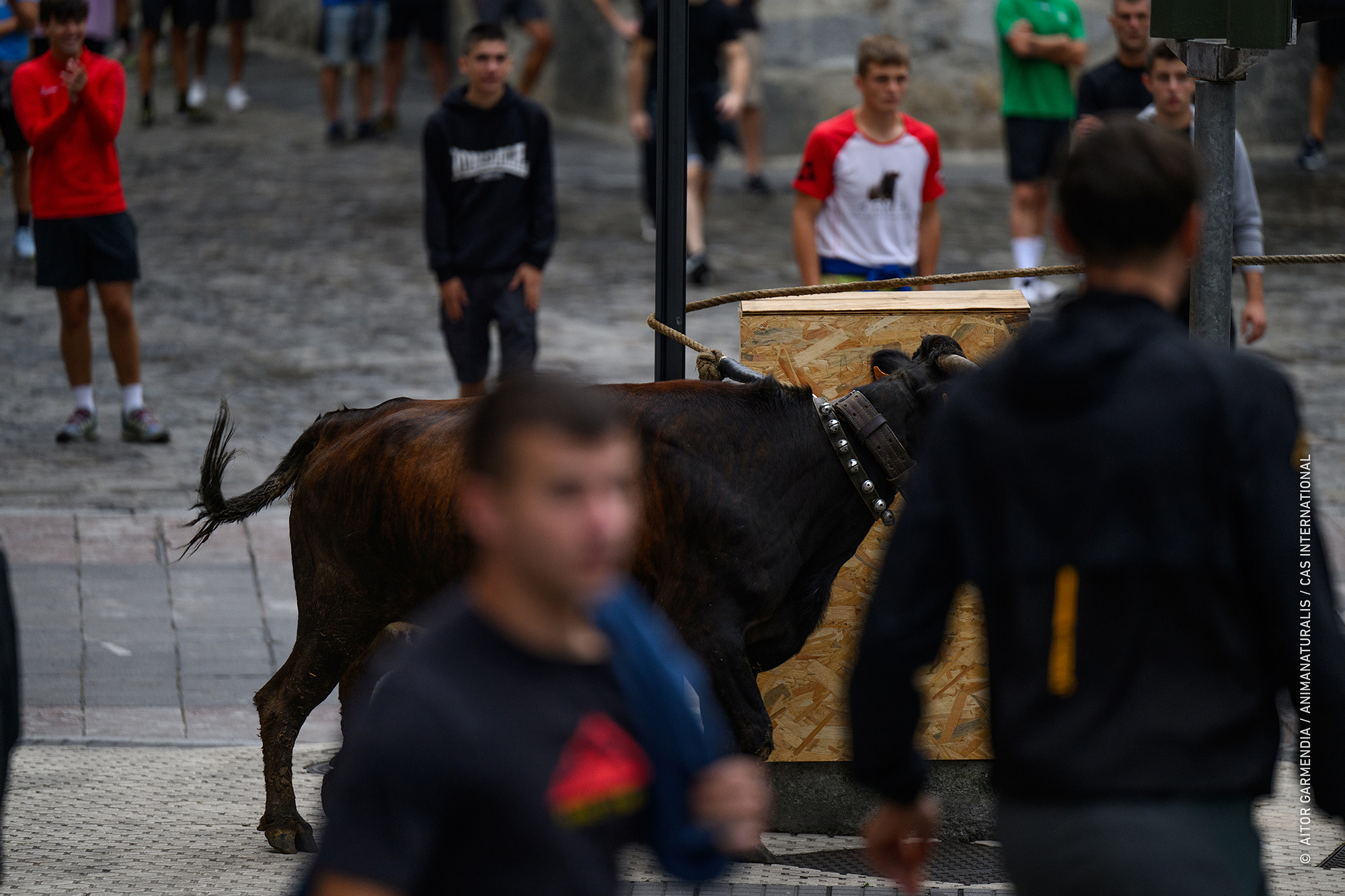
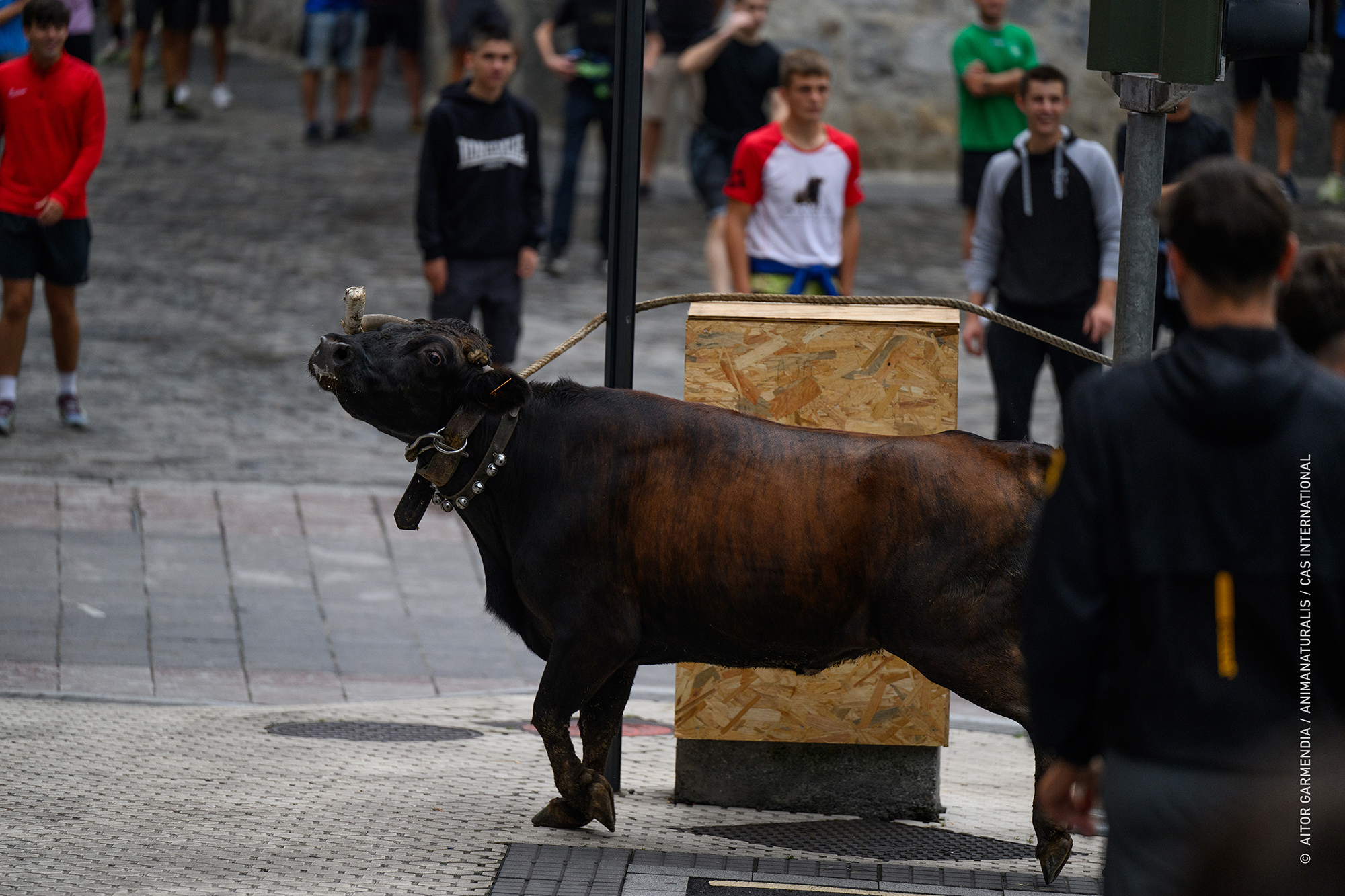
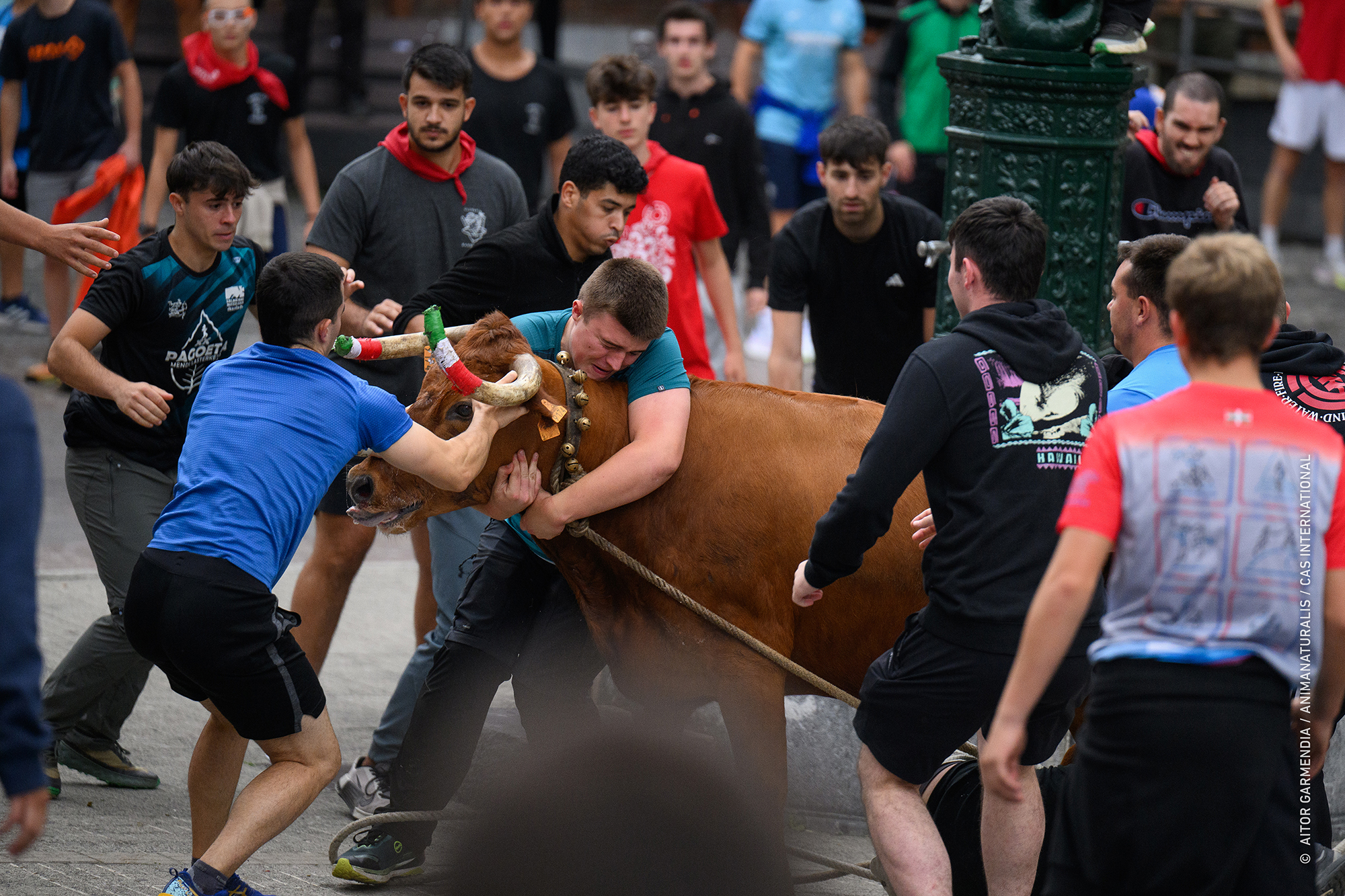
To increase this submission and reduce any residual risk, organizers practice “tipping” or “blunting” the horns. This involves covering the horn tips with soft material such as cork or leather —or, in some cases, sawing the tips off entirely. This mutilation, often performed crudely, can cause intense pain and prevents the animal from defending itself effectively.
“Horn blunting is the final insult,” says Gascón. “It strips them of their only means of defense, underscoring the total imbalance of this ‘spectacle.’ It nullifies any chance that, in a desperate act of self-preservation, the animal could harm its tormentors. It creates a false sense of safety that only emboldens the crowd further. It’s like tying someone hand and foot and then mocking them. There’s nothing brave about it.”
The *sokamuturra* inflicts multiple kinds of suffering, often simultaneously:
- Acute and chronic stress: noise, crowds, rough handling, and restraint by the rope trigger high cortisol levels and intense fear responses. Veterinary studies and field observations show clear signs of distress: panting, drooling, trembling, rapid breathing, and escape behavior.
- Muscle damage and lactic acidosis: repeated, high-intensity runs without conditioning cause extreme fatigue; lactic acid buildup leads to pain, weakness, and risk of collapse. Forced to move on hard, slippery surfaces, animals suffer leg injuries, lameness, and abrasions.
- Blows, falls, and rope asphyxiation: guided by a long rope, animals can become entangled, crash into fences, poles, or walls. In several documented cases, falls have led to trauma or life-threatening incidents —such as a heifer that fell into the sea during a route in Pasai Donibane. The event continued despite the fall, prompting AnimaNaturalis to file an administrative complaint and revealing the absence of basic safety protocols for both animals and the public.
- Prolonged fear and behavioral effects: beyond physical injuries, repeated panic alters the animal’s behavior. Many show avoidance, disorientation, or hypervigilance that persists long after the event.
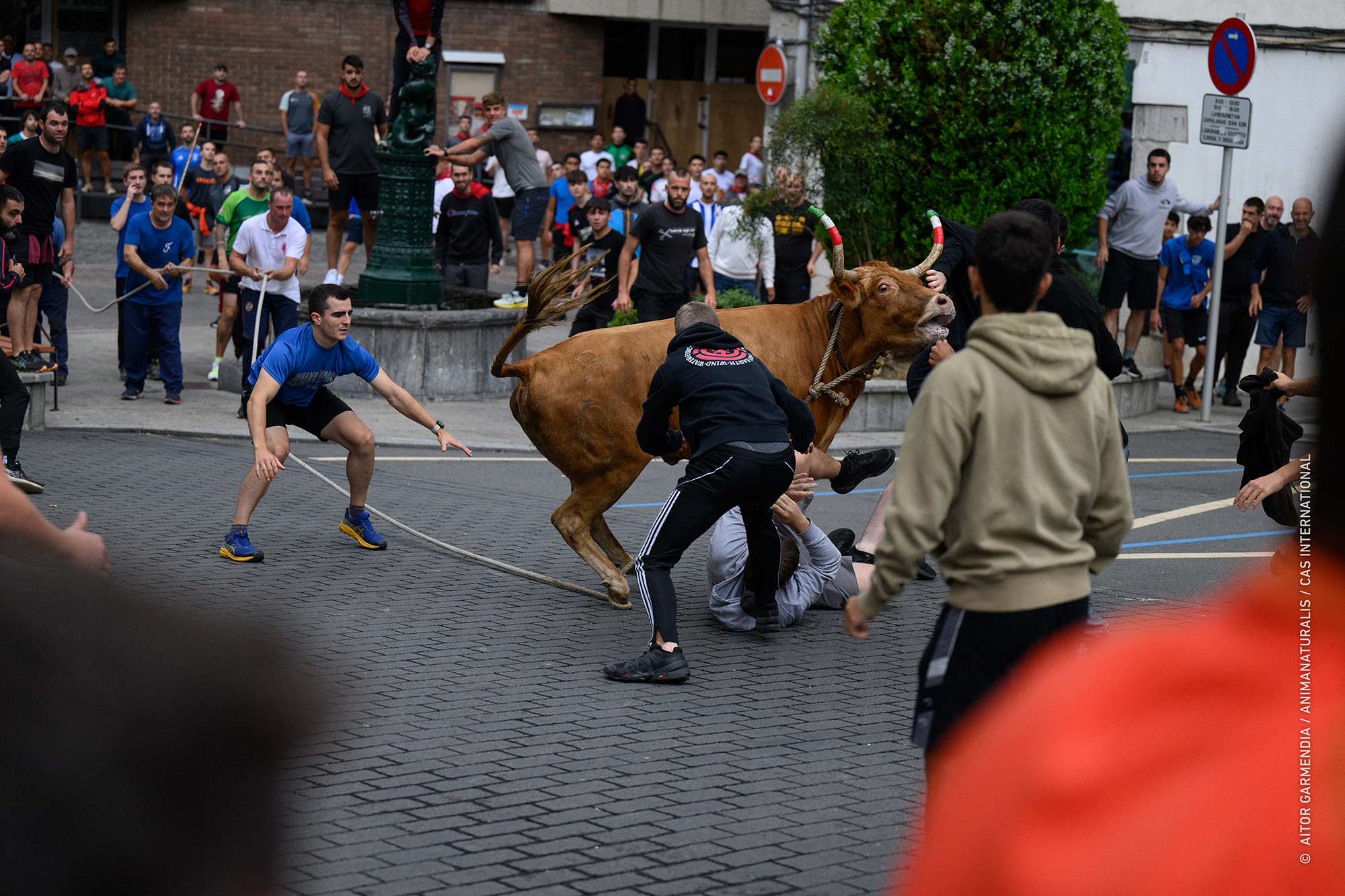
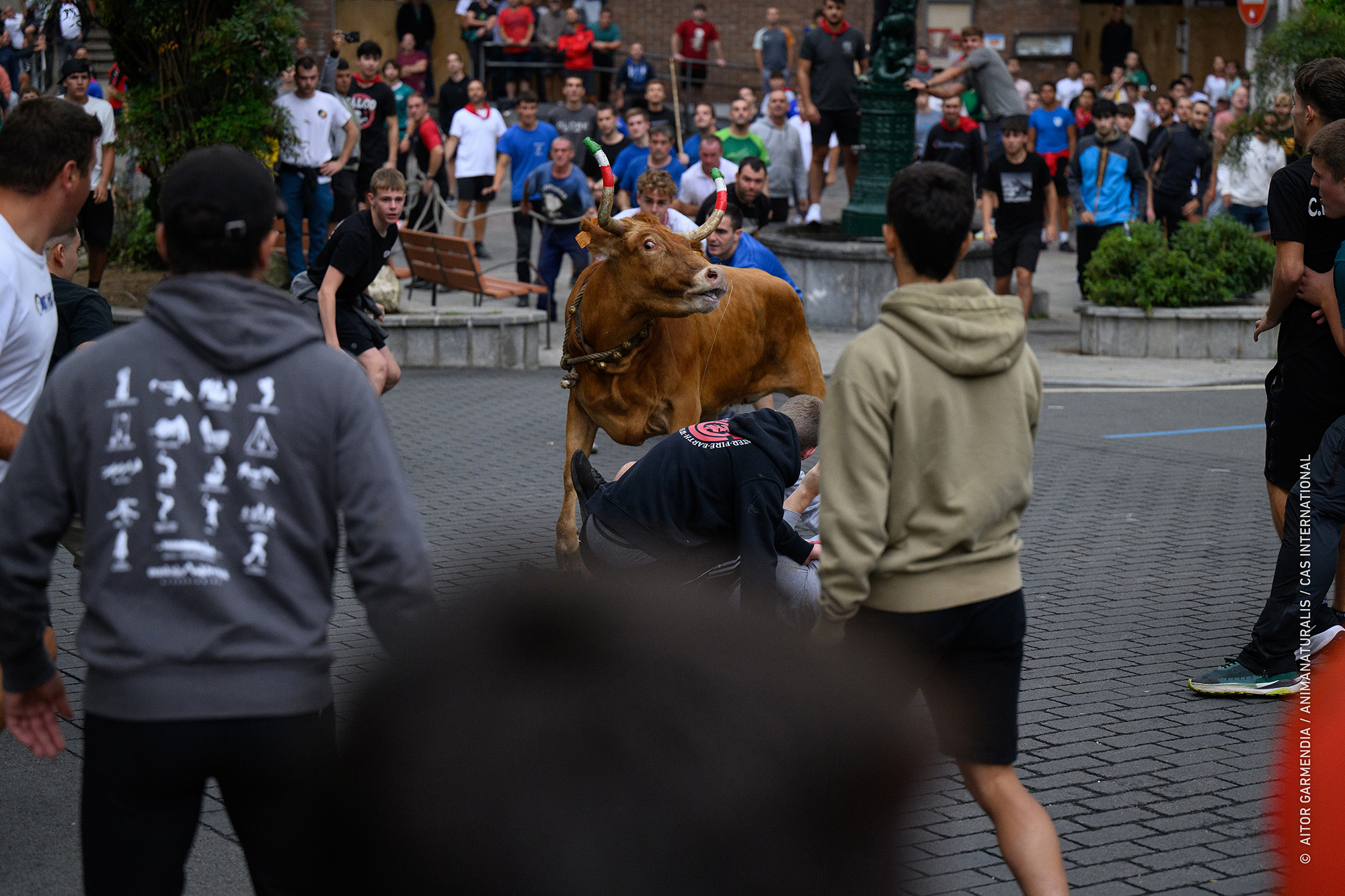
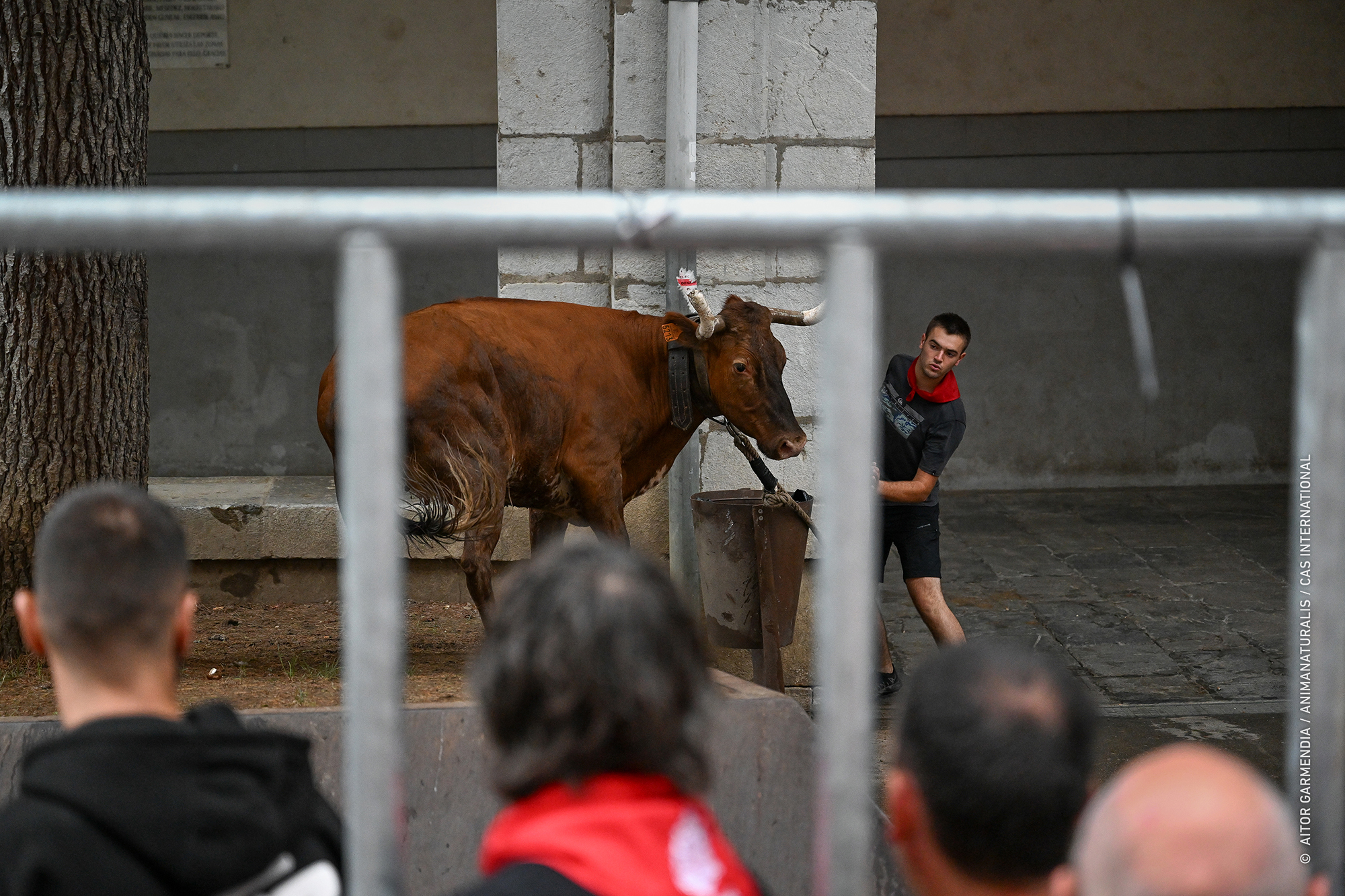
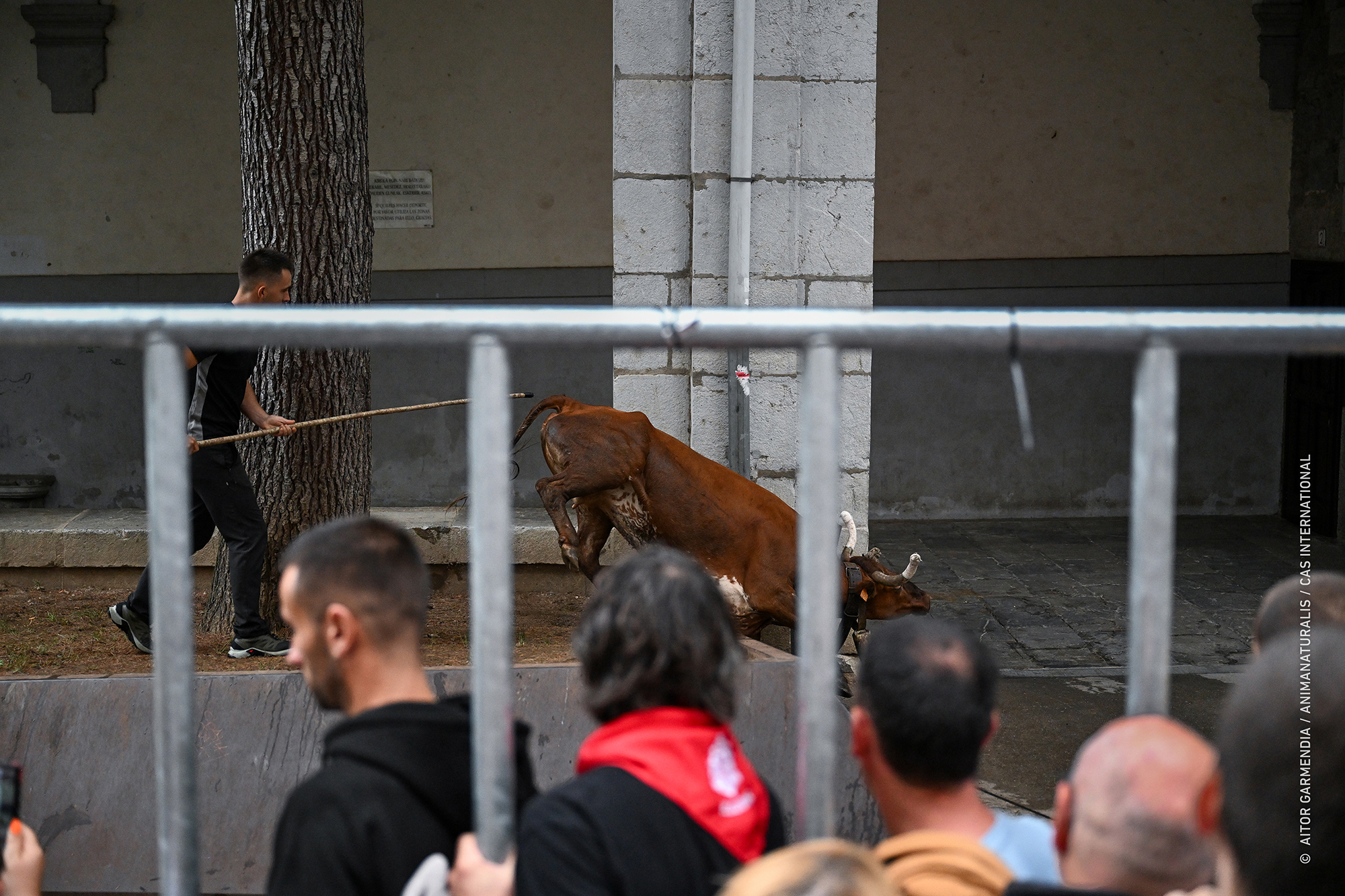
Minute by minute: the anatomy of suffering
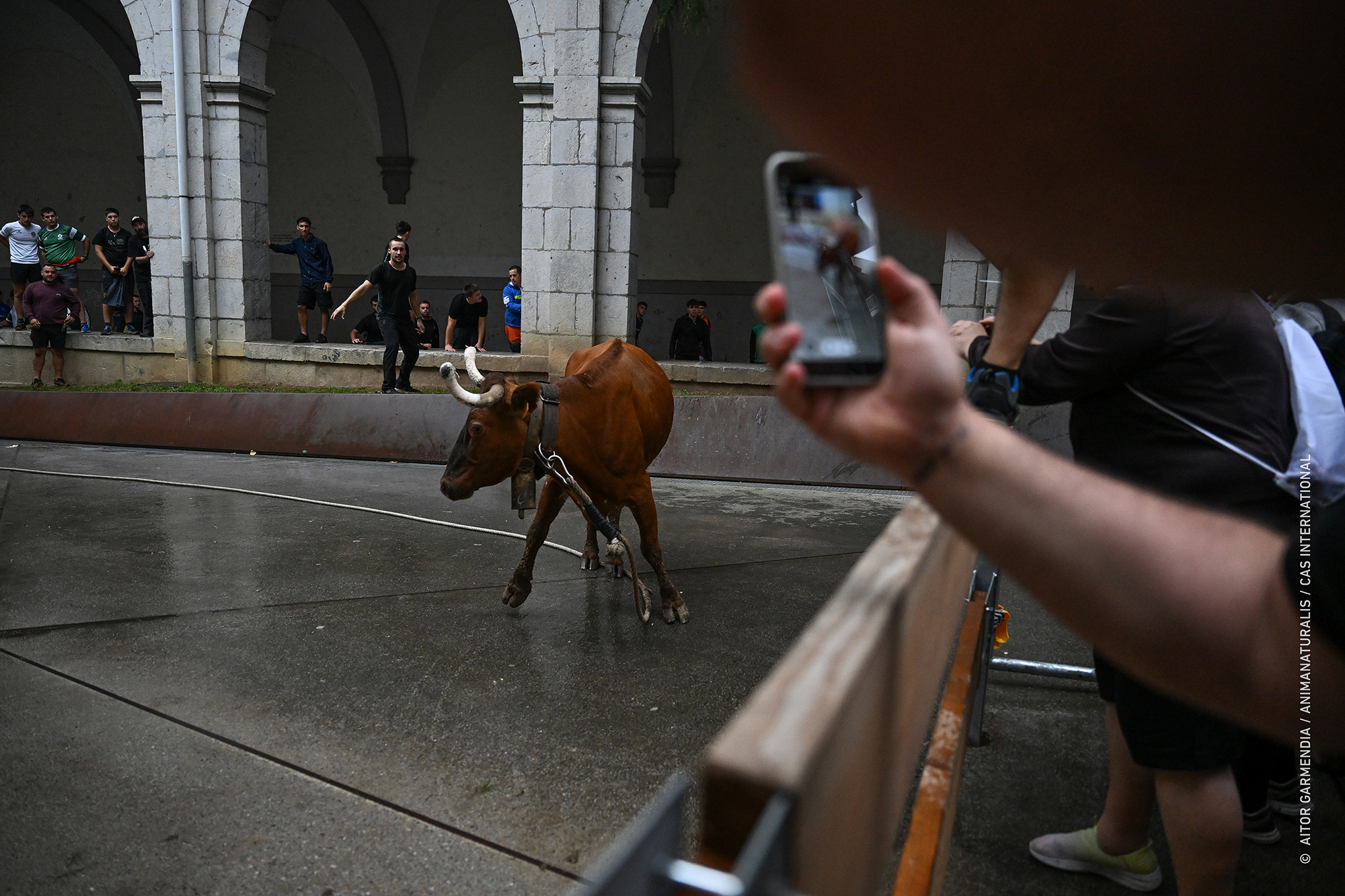
The investigation by AnimaNaturalis and CAS International allows us to reconstruct, step by step, the ordeal these animals endure —from their arrival at the fairgrounds to their exhausted removal.
- Waiting and Confinement: animals are kept crowded in trucks or makeshift pens, listening to the rising noise of the square. Stress becomes evident —rapid breathing, escape attempts, sweating. “Their instincts tell them something terrible is coming. They are prey animals in a completely hostile environment. Fear is their only companion,” says Gascón.
- The Release and First Shock: when released into the street, the animal suddenly faces a human tunnel of shouting, gesturing bodies. The noise is deafening. Its natural reaction is to flee —but there’s nowhere to go. The rope, pulled tight and slackened at random, jerks its body in every direction. “That first tug is the first psychological blow,” explains Gascón. “It realizes it has no control —that its body no longer belongs to it. That the crowd owns its destiny. That’s when panic becomes permanent.”
- The Chase and the Falls: the animal runs back and forth, slipping on asphalt its hooves were never meant to grip. The falls are constant and brutal. The impact of several hundred kilos hitting the ground is dull and heavy. Often the animal crashes into fences or house walls. “The falls are among the most critical moments,” says Gascón. “Each one can mean broken ribs, internal injuries, concussions, dislocations. We see them stand up dazed, staggering, gasping for air. But the crowd gives no respite —the shouting grows, the rope tightens again, and they’re forced to continue. It’s a spiral of pain and exhaustion.”
- Extreme Exhaustion: after several minutes of this torture, the animal shows clear signs of collapse —tongue hanging, foamy drool, muscle tremors, uncontrollable panting. Its heart rate soars to dangerous levels. It desperately seeks a place to stop —but it’s not allowed. “Seeing such a large, potentially strong animal reduced to total collapse is heartbreaking,” confides Gascón. “Its body gives up, but the mob doesn’t. At that point, they no longer flee by instinct but because they’re dragged by the rope or kicked to rise again. Eventually, fear gives way to physical breakdown —and that’s when its life is truly at risk.”
- The Withdrawal: when the animal can no longer move, it’s dragged away from the square amid shouting and pushing. The silence and darkness of the truck are its only refuge. But the trauma remains. The physical and psychological consequences often follow them for the rest of their short lives, as many are reused in similar spectacles until they’re too weak or sent to slaughter.
The images obtained by AnimaNaturalis and CAS International in Elgoibar are not just a denunciation —they are a mirror. A mirror in which Basque and Spanish society must look to ask what kind of values they truly wish to defend.