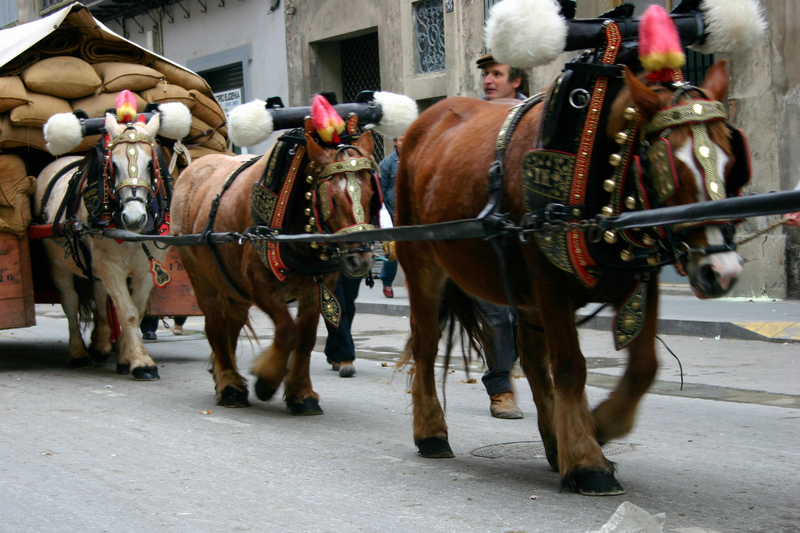
On January 17, 2025, at 11:11 a.m., Santo — a horse pulling the cart carrying the image of Saint Anthony the Abbot — collapsed on Carrer del Parlament in Barcelona. Witnesses reported that the animal showed signs of distress before falling onto the asphalt. Attempts were made to revive him with water. Veterinarians from the Generalitat arrived minutes later, but it was already too late. The autopsy confirmed a sudden heart attack caused by extreme stress after hours of walking through crowded streets, surrounded by noise and large crowds, pushed to the limits of his physical endurance. This was not an accident. It was the predictable outcome of subjecting a sentient individual to conditions his body and mind could not withstand.
Santo is not the first horse to die during the Tres Tombs. In 2017, another horse lost his life during the same celebration. Nor will he be the last if institutions continue to allow this tradition to take place without radical transformation. Because what happens every January in dozens of Catalan towns is not a tribute to animals, but their systematic instrumentalization under the guise of cultural heritage.
The Tres Tombs are parades held around January 17 in honor of Saint Anthony the Abbot, supposedly the patron saint of animals. The irony is brutal: a festival that claims to bless animals while turning them into objects of spectacle. Heavily loaded carriages, horses forced to walk for kilometers on hard pavement, donkeys and mules dragged through urban streets while the public applauds, ignoring invisible suffering. Constant nervous movements, head tossing, excessive salivation, obvious stereotypies — clear signs of distress that are ignored year after year in the name of tradition.
A past that does not justify the present
The origins of the Tres Tombs date back to 1825 in Barcelona, when horse-drawn carts made three laps around the gate of Saint Anthony the Abbot. In that pre-industrial context, horses, donkeys, and mules were essential for transporting goods. The traginers — muleteers who formed a key guild in the Catalan economy — sought divine protection for their animals every January 17. The first lap asked for protection for the animals, the second for a good harvest, and the third for human health.
History can explain origins, but it cannot validate continuity. Context has changed radically. With the mechanization of transport, the tradition lost its original economic function but survived as a cultural spectacle. Today, the Tres Tombs are not a necessity: they are entertainment funded with public money that subjects sentient individuals to stress, pain, and the risk of death.
“It is not normal for a young equid to die like this. These animals are exposed to chaotic urban environments, noise, and crowds that generate extreme anxiety,” says Aïda Gascón, director of AnimaNaturalis in Spain. In 2017, another horse died during the same festival in Barcelona, and in previous editions there have been reports of exhaustion and injuries. These are not isolated accidents. They are the systematic consequences of a practice that prioritizes spectacle over life.
Tradition as an excuse, suffering as the norm
In Spain, the 2023 Law on the Protection of Animal Rights and Welfare prohibits the use of animals in spectacles that cause anguish, pain, or suffering. However, a clear double standard persists: while circuses with wild animals were banned, traditions such as the Tres Tombs, correbous, or bull runs remain protected under cultural exceptions. European legislation places respect for cultural traditions and regional heritage above animal welfare, effectively weakening real protection.
“It is unacceptable that in 2025 animals are still being used as tourist attractions. Traditions must evolve or disappear,” argues Gascón. She adds: “Progress is not about denying the past, but about building a future where culture and compassion go hand in hand. Animals are not heritage; they are sentient beings who deserve protection.”
Yet institutions remain deaf. In 2026, amid growing animal advocacy pressure and a lack of generational renewal, several Catalan municipalities were forced to suspend the Tres Tombs — not out of ethical conviction, but pragmatism. Terrassa canceled its 2026 edition after acknowledging a lack of human and financial resources. The president of the Association Amics dels Tres Tombs de Terrassa, Joaquim Riera, admitted they have been unable to find generational replacement for 25 years. Mataró has now gone four consecutive years without holding the parade, although it still maintains the blessing of companion animals. Lleida suspended its 2026 edition due to rain, but weather was merely the visible excuse: the underlying issue is social rejection and the logistical difficulty of sustaining an increasingly questioned practice.
Barcelona, too, yields to climatic reality. On January 24, 2026, the Tres Tombs parade scheduled to close the bicentennial celebrations was postponed due to forecast rain. City authorities cited animal welfare. But the uncomfortable question remains: if rain poses a risk to their health, what does that say about the risk inherent in the celebration under normal conditions?
The Catalan Federation of Tres Tombs presented a 2026 calendar with more than 80 parades scheduled between January and October. Municipalities such as Igualada, Manresa, Vic, Reus, Valls, Granollers, or Vilanova i la Geltrú continue to hold their events. But the picture is misleading: many towns are reducing participants, shortening routes, or desperately seeking volunteers to sustain a tradition that is clearly crumbling.
Invisible signs of visible suffering
“We’re talking about accumulated stress. Many of these horses are transported from rural areas into cities, confined in trailers, disoriented by noise… It’s silent torture,” denounces Gascón. During the 2025 Tres Tombs in Terrassa, activists documented riders kicking horses, equines with foam and blood in their mouths, and clear signs of distress.
The signs are there for anyone willing to see them. Constant nervous movements. Head swaying. Excessive salivation. Repetitive shaking. These are stereotypies — abnormal behaviors indicating extreme stress — immediately recognized by animal welfare experts, but ignored by the general public as they applaud passing carriages.
Administrations still fail to regulate basic conditions such as carriage weight limits, mandatory rest periods, or rigorous veterinary checks. Existing protocols are insufficient. In Terrassa, for example, breathalyzer tests for participants were introduced and more veterinarians assigned. Cosmetic measures that fail to address the core issue: the animals should not be there.
Each year, opposition becomes more visible. In Terrassa, around 40 activists from Barcelona and Vallès Animal Save protested silently during the 2025 parade. In Molins de Rei, clashes with animal advocacy groups escalated to the point that organizers temporarily suspended the festival, only to later yield to pressure from defenders of tradition. In cities like Barcelona, banners and boos now routinely accompany the carriages.
In Terrassa, Noel Duque, Councilor for Animal Welfare, proposes a radical transformation: moving the celebration to the city’s Green Belt, eliminating punitive elements, loads, and riders, allowing horses to roam freely, and integrating sanctuaries and animal advocacy organizations. He even proposes a parade of animals available for adoption. His vision is clear: to turn the Tres Tombs into a genuinely animal-friendly celebration, not a spectacle that instrumentalizes those it claims to honor.
Alternatives exist — political will does not
Proposals to transform this tradition are not utopian. They are concrete, viable, and respectful of both historical memory and animal rights:
- Empty symbolic carriages. Preserve the parade of historic carts without animals pulling them. Material heritage is preserved, memory honored, suffering eliminated.
- Theatrical performances and historical reenactments with actors. Tell the story of the traginers through performances, artistic installations, or educational exhibitions that contextualize the past without reproducing exploitation.
- Celebrations focused on adoption and rescue. Turn the date into an event highlighting sanctuaries, shelters, and responsible adoption programs.
- Animal-free cultural festivals. Maintain bonfires, communal meals, traditional music, and festive elements that do not involve sentient beings.
But these alternatives collide with an institutional wall. Municipalities afraid of losing votes. Federations defending “intangible heritage.” Organizers repeating the mantra “it’s always been done this way,” as if age alone made a practice unquestionable.
In Terrassa, Deputy Mayor Joan Salvador stated bluntly that the City Council does not consider it appropriate to organize the Tres Tombs directly. His reasoning: animal advocacy controversy makes it better to “remain neutral.” Neutrality that, in practice, means letting an agonizing tradition fade while washing hands of the ethical debate.
The moment of choice: heritage or compassion
Santo’s death is not just an “accident.” It is the symptom of a system that normalizes the use of animals as entertainment tools. As long as administrations continue to reward festivities that put animals at risk, we are failing as a society.
“Saint Anthony is the patron saint of animals, yet this festival turns them into objects. There is no spirituality in subjecting them to suffering,” says Gascón. The hypocrisy is clear: blessing animals in an event that exploits them. Asking for divine protection for those instrumentalized in the name of tradition.
From AnimaNaturalis, we demand concrete and immediate measures from institutions:
- Ban the participation of animals in events involving crowds, excessive noise, or harmful conditions. The law already prohibits spectacles that cause suffering. The Tres Tombs are no exception.
- Promote ethical alternatives such as empty symbolic carriages or theatrical representations. Cultural heritage does not require victims. Human creativity can honor the past without reproducing exploitation.
- Sanction organizers who violate animal welfare protocols. Fines must be dissuasive, not symbolic. Legal responsibility must fall on those who put lives at risk.
- Allocate public resources to educational campaigns on animal sentience. Society must understand that horses, donkeys, and mules are not decorative objects. They are individuals capable of suffering, fear, and distress.
Change will not come from above unless we demand it from below. We need an informed, mobilized citizenry willing to question the unquestionable. Tradition cannot be an excuse to perpetuate suffering.
Join the AnimaNaturalis Volunteer Network. Be part of the campaign we are preparing to demand a ban on the use of animals in traditions and spectacles. Your participation can make the difference between the continuation of exploitation and the beginning of real change.
Demand that your political representatives legislate with compassion. Contact councilors, lawmakers, and representatives. Ask them why tourism is prioritized over life. Remind them that traditions either evolve or disappear.
AnimaNaturalis exists because billions of animals suffer at human hands. Because those animals need solutions. Because they deserve someone to speak up for them. Because animals need change. Because we want to build a fairer world for all.
The one-time and recurring donations from our members are our main source of funding. Without your support, we cannot investigate, expose, educate, or mobilize. Without your commitment, legislative victories we have achieved — such as the ban on circuses with wild animals — would not have been possible.
Santo’s death should be the last. But it will only be the last if we act. If we demand change. If we refuse to accept suffering justified by beautiful words about heritage and tradition.
Animals are not objects we can dispose of at will. They are sentient beings who deserve protection. And that more just future begins today, with your decision not to remain indifferent.
We need your support
AnimaNaturalis exists because billions of animals suffer at human hands. Because they animals need solutions. Because they deserve someone to speak up for them. Because animals need change. Because at AnimaNaturalis we want to build a fairer world for everyone.
The donations of our supporters are the main source of our funds.