
The Festes de la Mare de Déu de la Ràpita, also known as the Festes del Barri, were officially held from 10 to 14 September 2025. As every year, the programme included music, dancing, the offering of fruit and flowers, and activities for all ages in this municipality in the Terres de l’Ebre region. The festivities featured concerts, sporting activities, parades, and the traditional floral offering to the patron saint. On 14 September, the celebrations concluded with the final festive events and the customary fireworks display marking the end of the annual festivities.
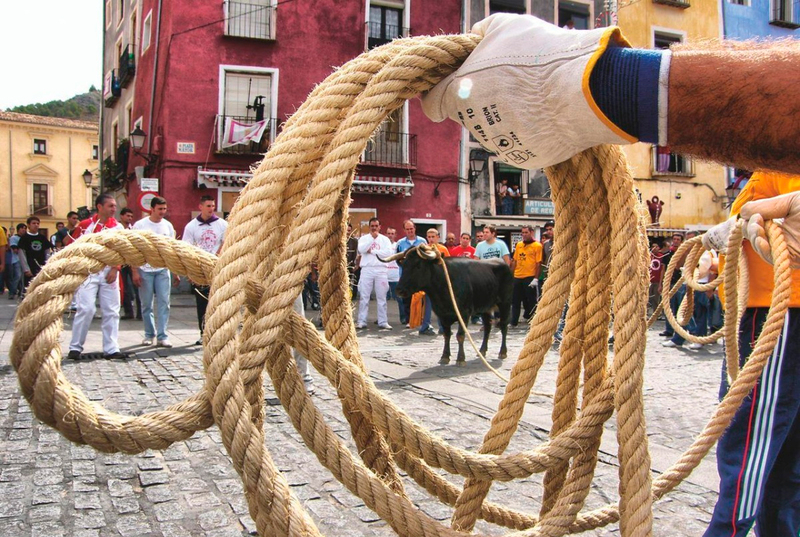
However, twelve days later, from 26 to 28 September, the Sant Carles de la Ràpita City Council authorised the 20th National *Bou amb Corda* Congress, an event that brought together thousands of bullfighting enthusiasts from across Spain, with 19 exhibitions involving animals used in the bou capllaçat modality and two involving cows. During those days, La Ràpita became the epicentre of Catalan bullfighting celebrations, attracting visitors from all regions where correbous are practised.
According to records held by the AnimaNaturalis Foundation, these dates fall outside the municipality’s traditional festive period and had never before been used to hold this type of spectacle. The temporal gap between the end of the Festes de la Mare de Déu and the start of the bullfighting congress is, according to the organisation, clear evidence that these are separate events, and that only one of them is legally protected by tradition.
AnimaNaturalis filed a complaint with the Department of the Interior of the Government of Catalonia, arguing that bullfighting events had been held in breach of Law 34/2010, which regulates when and where traditional bull festivities may take place in Catalonia. However, the administration dismissed the proceedings, considering that no infringement had occurred. A decision that AnimaNaturalis has now appealed through an administrative appeal before the General Secretariat for the Interior and Public Safety.
“Traditional festivities involving animals may only be held on the dates on which they have traditionally taken place, coinciding with major festivals or celebrations of special and significant importance,” explains Cristina Ibáñez, lawyer and representative of AnimaNaturalis. “Allowing bullfighting events outside these established dates empties the legal protection that the law intended to provide for animals of its meaning.”
Tradition as a legal boundary
Law 34/2010 regulating traditional bull festivities establishes in Article 3 that such spectacles may only be authorised in the localities and on the dates on which they have traditionally been held. This requirement seeks to delimit the exception to the general prohibition of animal abuse established by Legislative Decree 2/2008, the consolidated text of Catalonia’s Animal Protection Act.
The historical context of this legislation is key to understanding the scope of the conflict. In 2010, Catalonia experienced an intense public debate on bullfighting that culminated in the ban on bullfights involving the killing of the animal. This ban was achieved through a popular legislative initiative that gathered more than 180,000 citizen signatures and reflected a profound shift in social sensitivity towards animal suffering in spectacles.
However, just two months after approving the amendment to the Animal Protection Act banning bullfights, the Catalan Parliament passed Law 34/2010 to regulate correbous in the Terres de l’Ebre. This law acknowledged that traditional spectacles involving animals without killing them constitute a central element of popular celebrations in many Catalan towns, particularly in the regions of Baix Ebre, Montsià and Terra Alta.
The apparent contradiction between banning bullfights while allowing correbous was criticised from the outset by legal scholars and animal protection activists. The legislative response lies in temporal and territorial delimitation: only on the dates and in the places where such events have traditionally been held. This is the line that separates what is permitted from what is prohibited—and it is precisely this line that AnimaNaturalis argues the La Ràpita City Council has crossed.
According to official data from the municipal programme published on the La Ràpita City Council website, the Festes de la Mare de Déu took place between 10 and 14 September 2025, concluding with a fireworks display on the final day. By contrast, the 20th National *Bou amb Corda* Congress was held from 26 to 28 September, almost two weeks after the recognised festivities had ended.
The congress was presented as a historic event for La Ràpita. The municipality’s bid, submitted by the Penya Bou Capllaçat with the support of the City Council, was selected at a gala held in Beas de Segura, Jaén. The event brought together 23 municipalities that are members of the Federació de Bou amb Corda, with animal exhibitions from various local farms. According to local media reports, the congress generated a considerable economic impact, with an estimated attendance of between 8,000 and 10,000 people.
As demonstrated by the municipal council resolution of 31 May 2024 cited by AnimaNaturalis in its appeal, the Festes del Barri had never previously included events on dates at the end of September. The tradition invoked to justify these spectacles simply does not exist on those dates, the organisation argues.
“Authorising bullfighting events outside the legally established tradition constitutes a breach of the regulations and an improper use of municipal powers,” states Ibáñez. “Respect for the law is a minimum requirement for the administration.”
A pattern of dismissed complaints
The appeal submitted by AnimaNaturalis details that the decision to dismiss the preliminary proceedings constitutes an artificial interpretation of the law which, in practice, allows bullfighting events to be held outside the festivities recognised by Law 34/2010. According to the organisation, this municipal action represents an abuse of administrative authority that empties the legal framework of protection of its substance.
AnimaNaturalis’s complaints against bullfighting events in Catalonia are not new. For years, the organisation has documented violations in various municipalities in the Terres de l’Ebre, ranging from the repeated use of the same animal within a 24-hour period to the alleged deaths of animals after being subjected to fire on their horns, as well as the participation of minors under 14 in prohibited events.
In 2022, AnimaNaturalis filed complaints against five animal spectacles in Catalonia for alleged abuse and breaches of the correbous regulations. The complaints concerned the municipalities of Amposta, l’Aldea, Camarles and Vidreres, involving infringements that could be considered very serious and carry fines of up to €150,000. The reported cases included organising a festival without authorisation, using pyrotechnics inside the arena with animals present, and animals collapsing from exhaustion.
In earlier years, in 2011 and 2012, AnimaNaturalis and PACMA filed 11 complaints for serious violations at correbous in Sant Carles de la Ràpita, Camarles, Amposta and l’Aldea. These complaints documented assaults on animals, serious breaches of safety measures, and the participation of minors. The combined sanctions could have reached €600,000, but most cases were dismissed or resulted in symbolic fines.
This pattern of dismissed or minimised complaints generates frustration among animal protection organisations. “We have documented cases of animals collapsing from exhaustion, being kicked and beaten, subjected to fire on their horns, and forced to take part in several spectacles within less than 24 hours when the law expressly forbids it,” lists Ibáñez. “And yet, most of our complaints are shelved without even opening sanctioning proceedings.”
The La Ràpita case has a strategic particularity: it does not seek to denounce abuse during the events themselves, but rather to challenge the very legality of their authorisation. AnimaNaturalis argues that the spectacles should never have been authorised because they were held outside the traditional dates established by law.
This legal strategy has the potential to set an important precedent. If AnimaNaturalis succeeds in demonstrating that the City Council breached Law 34/2010 by authorising bullfighting events outside the traditional festive period, it could significantly limit municipalities’ ability to arbitrarily extend the dates on which these spectacles are held.
“We see a systematic pattern in which the administration looks for any legal loophole to allow these spectacles, even if that means interpreting the law in a way that runs counter to its protective spirit,” explains Ibáñez.
According to data compiled by media outlets specialising in transparency, Catalan municipalities have spent more than €4.2 million on correbous over the past ten years. The economic impact these spectacles generate in terms of tourism and local commerce is frequently cited by their defenders as justification for their continuation.
A study carried out in 2018 in eight municipalities in the Terres de l’Ebre estimated that the total economic impact of correbous in the region is around €4.5 million per year. This economic argument is used by bullfighting clubs and some local councils to justify maintaining—and even expanding—these spectacles.
However, animal rights organisations challenge both the methodology of these studies and the moral premise underlying this argument. “Economic benefit can never justify the suffering of sentient beings,” states Ibáñez. “Moreover, that economic impact could be generated through other festive activities that do not involve using animals.”
The tension between tradition and protection
The administrative appeal requests that the dismissal of the preliminary proceedings be overturned, that the corresponding sanctioning procedure be initiated with full adversarial processing, and that the AnimaNaturalis Foundation be recognised as an interested party in the proceedings.
The organisation argues that allowing bullfighting events to take place on 26, 27 and 28 September, when the Festes de la Mare de Déu ended on 14 September, constitutes a clear breach of Article 3 of Law 34/2010. This article establishes that such spectacles may only be authorised on dates coinciding with major festivals, fairs or popular celebrations of special and significant importance.
The appeal details that the Festes de la Mare de Déu of La Ràpita have historically established dates, held every year in early September—specifically between the 6th and the 14th. The documentation provided by AnimaNaturalis includes the official festival programme published by the City Council and the municipal council resolution of 31 May 2024, which demonstrate that historically these festivities have only been held in the first half of September.
“The documentation is clear and conclusive,” insists Ibáñez. “There is no recognised traditional festivity in La Ràpita at the end of September. The *bou amb corda* congress was held almost two weeks after the official festivities had ended.”
The lawyer for AnimaNaturalis argues that a city council cannot arbitrarily create traditional festivities to justify bullfighting events. “Tradition, by definition, requires historical continuity and repetition over time. You cannot invent a tradition to justify an event that has never before been held on those dates,” she explains.
The case raises significant legal questions about the limits of municipal power in interpreting animal protection legislation. How far can administrative discretion go in authorising bullfighting events? Is it enough for a city council to declare that an event forms part of its festivities for it to be automatically covered by the exception in Law 34/2010?
The La Ràpita case exemplifies the tensions in Catalonia between animal protection and the maintenance of controversial traditions. This legal exception has become a constant source of dispute. Animal advocacy organisations document practices they consider abusive year after year, while bullfighting supporters defend these celebrations as a fundamental part of their cultural identity.
The debate over correbous in Catalonia is part of a broader trend across Europe towards stronger animal protection in national and EU legislation. Since the Treaty of Lisbon, the European Union has recognised animals as sentient beings, and many countries have banned or severely restricted the use of animals in spectacles.
However, the same Treaty of Lisbon includes a clause respecting the cultural traditions of Member States, which has allowed bullfighting spectacles to continue in Spain, Portugal and southern France. This tension between recognising animal sentience and respecting cultural traditions is mirrored at the Catalan level in Law 34/2010.
“If we allow each municipality to invent new traditions or extend festivities at will, we render all animal protection legislation meaningless,” warns Ibáñez. “We cannot say that animals are sentient beings deserving of protection while at the same time allowing them to be subjected to stress, fear and pain in the name of tradition.”
Supporters of correbous argue that these celebrations respect the animal as the protagonist of the festival and that significant efforts have been made to minimise suffering. However, AnimaNaturalis considers these improvements insufficient because they do not eliminate the inherent suffering of these practices. The organisation has documented that even when all safety and welfare regulations are followed, animals experience intense stress during these spectacles.
Veterinary studies have confirmed that modalities such as bou embolat, in which balls of fire are attached to the animal’s horns, generate extreme levels of stress and panic. The animal desperately attempts to escape the fire, crashing into walls and barriers in a state of terror that can last several minutes.
The case will now be decided by the General Secretariat for the Interior and Public Safety, which must determine whether the celebrations of the 20th National *Bou amb Corda* Congress were carried out within the legal framework or whether, as AnimaNaturalis maintains, the law designed to protect animals from unnecessary suffering was breached.
The decision taken by the administration will set a precedent on whether municipalities can authorise bullfighting events outside recognised traditional festivities, or whether the legal protection of animals must prevail over flexible administrative interpretations.
“We will continue to appeal and to file complaints for as long as necessary,” concludes Ibáñez. “The animals used in these spectacles have no voice of their own to defend themselves. We will not stop being that voice.”