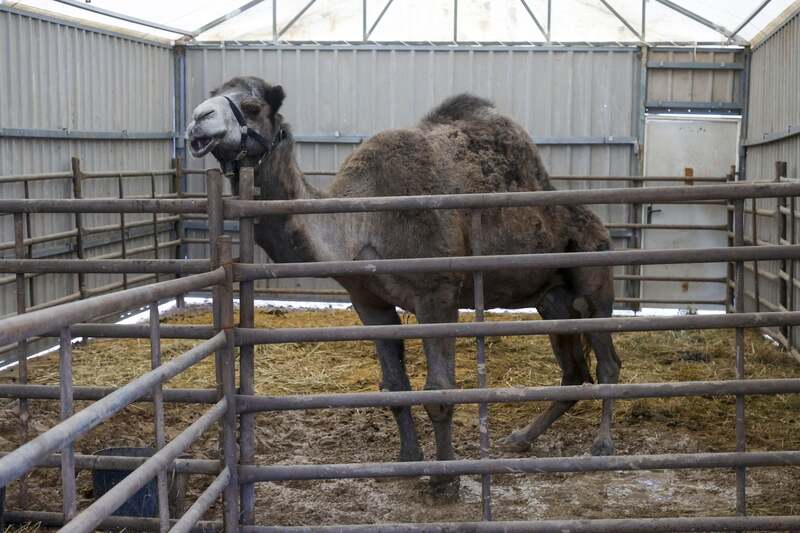
Between 6 December 2025 and 10 January 2026, a dromedary performed night after night at the "Circ de Nadal" in Valencia, managed by the company Consultores y Espectáculos Gestimark Valencia, S.L. What the public could observe with the naked eye, and what was clearly captured on camera by those who reported it, was an evident limp. The animal was injured. And yet it continued to take to the ring.
The coalition InfoCircos, comprising the AnimaNaturalis International Foundation, the AAP Primadomus Foundation for the Care of Exotic Animals, the National Association for the Defence of Animals (ANDA) and FAADA, Foundation for Advice and Action in Defence of Animals, filed a formal complaint with Valencia City Council. The basis: audiovisual material demonstrating how the dromedary was forced to participate in performances despite its physical condition.
"Profit cannot be justified at the expense of the wellbeing of living beings that feel pain and fear just like any other", states Aïda Gascón, director of AnimaNaturalis in Spain. According to the organisations, the facts do not point to an accidental oversight. They point to a conscious decision: to keep the animal in the activity despite its condition, placing the economic interests of the show above the wellbeing of a living being.
What the law prohibits… and what happened
The Spanish legal framework is clear. Law 32/2007 expressly prohibits subjecting animals to unnecessary suffering or forcing them through violence to perform activities that may cause them pain or fear. Serious infringements under this law can result in fines of up to 100,000 euros, as well as additional sanctions including the seizure of the animal, the cessation of the activity or the closure of the premises.
Added to this is Animal Health Law 8/2003, which places on those responsible the obligation to guarantee the health and wellbeing of animals in their care. Sanctions for very serious infringements under this law can reach 1,200,000 euros and include immediate precautionary measures to protect the animals and prevent the continuation of situations of risk.
In other words: legal tools existed to stop the show. They were not used. A dromedary with a limp visible to the naked eye continued performing for weeks in front of thousands of people.
"The animal's suffering is completely incompatible with any standard of welfare", adds Olga Martín, spokesperson for AAP Primadomus. According to Alberto Díez, spokesperson for ANDA, "citizen surveillance and reporting are essential tools for ensuring compliance with the law and animal protection."
The case is not, unfortunately, exceptional. It is representative of an entertainment model that uses sentient individuals as props, that depends on their submission and that operates within a framework of insufficient oversight. "Citizen surveillance and reporting are essential tools for ensuring compliance with the law and animal protection", Díez reiterates.
What the organisations are calling for
The InfoCircos coalition does not limit itself to identifying a problem. Its complaint to Valencia City Council includes specific demands: that the corresponding disciplinary proceedings be opened, that InfoCircos be recognised as an interested party in the procedure, that immediate precautionary measures be adopted to protect the dromedary and that a ban on keeping animals be considered for those responsible for the show.
Each of these demands has implications that go beyond the specific case. If the City Council opens proceedings and applies the sanctions provided for under Law 32/2007 and Law 8/2003, it will send an unequivocal signal to the sector: the documented suffering of an animal in a show has real legal consequences. If, on the other hand, the proceedings come to nothing, the message will be the opposite.
As Andrea Torres, spokesperson for FAADA, underlines: "Demanding effective legal protection is the only way to prevent these episodes from recurring." The words are simple, but their meaning is political: it is not enough for laws to exist. They must be enforced.
Act now
The dromedary from the "Circ de Nadal" could not leave the ring on its own. It could not refuse to perform, could not ask to be seen by a vet, could not say no. It depended, entirely, on the humans responsible making the right decision. They did not. But others did: those who filmed, those who reported, those who submitted the documentation to the City Council.
You too can be part of that chain. When you attend a show or event and observe an animal showing signs of distress, record it, document it and report it to the local authorities or to organisations such as AnimaNaturalis, AAP Primadomus, ANDA or FAADA. Citizen vigilance is not optional: it is what makes the animal protection system work in practice.
Beyond the individual act, you can join the InfoCircos campaigns to demand that Valencia City Council processes the disciplinary file and that precautionary measures are adopted for the affected dromedary. Sharing this complaint, signing active petitions and pressing your local representatives are concrete actions with real impact.
"Profit cannot be justified at the expense of the wellbeing of living beings that feel pain and fear just like any other", Gascón reminds us. That dromedary that took to the ring with a visible limp was not a show prop: it was an individual capable of suffering. And today, just as then, it needs someone to decide to act.
We need your support
AnimaNaturalis exists because billions of animals suffer at human hands. Because they animals need solutions. Because they deserve someone to speak up for them. Because animals need change. Because at AnimaNaturalis we want to build a fairer world for everyone.
The donations of our supporters are the main source of our funds.