On February 3, 2026, the European Food Safety Authority (EFSA) published its first scientific opinion on the welfare of turkeys on farms, a 300-page document requested by the European Commission and based on a review of scientific literature accumulated from 1954 to 2025. The conclusions are damning: current production systems do not meet the behavioral or physiological needs of these animals, and substantial reforms are necessary to avoid preventable suffering.
"This EFSA report only confirms what we have been denouncing for years from AnimaNaturalis: turkeys are one of the most ignored species by European legislation, and the price of that neglect is paid by them with chronic pain and an existence of total deprivation," states Aïda Gascón, director of AnimaNaturalis in Spain.
More than 240 million turkeys are raised in the EU each year. In Spain alone, in 2020 there were 13.7 million animals on nearly 1,880 farms, 200% more than in 2008, according to data from the Ministry of Agriculture. 90% of European production is concentrated in just five countries: Germany, Poland, France, Italy, and Spain. These animals, which in the wild can live up to 15 years, are taken to slaughterhouses at just 13 weeks of age in the case of females and 22 weeks for males on intensive farms.
Nineteen Documented Ways of Suffering
The EFSA scientific panel identified 19 negative consequences for the welfare of turkeys on farms, evaluating factors such as litter quality, environmental enrichment, outdoor access, available space, air quality, temperature, lighting, and hatchery conditions. The results reveal a pattern of structural deprivation affecting all animals regardless of the farm.
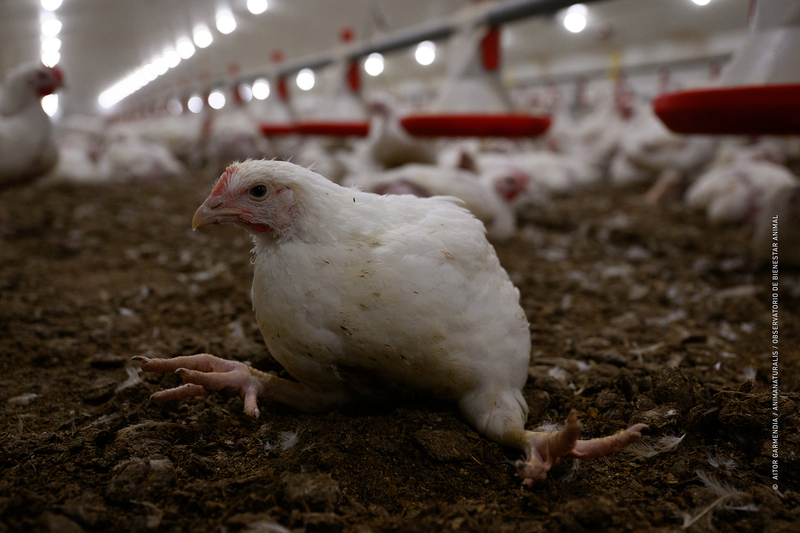
Among the most serious problems is excessively wet litter. Turkeys spend their entire lives on the same floor where their own excrement accumulates. Constant contact with this surface causes severe footpad dermatitis, soft tissue lesions, and chronic respiratory diseases. The high concentration of ammonia, bacteria, and fungi turns the air they breathe into a permanent source of infection, something AnimaNaturalis also documented in its undercover investigations on Spanish farms, where it found moribund animals, with bone malformations, and unable to walk.
Lack of space is another central axis of the report. EFSA developed a specific model to calculate the minimum space needed for a turkey to perform natural behaviors: at least 0.49 m² for birds of 7 kg and 0.82 m² for those of 25 kg. In most current systems, this space is not guaranteed, preventing animals from performing basic behaviors such as dust bathing, wing flapping, or resting on perches. The absence of environmental enrichment worsens the problem: without objects to explore, materials to forage in, or structures to perch on, turkeys develop chronic stress, locomotor disorders, and aggressive behaviors towards each other, including cannibalism.
"What the EFSA report calls 'enrichment' — ramps, straw bales, forageable materials, dust baths — should actually be considered a minimum housing requirement, not an optional luxury. The EFSA scientific panel itself recognizes this in its opinion," notes Gascón.
Conditions in hatcheries are also assessed as high risk. Newly hatched chicks are subjected to prolonged deprivation of water and food after hatching, excessive noise levels, and inadequate light cycles. These deficiencies cause umbilical disorders and locomotor problems that accompany them for life. Inadequate temperatures generate, on one hand, cold stress in younger animals and, on the other, heat stress in adults, whose body mass — artificially inflated by decades of genetic selection — hinders thermoregulation.
Cutting, Burning, Amputating
One of the most disturbing aspects of the report is the normalization of mutilations. Beak trimming, toe amputation, and desnooding — the removal of the fleshy appendage on their forehead — are routine practices on most European farms. EFSA unequivocally concludes that these procedures cause acute and chronic pain, alter natural behaviors, cause locomotor problems, and hinder the animals' thermoregulation.
These mutilations are not done on a whim: they are the industry's response to the inevitable consequences of overcrowding. When thousands of sentient beings are confined in tight spaces without sufficient stimulation, stress and aggressiveness increase in direct proportion to density. Instead of eliminating the causes of the problem — extreme confinement — the body parts with which the animals could harm each other are removed. In other words, the individual is punished for the system's failures.
Added to this is the impact of extreme genetic selection. The giant white turkey breed, predominant in the European industry, is the result of decades of crossbreeding aimed at maximizing breast muscle mass. The result is a body so disproportionate that males are physically incapable of reproducing naturally. Females are systematically artificially inseminated, a procedure that involves repeated physical manipulation and which EFSA recommends subjecting to more rigorous handling standards.
EFSA Calls for Changes That the Law Does Not Yet Require
The EFSA opinion includes concrete recommendations directed at producers, the breeding industry, and slaughterhouses: progressively eliminate mutilations, ensure chicks receive water and food within the first 48 hours after hatching, improve ventilation and litter type to keep it dry and friable, install ramps, straw bales, foraging materials, and visual barriers, optimize light and dark cycles, and apply strict handling protocols during artificial insemination, thinning, and hatchery procedures.
The underlying problem is that none of these recommendations are mandatory. To this day, there is no specific European legislation for the protection of turkeys on farms. They are only covered by the general Directive 98/58/EC on farm animals, a generic regulation that does not contemplate any specific requirements for this species. The report itself emphasizes that it was requested by the European Commission precisely to serve as a basis for possible future legislation.
"The fact that in 2026 there is still no specific European regulation for turkeys, despite 240 million being raised per year in the EU, is a political scandal with no ethical justification. This EFSA report must be translated into binding legislation urgently," adds Gascón.
The European coalition Eurogroup for Animals, of which AnimaNaturalis is a part, has also responded forcefully to the opinion. "By integrating EFSA's recommendations into law, the EU can reduce the suffering of millions of turkeys, stimulate a shift towards more sustainable and humane production, and avoid practices incompatible with the expectations of European citizens and with scientific evidence. This historic EFSA opinion must be met with equally ambitious legislative action," declares Marta Klimczak, farm animal officer at Eurogroup for Animals. For AnimaNaturalis, which works closely with this network of more than 80 organizations across Europe, the publication of the report is not an endpoint but the beginning of a political battle that is already underway.